ARRESTED.FERMENTATION

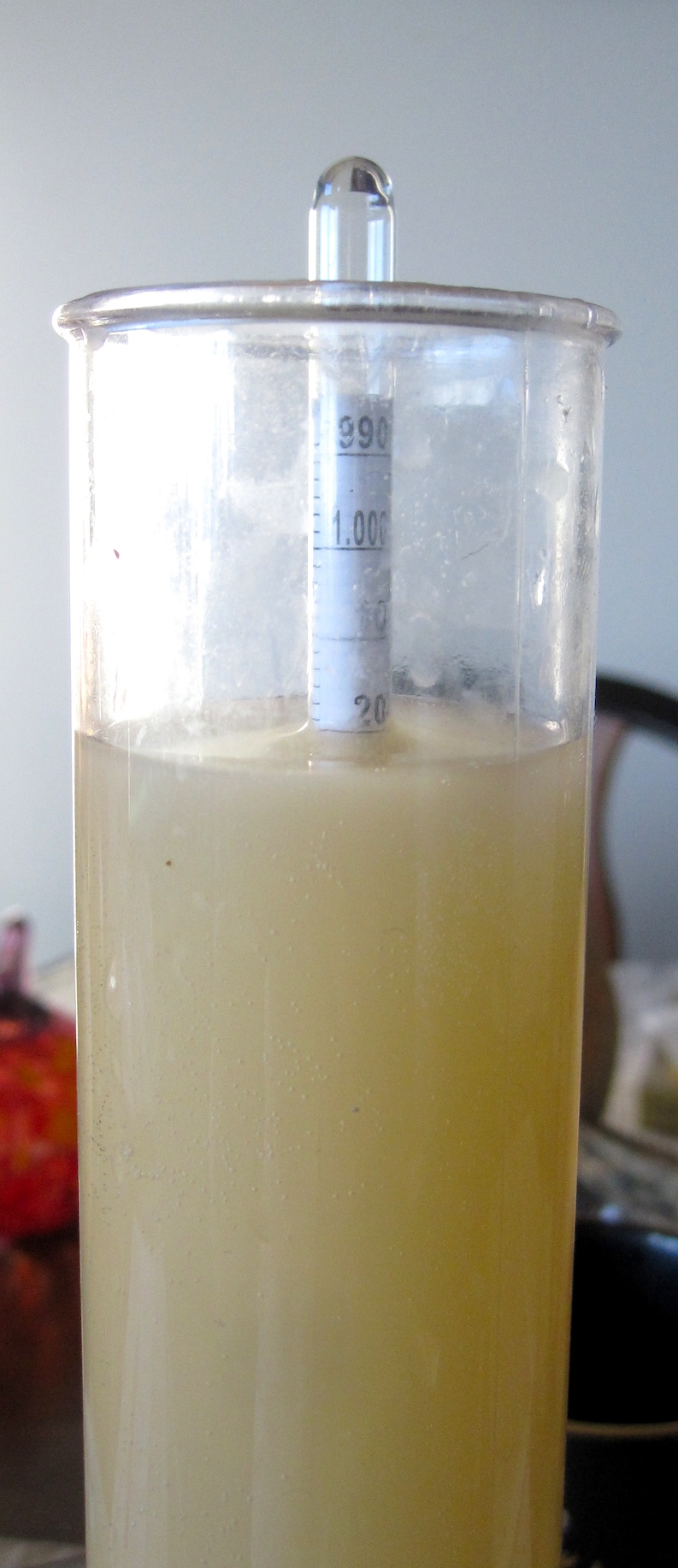
Specific gravity perfection I'd say.

After two more days, I am ready to stop fermentation.

My wine tastes mindblowingly perfect. At 1.020 specific gravity, I have 10% alcohol and 2.5% residual sugar: as mathematically pure and balanced as the Parthenon, the Fibonacci Sequence and espresso.

In truth, I am not sure if I can kill the yeasts. To hedge my bets, I want to start early. I like where the wine is. But will it taste disgusting if allowed to ferment dry? Acidity and alcohol are inching their way into the fore and might overwhelm the present fruit.

The plan: siphon the juice into the clean glass carboy, kill the yeasts with potassium sorbate, and stop spoilage with potassium metabisulphite.

If that fails, I have to freeze seven gallons of fermenting juice somehow in order to halt the yeasts. Failing that, I will have to drink a dry vignoles, or go German and add my secret gallon of unfermented juice from the fridge (i.e. süssreserve). Enough talk, time to siphon the lot:

Onto murder some yeasts.

First, I add potassium sorbate (one gram per gallon) to the fermenting must. This salt comes from the berries of mountain ash trees. Once in the wine, the sorbate salt becomes sorbic acid, which is volitile to yeasts. It will stabilize the wine by, ahem, aborting any future yeasts. Not a pleasant thought, but the single parents, newly neutered, will die naturally and never multiply again.

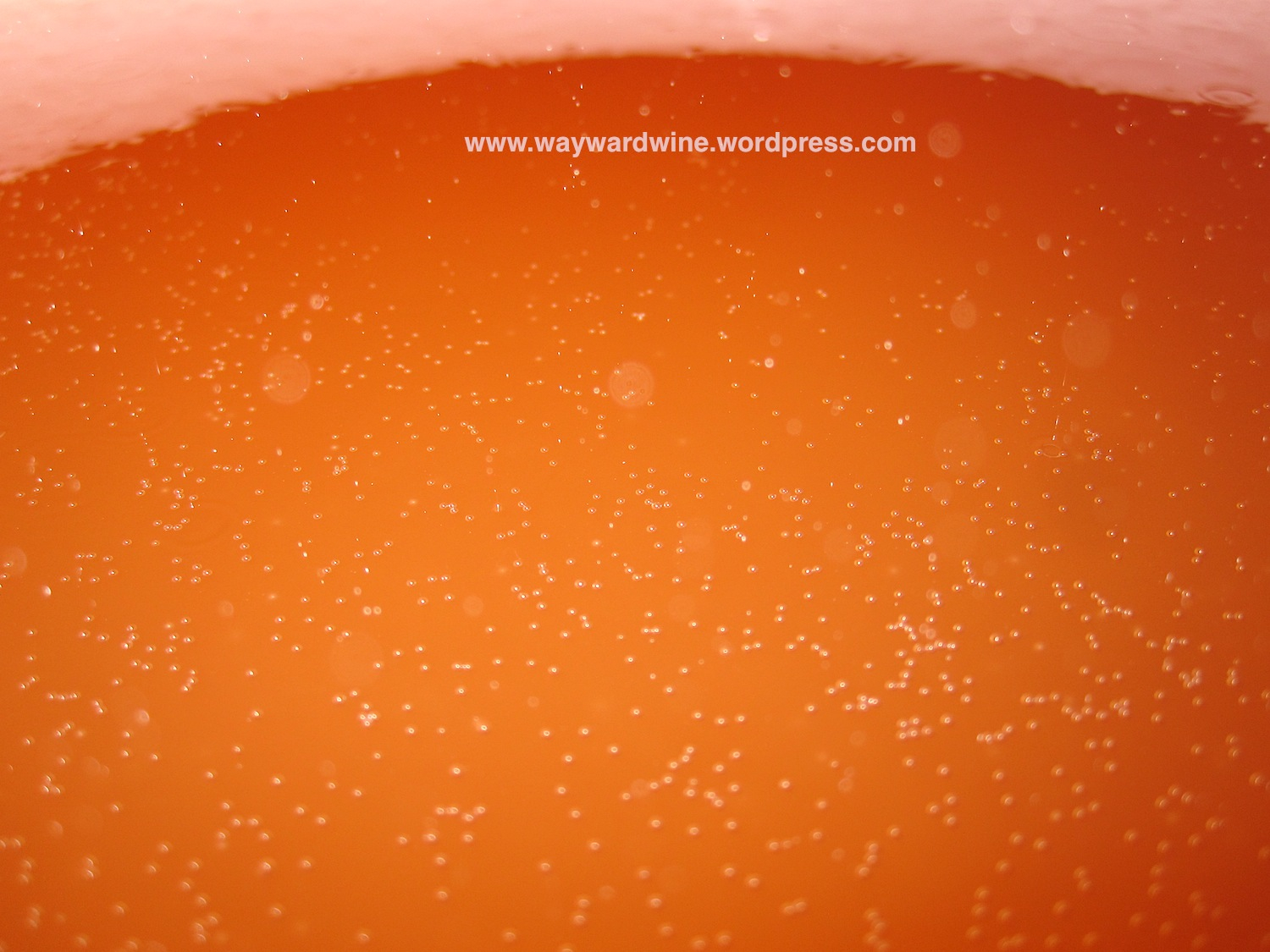
Hmmm….oddly fizzy. But no matter.

To keep my meta levels…level, I need to also add potassium metabisulphite. The sulphite will strengthen the sorbic acid to keep bacteria at bay. If there was no sulfite, the wine would go into malolactic fermentation, wherein bacteria would convert the sorbate into geraniol (aka hexadienol), which smells of rotten geraniums and trout. I do not like trout or geraniums. So in it goes…just as my wife wakes up…

“Smells nice”…so will the carpet.

How the hell did I create a science fair volcano? Fallbright had given me a only paragraph on stabilizing wine. It said to add both sorbate and sulphite “at the same time.” The internet told me the same. I could have waited until fermentation ended, just before bottling, but no one mentioned exploding carboys and ruined carpets.

What happened?

Basically, adding potassium sulphite was like giving the sorbic acid steroids. I should have held off on the sulphite until the fizzing stopped.

Completely normal volcanic aftermath.

Vesuvius killed my pride, but the wine tastes the same. It is all I have. So I press on.

While cleaning the carpet, I plot how to cold stabilize the yeasts to ensure they never come back.

Posted in OENOLOGICAL ODYSSEY, VIGNOLES VENTURING | Tagged , , , , , , , , , , , , | 6 Comments

Vidal Ice Wine, Newport Winery, Rhode Island 2007

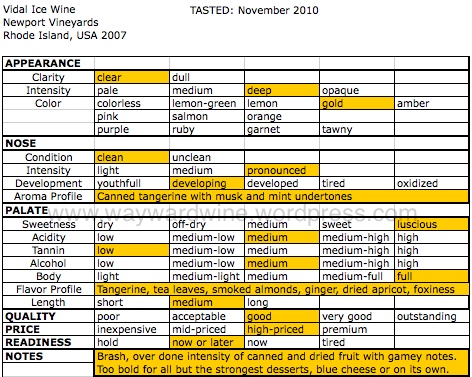
Open Newport Vineyards‘ Vidal Ice Wine with a crash helmet and a very small glass. Why? This dessert will swing its splintered bat of intensity at your face the second you uncork it.

The wine is certainly enjoyable, in the way that a rickity old wooden roller-coaster is enjoyable. You have to be ready for the ride. Exotic spices and dried fruits will siege for your attention. The musky edges on the nose and palate will rattle your senses. It tells you to forget your guests and finished dinner. Just sit back, sip its chilled syrup, and let it jerk your palate about.

How did Newport turn the humble vidal blanc into such a brawler? By waiting. Even with netting and alarms, grapes were lost to crows, deer and coworkers. Yet Newport left its vidal on the vine long after the Fall harvest. Those that survived shriveled on the vine, evaporating water and concentrating sugars to a massive 38 Brix.

By the third hard frost, they were picked at night. The cold had frozen the remaining water but not the syrup. Upon pressing the grapes, ice water and skins stayed in the press, while sugars and flavor compounds poured into the fermentation vat. A hyper-concentrated dessert wine resulted after fermentation was stopped to keep the residual sugar at 19%.

That is true ice wine: labor intensive, risky and pricey. If it is below thirty dollars, it is probably iced wine: a less concentrated late harvest that is chucked into a freezer and then pressed (i.e. cryoextraction).

Why vidal blanc?

The grape is another winter-hardy hybrid like my vignoles. Its parents include the ancient ugni blanc (i.e. trebbiano) and the modern rayon d’or (i.e. Seibel 4986). The former gives the acidity and fruit, while the latter provides thicker skins, ideal for late ripening. In the 1930s, Jean Louis Vidal bred this grape for cognac production because it was more mildew-proof than ugni blanc. But it was the Canadians and Americans around the Great Lakes that capitalized on the grape for dessert wine.

Acidity makes the difference. Without Newport’s cold, the sweetness would have nothing to clean it up. Vidal blanc’s ugni blanc parentage and the climate provide the zip.

This is not a great wine. The fruit shows no restraint, while the foxy, gamy spice overwhelms any elegance (probably from wild yeasts sneaking into unclean equipment or less-than-perfect grape sorting). There are better-balanced ices out there. But Newport Vineyard’s Vidal Blanc Icewine will grab you, whether you’re ready or not. Just strap in and let it obliterate meals, people or evenings you would prefer to forget.

Posted in Dessert, Vidal Blanc | 2 Comments

CLEAN.RETURNS

Blurry video aside…

Two more days gifted me another percent and a half of alcohol. Can I taste the difference? Probably not. But if my wine no longer seems sweet and cloying, maybe, just maybe, I can stop the yeasts and keep it that way.

To do this, I need my glass carboy back. Why not use the tank? Well, looking for dead yeast sediment through an opaque bucket is hard. Once yeasts settle to the bottom, I need to see them. Otherwise, stopping the siphon to remove only the juice would involve psychic powers, augury or experience: none of which I have.

Time to bring my glass carboy out of retirement…

Rambling aside…I shake out the last drops and wait for the eggy reek of sulphur to waft away. Impatient, I try it…the wine that is, not the sulphur.

It still tastes overly sweet.

Lurking amidst my subconscious is the thought that I need to get the residual sugar down to two percent. Maybe its all that gendered baggage of dry wines being manly and the sweet feminine. Yet I already have a case of dessert wines. I rarely drink them, but they tasted great at the wineries because, alone, sweetness is delicious but it hides a plethora of faults.

When confronted by dryness, tannin or acidity, we cringe at that first sip. We forget that it says more about us than the wine. Our palate is gauged near neutral at 7.1 pH, whereas most wine has a pH of 3.5, akin to orange juice or lemonade. If we kept with it, our palate would come to terms with the acidity. Instead, we twist our faces.

We also forget that wine and food transform each other. Edgy tannins bind with proteins and dissolve into silk. Acidity cuts through thick sauces or serves like a fresh squeeze of citrus. Flavors can meld or counterpoint depending on the pairing. Context is everything.

Nonetheless, since habit sees me usually drink with dinner, I want a wine dry enough to match most foods.

But now I am late for real work. I leave the carboy to air out and the yeasts to slave away for me.

Posted in VIGNOLES VENTURING | 2 Comments

TASTE.FEST

A week of not freaking out has passed. Time to check the wine.

Once I stop talking for a second, I actually think about the next sip. This is fine but still too sweet. It needs a few more days.

Posted in OENOLOGICAL ODYSSEY, VIGNOLES VENTURING | 1 Comment

SLOW.GROWING

I check my wine each morning and evening. The tank temperature jumps ten degrees during the first two days. Too much heat will create a rapid, volatile fermentation that kills the yeasts. Fermenting faster might seem easier and thus better, but the yeasts need to go slow to carry the fruit’s natural flavors. Otherwise, bacteria, acidity and stewed notes would take over.

I lack fancy stainless steel tanks, with their jacketed walls full of computer controlled coolant. Apartment living (with central heating) is even bereft of caves or cellars. Surprising. In those darker, cooler places, temperature stays unchanged and fermentation can crawl along in a cement vat, old barrel or pithos. In their stead, I open the window to the November tundra outside and learn to wear a sweater. By day two, the yeasts settle into a steady roll at 74 degrees.

CO2 never looked so good.

Every ten hours sees another percent of alcohol created. There is also no foaming, which follows the traits of the Côte de Blancs yeast. Yet taste tests are still overwhelmed by sweetness, caramel apple and honey notes. Far from the finish, I keep stirring…

Six days pass and half the sugar has fermented. As we near six percent alcohol, the rate of change starts to slow. The yeasts are finding less sugar to enjoy and alcohol is making their world unpleasant. The temperature has dropped a few degrees as well.

Anxiety sets in again. I have to taste it.

Posted in OENOLOGICAL ODYSSEY, VIGNOLES VENTURING | Leave a comment