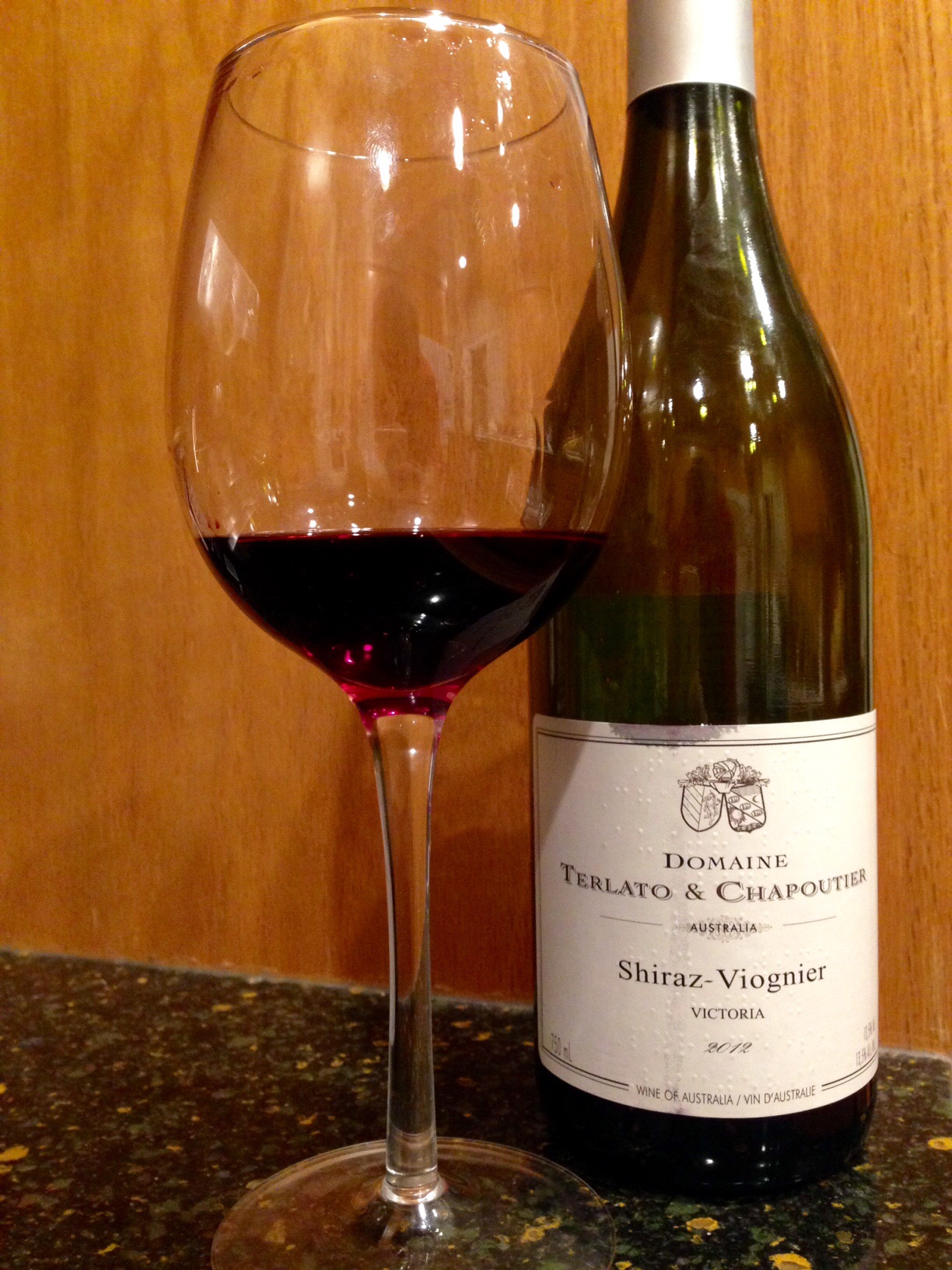
This Thirsty Thursday lights on a strange affair riven between three countries. The wine is from Domaine Terlato and Chapoutier. Neither name sounds very Australian. This is because Napa bound Tony Terlato began importing Michel Chapoutier’s wines from the Cotes du Rhone. A decade later in 1998, Michel discovered land in Australia, got excited, and got Tony to support planting Shiraz. Six years of drought delayed production, but by 2004 640 cases happened.
At the same time, a larger plot over in Victoria grew Shiraz and Viognier: catnip for Michel to make into his own version of Australian Cote Rotie. Thus, 2012 saw 90% Shiraz and 10% Viognier cofermented and aged in stainless and cement tanks far from any barrel. The coferment retains shiraz’s brilliancy, while adding floral tones and much needed acidity.
Appearance: a pretty intense ruby color with a razor thin clear rim.
Aromas: smell of medium intense leather, marischino cherry syrup, violet, blackberries, and iron filings.
Palate: feels dry, with just enough acidity, very present medium muscular tannins, warm coal alcohol 13.5%, making for a medium body.
Flavors: taste properly focused, brambly blackberry, tart blood orange, laced with iron filings and a medium plus length.
Terlato and Chapoutier’s Shiraz Viognier is continuously drinkable. The lack of oak allows shiraz to flaunt its spice and complexity. It is serious wine and could stand up to most foods yet drinks alone with youthful exuberance. At $16 you can’t go awry.
A few months back Wayward Wine reviewed Biodynamic wines by Bourdy from France’s smallest, most extreme region: Jura, France (click here for that post).
From 2010 to 1967, the wines ranged wildly from taught and acidic to spiced and honeyed. Time to delve past Bourdy’s varied but entry level Chardonnay and Pinot Noir blends. Time to visit their Savagnin grape-based higher tier.
Bourdy’s ’09 of Savagnin alone looks, smells, and tastes lemony tart and bright, with lime meringue, white pear, light honey, salinity, and floral tones. But their goal is something greater: Chateau Chalon.
Only about one year in six, a blind judging manages to find a barrel worthy of calling Chateau Chalon. Here is Jean Francois impersonating his father’s selection process:
The 2006 shines a light gold, with pronounced aromas and flavors of verbena, lemongrass, violet candy, almond, and honey. The acidity is eye-widening, young and jagged, saline, mineral and lean. Very good 4 of 5 (although it costs $107, three times their entry Savagnin).
But then some barrels carry a wild yeast that sometimes, under the right conditions, produces a fat cap of yeast. Rarely that cap holds, allowing the wine below to safely, gradually oxidize. That cap is called the flor. Jean-Francois helps us with pronunciation:
A five person senate declares vin Jaune. In 1993 they only declared 3 parcels. We try 1996:
The color looks a clear, bright, light gold. Aromas hardly smell of grapes but instead slightly feral, like bacon, with ethanol, sherry barrel, fruity Speyside whisky and vanilla powder. It feels dry, acidic, fairly tannic, with warm alcohol and round body. Flavors dive a different direction, tasting like crust baguette, lemon peel, cinnabar, smoke, minor mineral, that flow into a soft, creamy finish. Very, very good (4 of 5, for a mere $171.99).
But how about something older than me? 1976’s Chateau Chalon washes the glass with gold. Aromas pounce with orange marmalade, tomato leaf, Peking tea, wax, and almond, all of which match the palate. Acids and tannins provide stiff structure balanced by a very ripe, lush body. ’76 like 2003 was warm, dry and made for a far more open, rich white (very good 4 of 5…but rarity makes it $413.50).
We rev up the time machine and visit 1959’s Vin Jaune de Garde. Aromas smell loudly but delicately of verbena, wood, chamomile, orange peel, and crystallized honey. 59 is lean, powerfully structured, and bright. It finishes long and lovely with flavors of creme fresh. It is outstanding stuff (5 of 5), extremely clear and expressive and cheapened by words (although certainly not cheap $613.99).
Bourdy suggests food to tame all this acid and complexity: eggs cooked 1 minute with wine, mixed mushrooms, Comte cheese and nuts. Our already watering palates feel desperate for food. But focus Aaron!
14 wines in, Bourdy is nowhere near finished. Time for two brandy from Jura:
Leftover grape skins get pressed in small vats, then distilled into 16.5% alcohol following a 1579 recipe developed by drunken nuns.
Bourdy’s Macvin Blanc looks medium gold. Strong aromas smell of violet candy. It is sweet, acidic, alcoholic, hot, warm and bright. Flavors taste of aniseed, licorice, pear, and pleasant bitter green, leafy eucalyptus. It is very good (4 of 5) and $27.99.
The Galant Premier Grand Cru sees 3 years of barrel time. It smells fantastically of apple pie, mulled wine, mace, candied pear, and nuts: like walking past chestnut roasters at wintertime. Flavors wander towards aniseed, jerky, salt, and honey. Very good ($66.99). Bourdy suggests blue cheese, glazed pork.
Completely lost and my palate obliterated by acidity, alcohol, and intensity, I call a cab home and gorge on cheese to absorb all that cold climate brilliance.
Bourdy’s small 10 hectare plot produces fantastic, wholly unique wine. Jean Francois is affable and confused by American cuisine (sugar in bread? Madness). This tasting was of their middling vintages, and I can only imagine greater things far beyond my meager appreciation.
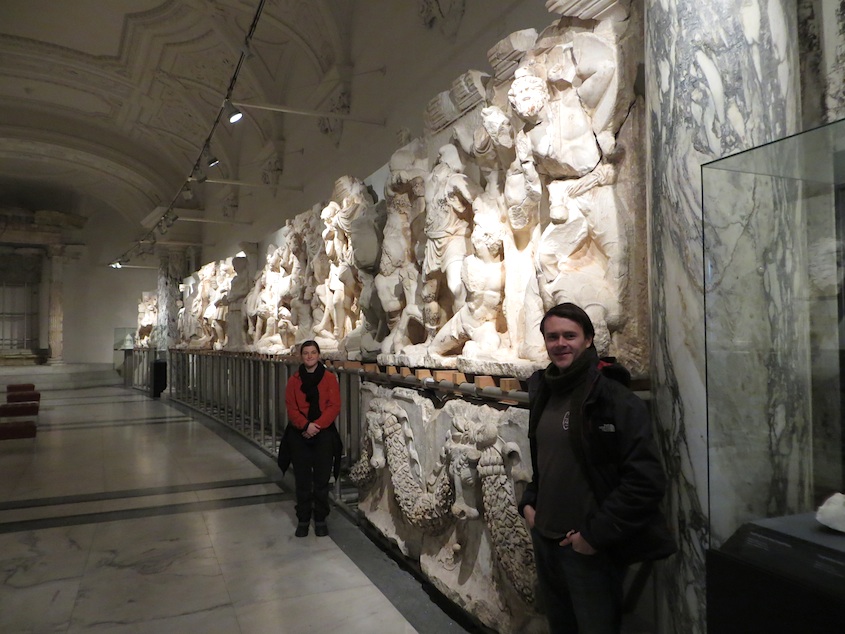
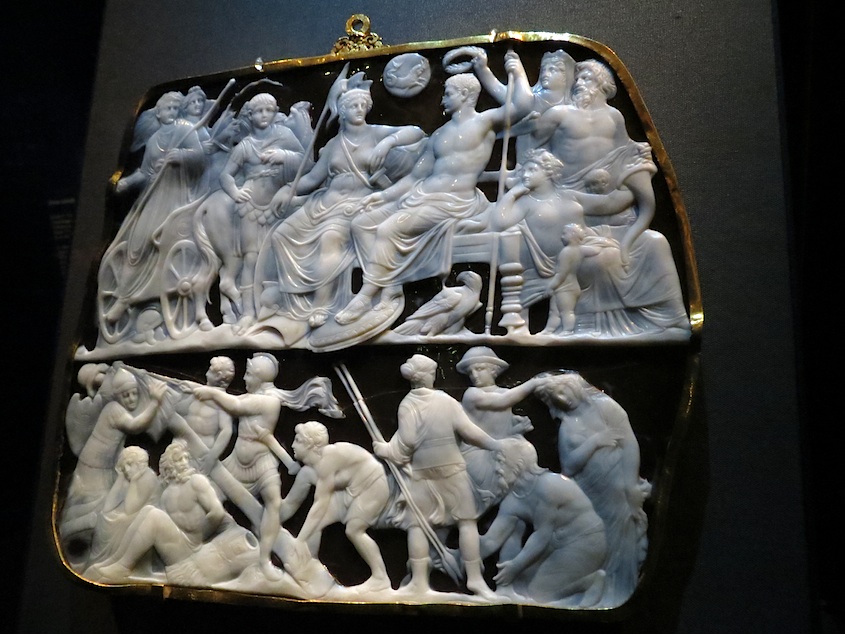
It has been 148 days of travel. So overwhelmed by Vienna’s art-packed core (last Monday’s post), we tacked on another day and return to the Kunsthistorisches Museum. Down monumental steps a marble lion greats us to the Ephesus Collection:
Taken from Turkey over a hundred years ago, its marble frieze depicts scenes of slaughter, sacrifice, and succession with Hadrian hugging a preteen Marcus Aurelius:
Our Masters in Art History brought us here, but the museum woefully lacks anything didactic. My wife’s journal notes: “I was exhausted by the inexhaustible display of works without significant explanation”.
Wrapping stairs take us up to the musical museum. Relics of musical memory include the zither from the Third Man, pianos owned by Mozart, Schuman then Brahams, Chopin, and Beethoven, even his metronome:
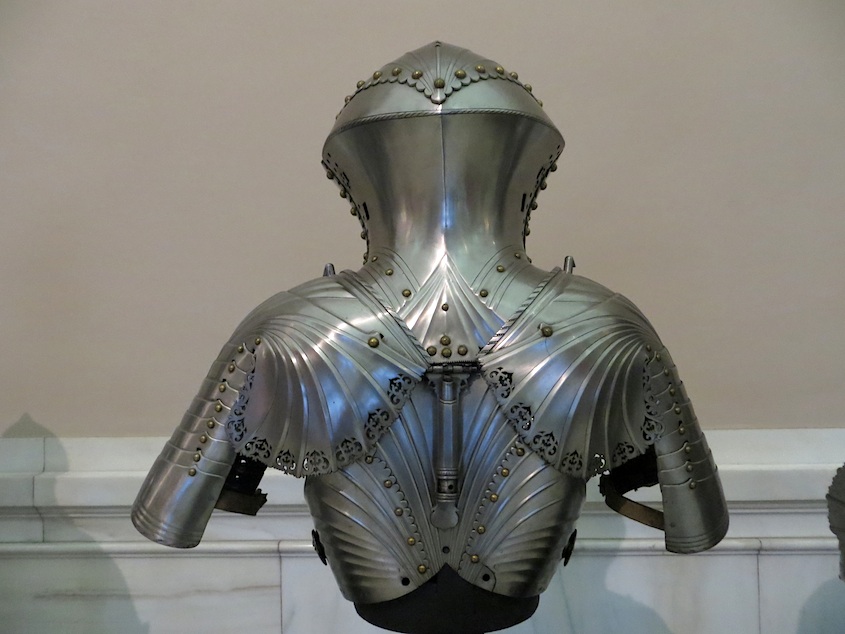
We try to tour the world’s largest collection of armor, Monty Python singing in our heads, but by now our brains are yogurt, even if it is fabulous.
We hit the pavement and find Aida cafe, birthplace of the fabulous, chocolate-tastic Sacher Torte. Torte in hand, Aida’s just happens to be near a birthplace of modern art: The Secession.
Here the first, blank, white, single gallery for modern art was built in 1897 with Gustav Klimt as its president. But it costs too much for our Austerity Travel measures and our train awaits. A block away is Wein & Co, Austria’s best wine shop. We grab a few bottles, tasty eggplant falafel (3 euros) at our market and hop on the 5 hour train to Prague with only 10 minutes to spare.
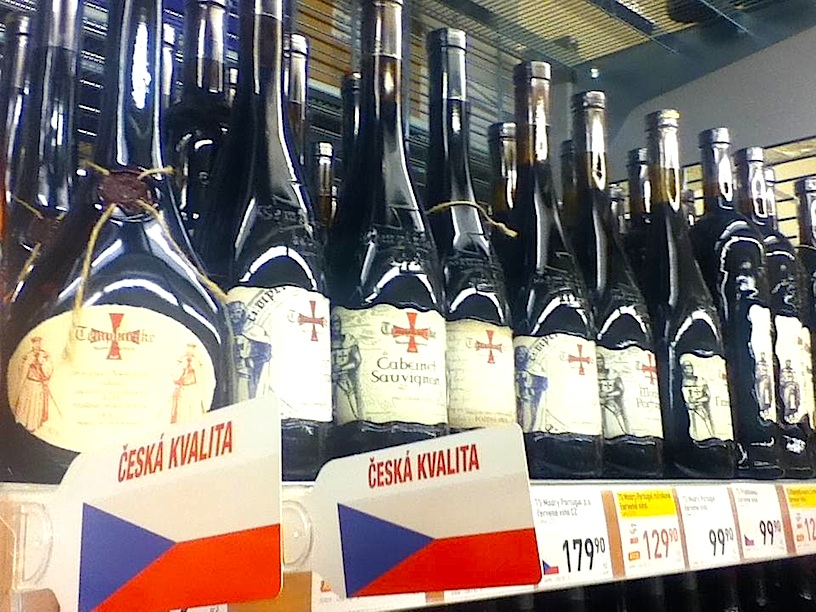
We arrive in Prague completely lost. Worried about everything being closed on Sunday, we go to a grocery and discover local, yes, local Czech wine.
Worrying labels and strange varietals aside, I find Rulandské modré…aka Pinot Noir. Sure it’s $6.26. Sure, we’re at the edge of cold climate, continental, northern wine making. But how bad could it be?
Vinnysklep Sovin, pinot noir (Rulandské modré), Moravské Zemské Vino Červené Suché, Czech Republic, 2010 $6.26 ….try saying that five times fast!
APPEARANCE: Sovin’s pinot looks hazy, moderately ruby, with a garnet rim.
AROMAS: smell, um, clean (?) and powerfully of beef jerky and clove. Somewhere behind the clove hides bramble berry and raspberry aromas.
PALATE: Feels dry, pretty acidic, moderately tannic, with medium alcohol (12%) leading to a medium body.
FLAVORS: taste in one quick hit of tart red berry, apple, truffle, cigar ash, clove, all rounded out by a wild, gamey pheasant flavor of medium length.
Sovin’s Pinot is acceptable at best (2 of 5). Sorry Sovin. It is real wine but just a mess. Maybe our palates have yet to make the Eastern jump. Acclimating to new terroir takes time and focus. We just got a handle on Austria’s edgy Gruners and Zweigelts.
Another burn out day in the trenches of wine sales sends me thirsty and hungry to Cooper’s Hall: Portland’s, maybe the US’s, largest conveyor of tapped wine. Yes. Bottles begone. Cooper’s features 44 keg wines: some imported, and some produced on site then self-distributed.
Instead of shipping and recycling endless bottles and producing more CO2, why not pop the wine into an oxygen deprived keg that you can ship, clean, and reuse?
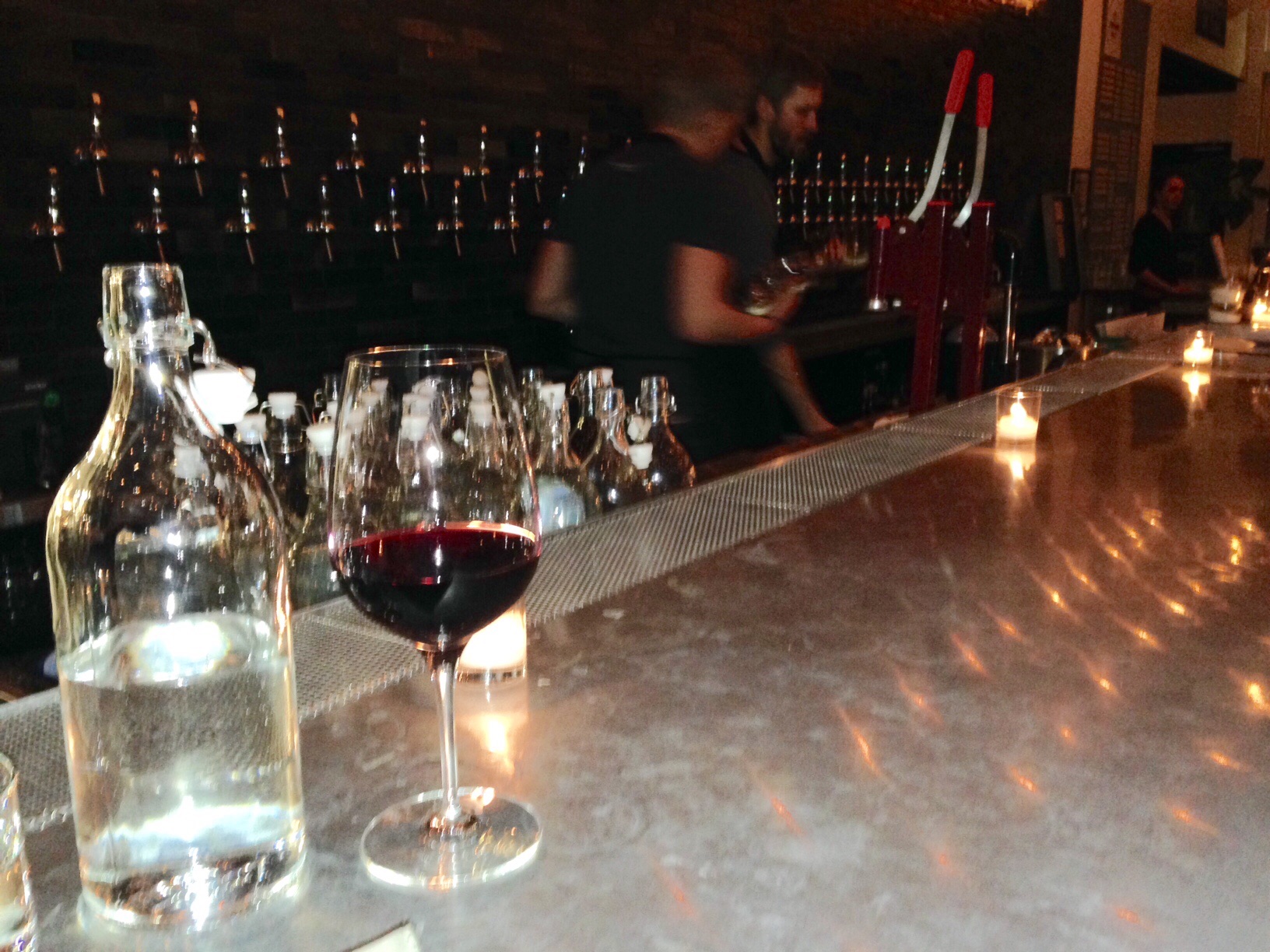
Their converted warehouse, sleek and dark, echoes with rap and chatter. I land at the bar and order Carignan: a red grape usually blended with Syrah, Cinsault, and/or Mourvedre throughout the Mediterranean. But tonight’s tap features something different: carbonic macerated Carignan from Mendocino, California.
Typically, carbonic maceration is used to rush harvest wines like Beaujolais Nouveau to market. But Cotes du Rhone, Languedoc, and some Rioja also use it to avoid Carignan’s aggressive tannins. By putting grapes in an enclosed, oxygen free, CO2 blanketed environment, ambient yeasts will still ferment sugars, but within the whole berries themselves. This avoids extracting heavy tannins but develops fruit, banana, and clove notes.
So how does Mendocino Carignan fair?
Carignan, Lioco, Kush, Mendocino, California 2012
Coopers hall carignan
APPEARANCE: a bright, young, clear ruby core turns purple along the narrow rim. Spider legs.
We continue last Monday’s Vienna visit (see post) with a visit to Belvedere Palace:
Prince Eugene of Savoy had Belvedere built as his summer home on funds from defeating the Ottomans. The gardens stretch in orderly, endless fashion.
Thanks to small rooms and small collections, we can easily digest the medieval art, armor, sculpture, and paintings (the Klimt collection stunned us). Both complexes manage to feel cozy yet extravagant.
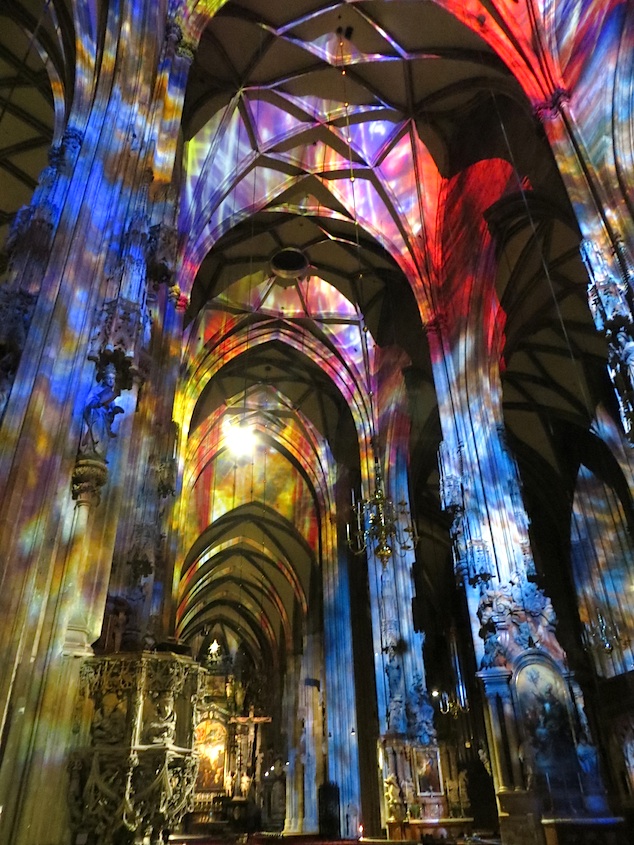
Another Christmas market lunch (potato, cheese, onion bake!) allows us spend the day there. We hike at dusk to the fairgrounds to find the world’s oldest ferris wheel: featured in Orson Wells’ The 3rd Man: Back at city center we find Mozart’s apartment. We get unreal coffee nearby. St Stephen’s Church stages performers outdoors and a light show flames above its fantastic altarpiece inside. Nothing beats the holidays in Europe.
We grab ingredients for dinner and a bottle of Austria’s famed grape: Grüner Veltliner.
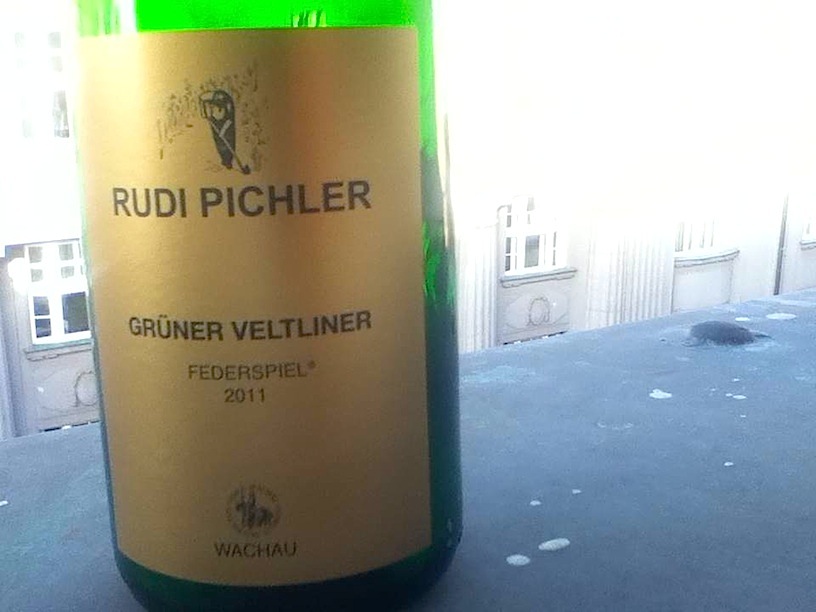
Rudi Pichler, Grüner Veltliner, Federspiel, Wachau, Austria 2011. €11.90
APPEARANCE: looks a pale lemon with slight petillance. AROMAS: smell clean, young and bright of fresh cut lawn, fennel, lime, lemon zest, white peach, orange blossom, and light honey. PALATE: feels dry, with extra acidity, some alcohol (12.5%), a lightish body, and edgy texture. FLAVORS: taste very complex and rich with ripe lime juice, a lovely line of fresh fennel running through things floral and white peach. The medium plus length makes this very good (4 of 5). Tightly packed with countless flavors makes Rudi Pichler’s Grüner Veltliner worthy but in 5 years, it should open out fantastically.
The next day, we plan on gorging even more art at the The Liechtenstein Palace and Royal Treasury (Vienna is the burbs for palaces). Just past Roman ruins, we catch the Spanish Riding School crossing the street:
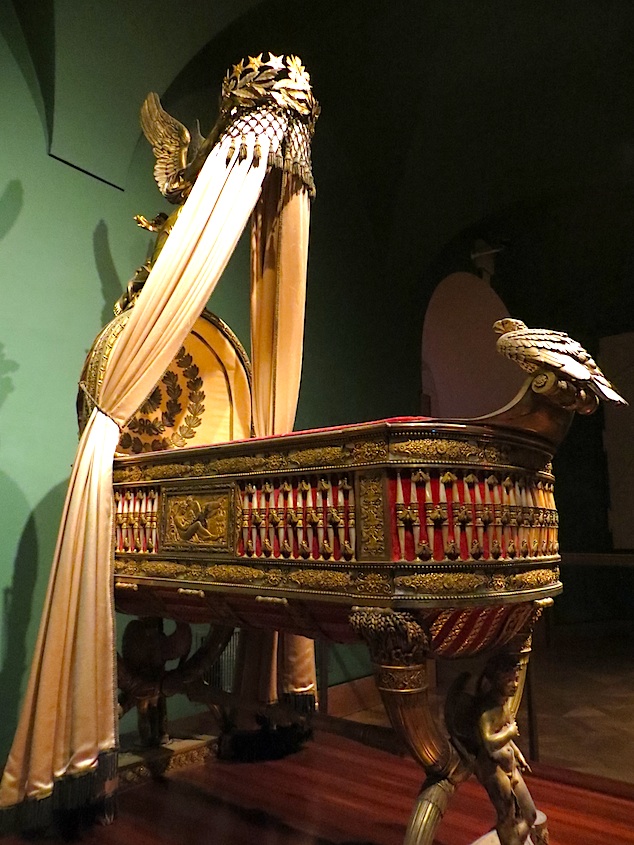
After listening to organ music in a quaint chapel, the Treasury completely wears us out. A sea of meandering glass cases reveals reliquaries, royal robes, Ottoman weapons, and a crib for Napoleon’s baby:
Mentally warped, we sit down for formal Viennese coffee and lunch at the next museum. They have more variations on coffee than Starbucks ever imagined. The space wasn’t too shabby either: The soup and coffees warm us. But once our server forgets us, we spend the next two and half hours in the Kunsthistorisches Museum. We soon realize, half our Art History books live here.
We leave bleary-eyed. We extend our trip a day and save the rest of the museum for tomorrow.
It’s late. We grab bread, cheese and eat in line, waiting for 8 Euro tickets to Vienna’s Opera. The cheap tickets come with a price. We cram into standing room only with a crowd of hot, sweaty people. But we stand center stage and tonight is La Boheme.
The somewhat paint-by-numbers performances do not detract from the moody sets, beautiful music, and strange focus a day of museums and miles of walking provide us.
















 WAYWARD WINE