Mélange de Trois, Jamesport Vineyards, North Fork Long Island, NY 2005

Sex sells wine and visa versa.

Our social insecurities about copulating pair beautifully with our concerns over alcohol. We giggle and titter at both because, although natural and basic, they seem to be taboo, private things. As kids, sex and drink were foreign, even forbidden for most. We carry that baggage into adulthood. Even as adults, we find it awkward to talk openly about sexual positions or binge drinking with strangers, grandparents, or children. Mass entertainment is founded on poking but not pushing these boundaries. Wine is no exception.

Label designers and brand managers at Folie à Deux took advantage of these symbiotic inhibitions when fabricating Ménage à Trois.

This wine “examines what happens when you put three attractive, single, young grapes in one exquisite bottle. It’s fun; it’s exciting; it’s legal in most states”

…tee…

…hee…

False advertising aside, Ménage à Trois taps into our need for safe escapism, by not-so-obliquely referencing threesomes. Opening a bottle gets our friends’ attention. We appear vaguely risky. We nervously laugh about the thought of group sex and let the subsequent inebriation and horrendously bland wine numb our nervous inner child. Such a forgettable social lubricant might even get us laid by disassembling inhibitions.

Titling it in French adds the vinous caché of wine’s symbolic home, France, and an exotic Parisian tint of sexual dalliance. Surely, a ménage à quatre or, gods forbid, …dix avec chien et poulet would go to far. But a third party is within the realm of fantasy or at least low budget pornography. Even if we can’t have threesomes, the bottle allows a false sense of adventure.

Countless customers ask me, winking, “do you have…you know…that sex wine?”. I stare blankly back at them. “You know…it’s a blend.”. Still nothing. “It’s really really good and cheap.” After allowing them to bastardize the French, I show them alternative blends. Astounded that Ménage à Trois didn’t invent blending, they either leave or begrudgingly buy something less titillatingly titled.

Hitching a ride on the pseudo-sexual bandwagon, is Jamesport Vineyards of North Fork, Long Island. I reported last week that their wines and winery are respectable. There were no koalas or cats on a label for miles. But then, there was Mélange de Trois.
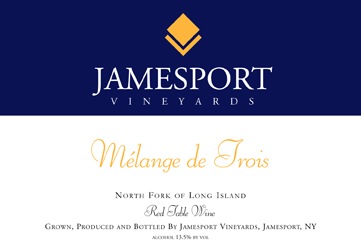
Seriously?

I ignored the name. Through the tasting, the quality was too good to forget, so I bought a bottle. But four months later, I opened it with trepidation.

Jamesport’s site implies: “This provacative [sp] blend of three dares to be sipped and savored.” The only provocation here is risk of lawsuit from Folie à Deux. But behind the innuendo and spelling spoof, this is a traditional bordelais mix of 49% Cab Sauv, 25% Merlot, and 26% Cab Franc. And it’s a pretty strong tripling.

Old and new French oak barrels were used with restraint, allowing dark berries and bell pepper to lead the march. Some fruit seems harvested late, with traces of raisin and dried cherry. The main tell that we aren’t on Bordeaux’s left bank is the high acidity. Long Island’s climate is 2 degrees cooler, 13.2 inches wetter, and slightly more seasonally extreme than that of Bordeaux. This means shorter, cooler seasons that translate into acidities that pierce the palate and demand food.

Unlike the polygamous monotony of Ménage à Trois, Jamesport’s Mélange de Trois actually grips you in the throes of its threesome (crap, stop sounding like these ad-men). Actually, there is nothing sexy about this wine, unless you like S&M. It is intense and precise. It does not become muddled into a “forward, silky and soft…delicious dalliance”, for those who find that “red wine is not your speed”. Unlike Ménage, Mélange tastes like real wine.

Yet if Jamesport’s wine is so decent, why pander so halfheartedly to a base anxiety? This is a thirty dollar bottle, which, against all reason, trades amongst the terminology of the ten buck realm. Maybe Long Island’s obscurity hurts too much. Maybe it started as a semi-rebellious pun against big wine. Maybe piggy-backing off of others success is all they can hope for. Either way, I’m sure it sells.

Ménage à Trois’ cringe-worthy Fact(-less) Sheet

MAT_Red_07_FS

WineSpectator 2005 Long Island Vintage Report

Posted in Cabernet Blend, Long Island, Red, Uncategorized, WINERIES WANDERED | Tagged , , , , , , , , , , , | Leave a comment

Sauvignon Blanc, Jamesport Vineyards, North Fork Long Island 2009

I was enamored with Jamesport Vineyards on Long Island. Maybe it was the first winery that morning. Maybe it was the previous day’s mixed results. Maybe we share the same birthdate.

Either way, they looked professional. The tasting room was spacious, sharp and uncluttered. The band, who arrived late, actually played something original (a rarity in Long Island). The labels were confident. No animals. Little kitsch. Just a bar of color, a bar of white, gold logo, and clear text. The glasses weren’t plastic cups, nor cheaply etched stemware stubs, but clean, stemless goblets. Even our pourer, Jake, knew where residual sugar comes from (not riesling elves).

For $15, you get to taste only 2 whites and 2 reds. Why? Because tourists from NYC and the Hamptons will pay it. Luckily, we were early, so we tried everything.

The vines. Ron Goerler Sr. and son (Ron #2) sustainably turn sixty acres of grapes into seven thousand cases a year. These include chardonnay, riesling, pinot noir, cabernet franc and sauvignon blanc, as well as grapes that usually freeze before they ripen in the Northeast: sémillon, merlot, cabernet sauvignon, syrah and the latest ripening of the lot, petit verdot. Which was stellar but $100.

My wife reasoned me from buying it. Back to earth, I bought Jamesport’s sauvignon blanc. It was 24 bucks. They have a 16 dollar “East End” range of wines. They’re decent but decidedly simple.

Once summer’s excitement waned into September, I pulled the wine from the fridge, worried. Getting stuck in New York City traffic had heat damaged some of the wines. Hell is sweating in the car, with dead air-conditioning, knowing the 100 degree heat was killing eighteen hand-picked, overpriced bottles in the trunk. Was the Jamesport a victim? Or had it been packed deep enough into luggage?

Chance had favored it.

The bottle retained sauvignon blanc’s traditional varietal notes. Except for the nose, which was quiet considering such a typically aromatic grape. Nonetheless, it had all the expected cool climate high acidity, with grass, grapefruit and citrus flavors dominating. The body was far from thin, with a viscous richness. Mineral notes kept it interesting. Jamesport’s sauv blanc would snap to attention most lightly prepared white meats, salads or goat cheeses.

How did North Fork Long Island pull it off? They share Bordeaux’s latitude. That means similar sun exposed seasons, allowing this late budding, early ripening grape enough time. They share the Atlantic’s water. That moderates temperatures from severe spikes or dips. Since the bordelais consider this grape native or wild (sauvage hence sauvignon), it makes sense that, with Jamesport’s close attention, it can thrive across the pond.

http://www.jamesportwines.com/index.php

New York Cork Report

Posted in Sauvignon Blanc | Tagged , , , , , , , , , , , | 1 Comment

Cabernet Franc Late Harvest, Palmer Vineyards, North Fork Long Island NY 2007

You get home from a weekend of wine tasting, partially unpack and then collapse. A few months later you find bottles from the trip. But when you open them, annoyingly, you don’t travel through space and time to that ethereal tasting at the winery. Those homely charms of the noble farmer, who described the wine as if it were their own child, now taste like dirt.

Context is king. Humans have fantastic mental control but the mood of the moment, and our blood alcohol level, can sway our perceptions and recollections. Your crap day at work will still be a crap day no matter how many souvenir glasses you fill.

With this in mind, I open Palmer Vineyards’ 2007 Late Harvest Cabernet Franc.

As mentioned in my last post, our trip to Long Island’s wine region was a lesson in demographics: a day’s drive from New York City means no worthwhile wine cost under $20. Palmer Vineyards was little different.

In early November of 2007, Palmer Vineyards harvested their cabernet franc, but not all of it. Grapes that didn’t make the first cut stayed on the vine. As November winded down, frosts set in and the vines shut down. Grapes that hadn’t rotted or been eaten started drying out. Once water content was low and sugar high, harvest led to fermentation. With so much sugar, a fully fermented wine would be little more than red rubbing alcohol. So Bob Palmer stopped fermentation at 14% alcohol by volume, retaining natural sugar, and hid the wine away in small French oak barrels.

Chilled or not, this makes for a voluptuous dessert wine. Sure, I’m not transported back to that barn, refurbished in antique-store-zeal with the 1930s Hotel Majestic counter, innumerable faded signs and nick nacks. Nor does my head swim, having tasting at ten wineries that morning. Nor is December’s chill anything like that June’s heat. Nor do I have to yell over the din. Nor, luckily, is a Beatles cover band forgetting which key they’re in.

In stead of all this, meeting Palmer’s late harvest again, is a bit like meeting an ex. We’ve both changed. She suffered a bit of heat damage stuck in the trunk during a NY city traffic jam. And I’ve become a bit jaded over the plight of New York viticulture. The romance is gone. But although we don’t swoon at meeting again, we still understand each other.

Catching up with this wine, I re-learn to respect it. It tastes like cabernet franc: dark fruits and bell pepper. Its acidity corrects the dried fruit notes from tasting too tired. There’s enough complexity to keep up conversation. It is oaked just enough to put an earthy edge on the sweetness.

We may have moved on, but at $25 per half bottle, we remain on good terms.

Posted in Cabernet Franc, Dessert | Tagged , , , , , , , , , , , , | Leave a comment

North Fork, Long Island, New York: June 2010

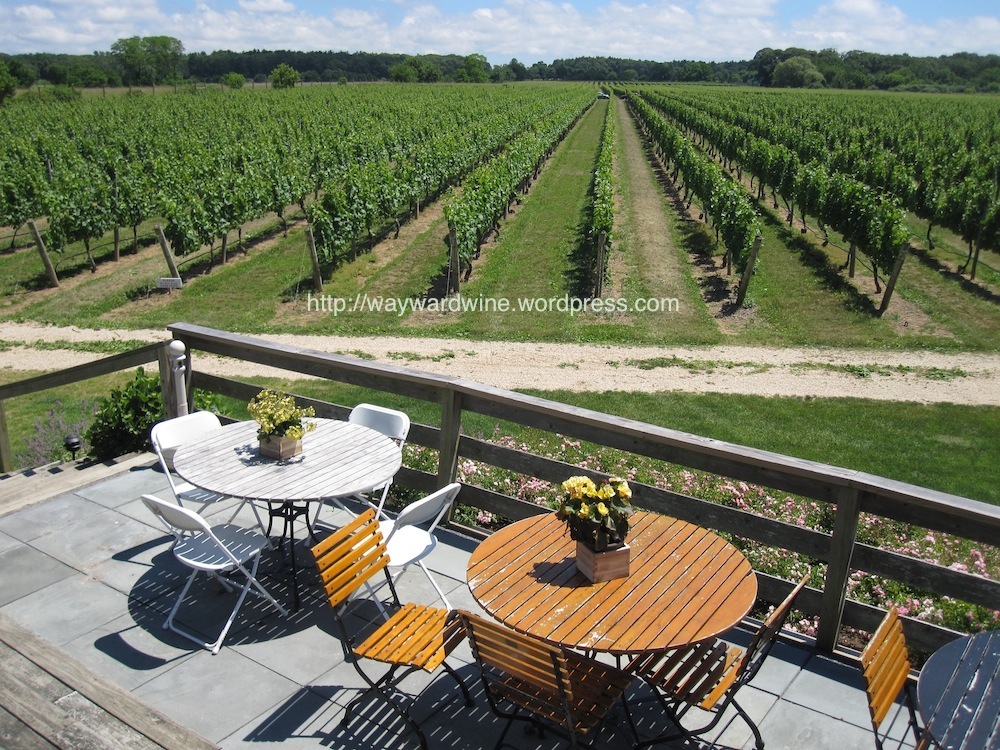
The ferry dropped my wife and I onto a strip of asphalt surrounded by the Atlantic. June sun bounced off the clockwork whitecaps marching in from the horizon. The Buick rumbled into life, aimed West, and we began our wine tour of Long Island.

We shall wooden sign!

Marshes widened into fields and homes sprouted from behind tree lines. I had a map, but there were too many wineries for one day. The Finger Lakes and Hudson had taught me that producers who try to please everyone end up pleasing the lowest common denominator. Maybe making wines sweet through dry, out of every varietal, at every price point over-stretches quality control. So I tried to focus on the serious producers: winemakers who grew their own grapes, experimented, or made only a few wines. I failed.

They make you pay for that extra "E".

Our first stop was Sparkling Pointe, yes Pointe, that’s with an “e”. This white plastic palace opened before us, replete with travertine floor, svwaroski chandaliered/Rio-themed dance hall, and massive patio facing a sea of vineyards. They only make vintage bubbly, and bottle fermented vintage bubbly at that. The quality was spotless sure. But they know their Manhattanite audience. No bottle was under $30. The tasting fee and aloof staff kept us from buying anything.

This turned out to be the model. Long Island wineries cater to crowds fleeing New York City. And when I mean fleeing, I actually mean being chauffeured, in golden chariots, by tigers. Wineries thus overcharge for counter-side flights or bottles that cute couples or bridal parties can open, while wallowing in their own extravagance before one of the countless sea-view, lake-view, marsh-view, or vine-view patios, accompanied by that day’s soft/folk/classic/jazz rock cover band.

Another Tom Petty cover? Seriously?

Nonetheless, wine quality was consistent and surprising, as were the range of varietals. I expected the usual suspects for New York’s cool climate: riesling, gewürztraminer, chardonnay, cab franc and the plethora of cold hardy natives, hybrids, and crossings (although those were present). But the Bordeaux-matching latitude and warm ocean seem to keep the frost at bay. That means syrah, sauvignon blanc, camenere, petit verdot et cetera can bud early enough, and ripen late enough for decent crops in warm years.

That's the price of delicious.

$20 is the starting point for anything decent. This mainly pays for battalions of computer-controlled stainless tanks, new barrels and Maseratis. What you get is higher levels of cleanliness and less musk, gaminess and underipe fruit. Whites are sterling, although not enough wineries have the will to ferment them dry. Rieslings in all shades of sweetness won the day, but chardonnay and sauvignon blanc surprised us. Most wineries have a token late harvest or sparkling wine, which were fine but expensive. If you like licking wood then ready your tongue, since every red sees new, small, seasoned French oak barrel aging at length. Acidities were surely softened, but in the pursuit of Napa-ness, our mouths were raw and wallets empty.

Jamesport at least mixes new barrique (below), with the big and old (above).

Our trip was rushed, but a few wines stood out to make it into future posts. Long Island is worth the trip, just watch your cash. Oddly, wineries that started in P stood out from our rushed tour: Peconic Bay, Pelligrini and Palmer.

Reviews of worthwhile Long Island wines will come in the following weeks.

Worthwhile wineries in Long Island:

Home 1

Home

Posted in Long Island, WINERIES WANDERED | Tagged , , , , , , , , , , , | Leave a comment

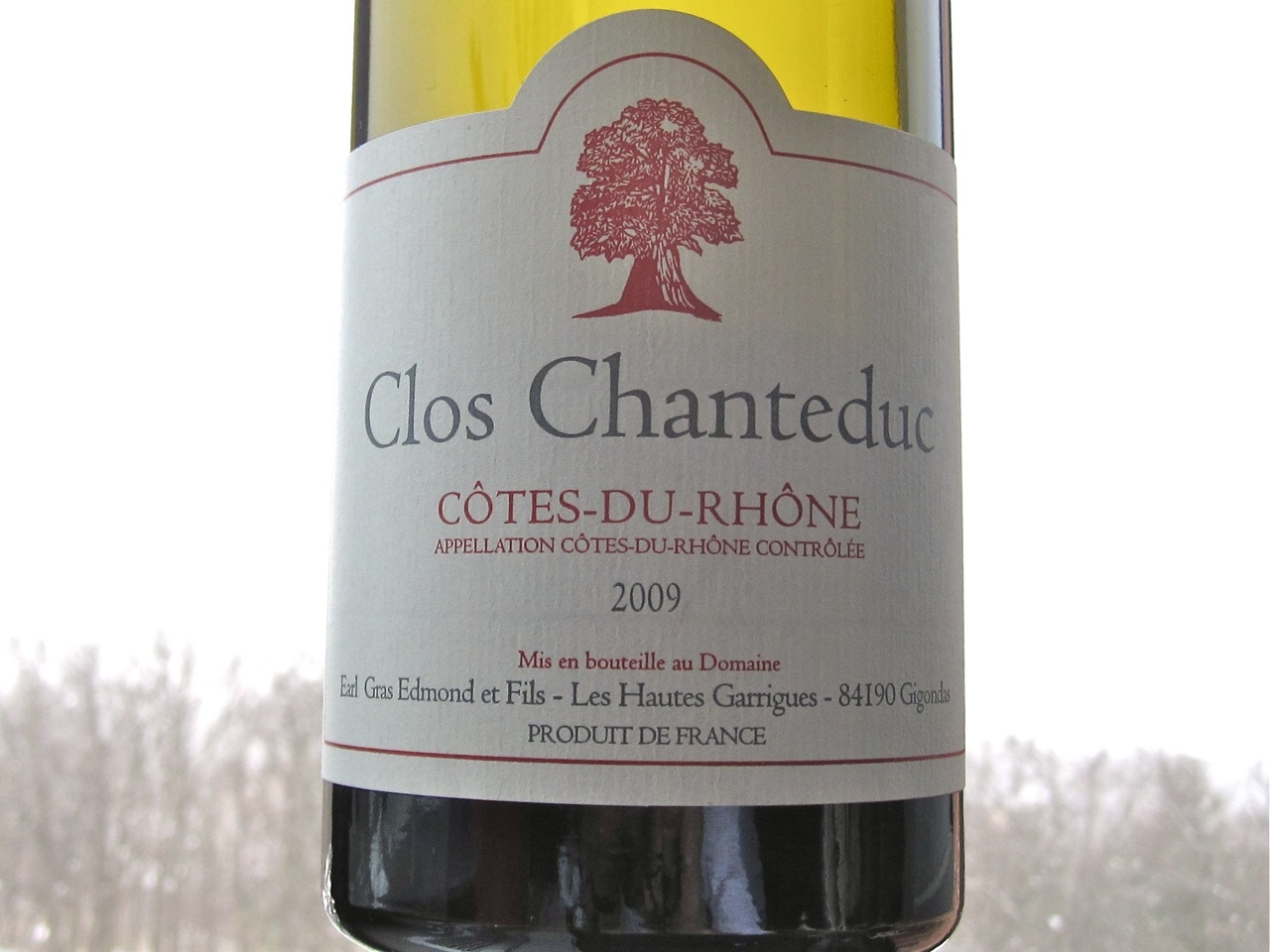
Grenache/Syrah, Clos Chanteduc, Côtes du Rhône, France 2009

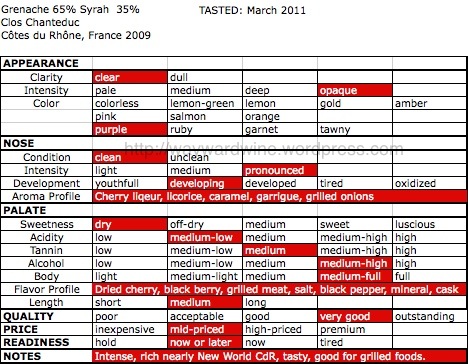
Clos Chanteduc is delicious. Drink it. End of story. Or is it?

In 1984, now famous chef Patricia Wells left America to live in Provence. She watched her first harvest from the villa in idle bliss, but was soon shocked. Wells blanched at the green and mildewy grapes coming in. The resulting wines were thin, acidic, and thus, undrinkably wrong. Ever American (and a touch entrepreneurial/imperialist) she knew better.

By 1990, Wells “paid the farmer a lot of money to go away”. Not a winemaker herself, she hired one, and watched three rough vintages not meet expectations. He retired. Wells hired another and got involved in blending until it fit her taste.

The “recipe” extended to the vineyard. More syrah was grafted onto cinsault vines. They got spice and fruit. Mourvèdre was planted for more color and tannin. They gave up on it. Cinsault soon disappeared entirely. The 2009 blend is a triumph of minimalism and manipulation: 65% Grenache backed by 35% Syrah.

Wells most loves the wine’s “naturalness” and “lack of pretension”. Yet it is pretense and artifice about what wine should be that led to all this accommodation.

The Wells have guided a delicious wine for sure. My problem is that it had to be. This is the self-fulfilling prophecy of modern wine. We increasingly squeeze grapes into what we expect good wine to taste like; removing stalks, gentle extraction, aging on lees, in casks for a year, et cetera.

We buy reds in the same way. They have to be “full of flavors of dark fruit” and have “a pleasant, peppery quality”. The fault is not the wine. It’s us. We expect wine to always comfort us. Wells imagines this is “[t]he kind of drink a wine writer might advise to drink with ‘uncritical consumption.’.” That would be fine, if it was a rare request. But we too often don’t like surprises. Wine must provide escapism, but down a predictable, “pleasant” path.

This apathy renders all reds the same. The wine world is getting really really boring. Consumers and vignerons should seek out the weird, the odd, the exciting. Wine can shake you and take you somewhere. Clos Chanteduc takes us to our cartoon of the Côtes-du-Rhône: rich, soft, spicy but never too edgy.

I’m jealous of Wells. I want to live in France with my own vineyard. Maybe knowing her intentions dismisses the benefit of doubt, which I extend to other wines. I likely can’t trust an expat to make “French” wine. As if I can taste nationality (which is as much a myth as this wine).

Hell, all wines are made to fit certain boxes. It just seems that those boxes are becoming the same.

I apologize for preaching. I love this wine. But I worry that I already had to. As if taste was predetermined. But that puts acculturated likes and dislikes before the act of acquiring taste. We are better than that. We learn to love new things all the time. Maybe Wells could have adapted to drinking that “thin and acidic, thus undrinkable” wine. The French had for years.

All Quotes from: Patricia Wells in Kermit Lynch Newsletter May 2006 pdf

Kermit Lynch’s May 2006 newsletter

http://www.patriciawells.com/

CLOS_CHANTEDUC_2009_pdf

Posted in Grenache Blend, Red | Tagged , , , , , , , , | 3 Comments