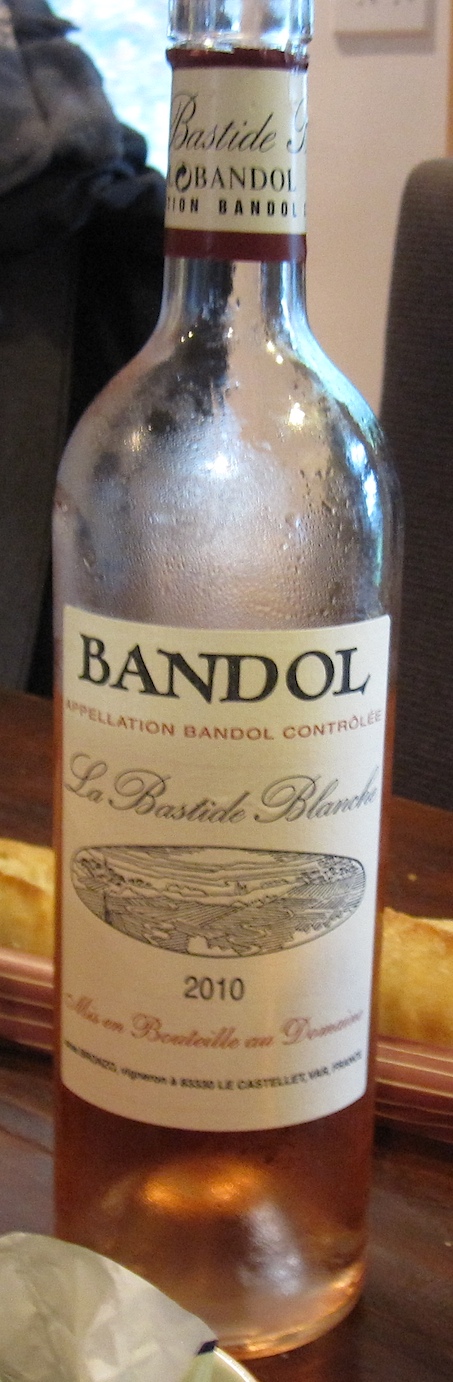
Mourvèdre Rosé Blend, La Bastide Blanche, Bandol 2010

The Northern hemisphere has rediscovered summer’s heat. Now armed with Waring Pro’s vaguely accurate wine chiller (my review), the world of colder wines unfurls before me.

Never on the cutting edge, I heed the last few years’ “Rethink Pink” advertisements. Rosé beckons a redrink.

But a wine’s color carries more gendered baggage than Paris Hilton’s valet. We construct feminine and masculine from birth: painting walls, buying bedding, color-coding clothing to ensure that baby fits into its normative, sexually dimorphic role. We tint adulthood as well. Walk down any clothing, book or wine isle. Pink is for girls. Blue, or with wine, red, is for boys. Wine descriptions and labels are equally laden with tropes divided male (muscular, bold, aggressive) and female (delicate, vivacious, alluring): all in order to align with years of identity programming and wallet opening.

Ever since Sutter Home first turned a purported failure into profit, “white” zinfandel (neither white, hardly zin) not only cornered but fossilized the female wine market in America.

For some, white zin was an entry into wine. Fine. For most, it became a dead end. Their identity was constructed upon it: “I’m a white zinfandel person” and nothing else would pass their lips. Today, pink still means sweet, light, fruity and feminine.

But pink is just a color.

It wasn’t even a word until the 17th century. It wasn’t even female in the US until the 1940s, before which it meant male. In Japan it symbolized fallen samurai (and softcore porn). The Chinese didn’t even have a word for pink (fěn hóng means “powder red”) until Western contact. Even then, they called it the “foreign color”.

So shed your color spectrum segregation and embrace wine in all its hues.

This week: Bandol.

Bandol's petite AOC at center in olive.

East of Marseille, at the start of the French Riviera, the commune of Bandol holds fast to one grape: mourvèdre. Phoenicians colonized Spain, bringing the grape West around 500 BCE. It jet-setted west along the French coast during the 16th century. After three hundred years of deliciousness, the phylloxera aphid not only wiped out most French vines, but also killed French faith in mourvèdre: except in Bandol.
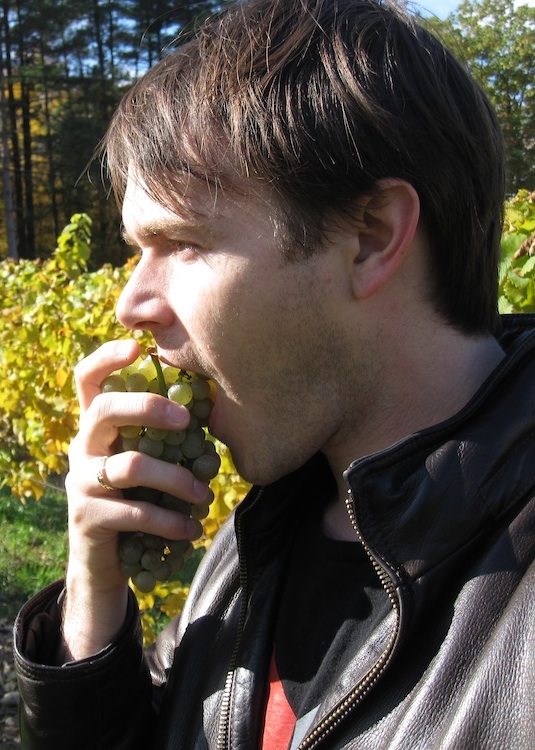
Mourvèdre ripens late, needy for long summers. Bandol’s coastal warmth makes it a perfect home. Half the wine must consist of it to print Bandol AOC on a label. Mourvèdre is thick skinned, thus often tannic, weighty, alcoholic, and blended to counterpoint the fruit of grenache. Bandol’s low soil fertility means low yields, which means high concentration. Huge, leathery, grippy reds with spice and barnyard are Bandol’s calling card.

Yet before they finish the red, most winemakers -like Michael and Louis Bronzo at Domain la Bastide Blanche– use the saignée method. Skin-contact colors wine. Blending white for pinkness’ sake is frowned upon (bad white zin! down boy!). So after twenty four hours of maceration, tinted juice is “bled” or siphoned into a separate tank, while the concentrated red keeps along it’s merry, darkening way with the skins. This pink product is released early (four to 10 months), ready to drink, and buy barrels for their red’s two years of aging.

But 2010’s Bastide Blanche is no pale reflection. It’s copper clarity glimmers. It’s nose rings with red fruits, wild strawberry, grapefruit. Behind these lurk bell pepper and roasted mushroom (classic Bandol brett.). Waves of tart strawberry, vanilla, ginger, spice, bell pepper and sea salt roll across the palate. Fruit dominates, but there is so much more in this sea.

Bastide Blanche offers a cheap ticket to the coast of Provence. Let the warm, relaxed tide draw you deeper to sea. Here, pink means neither sweet, light nor simple. Like most, this French rosé is reliably dry, medium bodied and food ready. Dip your feet, and summer’s heat will fade off. Dive in, and forget yourself. Forget your prejudice and assumptions about color. Redrink pink with an open mind and open glass .

SOURCES:

http://bastide-blanche.fr/

Sensational Color: All About the Color PINK

Les Vins du Siècle Bastide Blanche overview

guidevins.com Bastide Blanche overview

terroir-france on Bandol

Wikipedia’s best Bandol coverage

Posted in EMPTIED BOTTLES, Mourvèdre, Rosé | Tagged , , , , , , , , , , , , , , | 5 Comments

At War With Waring Pro’s Wine Chiller

I walked through Target, marveling at China’s manufacturing prowess, then something caught my eye. Beneath a red clearance sign was a humble mound of black plastic: a wine chiller.

Customers at my wine shop had asked me if we have a rapid chiller. My answer sent them to the freezer and twenty minutes of patience. But I had little clue what they meant. Curiosity made me pick it up.

Will it work???

The brand was Waring Pro. Everything seemed in order. The LCD screen and buttons were straightforward. The metal enclosure adequate for any 750 ml bottle. The detached cloth collar insulated and doubled as a silly hat. The plug looked fine. There was even a pointless foil cutter. But the chiller had no box.

Originally $99.99, orange stickers had slashed it to $25. Someone had probably returned what was once a gift. But why? Was it broken? Impractical? Misunderstood? I decided to do the charitable thing and give the poor, abandoned retch a second life.

Once home and hungry, I grabbed a bottle, plugged in the chiller and pressed power. The LCD beeped to life with a blue glow. I selected “WINE LIBRARY”, then “WHITE WINE”, and rolled through the options. Fourteen choices of “whites”, from “ZINFANDEL 59F” (*shudder*) to “SOAVE 41F”, followed (I assume “POLYFUISSE” is a type of fabric). Then I selected CHARDONNAY, and a loud whirring kicked in.

Over the following hour, my wife and I tried to ignore the constant hum. The bottle temperature shed one degree every few minutes. Dinner was cold, but the wine still wasn’t.

With ample time to spare, I searched for reviews. Amazon.com slighted Waring’s chiller with 2.5 stars. Most reviewers raged at it wasting their lives. Some turned to science. With thermometers and multiple bottles, one tested Waring Pro against their fridge. The fridge won. But they had asked the wrong question. The chiller brings wine to the ideal temp. It’s not meant to be fast, just accurate. But then is it?

Another review put an already cycled bottle back into the chiller. Before, the machine claimed to have taken the bottle from 77 to 46 degrees, but once back in, it said the bottle was still only 61F. Even the room temp reading was off by seven degrees. Clearly its air-temp thermometer is a bit numb.

Then, an odd silence came. The fan had stopped. A ding sounded, with “CHEERS!” exclaimed on the LCD. I checked the bottle. The base that touched the chiller’s inside was cold, but the rest of the glass was warm. I poured it anyway. Also warm. Ew.

Basically, without a thermometer inside the bottle, Waring’s chiller only knows the bottle’s exterior temperature. Maybe if it was calibrated with an equation that factored the bottle-to-liquid time of change it could work. But air chills slowly and unevenly. There’s simply too much space between the metal interior and the bottle. If you could immerse the bottle in something more conductive like water, then maybe it might manage more consistently.

But why chill it in the first place?

I defer to Jancis Robinson, queen behind the good book: the Oxford Companion to Wine.

Temperature alters how we experience wine. The colder a wine, the fewer volatile flavor compounds evaporate. That means you smell and taste less stuff: from sweetness and acidity to alcohol and faults. Cold retains fizz longer. Whites seem more refreshing. But chilling will emphasize tannins and bitterness, while masking the bouquet. So serve tannic reds warm (59-64F), complex whites slightly colder (54-61F), soft, light reds below that (50-55F), generic whites, rosé, fizz and desserts coldest (43-50F). Either way, we often drink reds too warm and whites too cold.

Cold enough, little more than a red’s color would give it away. It’s body would seem lighter, it’s intensity quieter. Conversely, a warm white would appear richer and heavier. If both a white and red were made the same way (with the same yeast, ferment time, oaking, et cetera) and drunk at the same temperature, blindfolded and with no prior knowledge of what they were, it would be very hard to tell them apart. Try it. The difference disturbs the heck out of assumptions.

Using the Waring Pro Chiller is better than doing nothing. Even at its worst, this toy…I mean tool, brings and keeps a wine vaguely closer to the correct temp. Sure it’s loud and imperfect. But it’s better than guessing. For whites and rosé, I keep them in the fridge, and when ready, let the chiller tweak their temp.

It asks us to think about serving at temperatures. There’s more to life than warmed reds and cold whites. There’s a whole range of temperature traditions to explore.

At least I didn’t buy the pink one…

*pony not inlcuded.

Posted in TOOLS TOYS & TIPS | Tagged , , , , , , , , , , , , | 3 Comments

Lambrusco, Villa di Corlo, Graparossa di Castelvetro, DOC Italy NV

I know, I know, another Italian wine. Sheesh, this guy is redundant. But I need to burst a bubble:

Most Lambrusco is not sweet.

Also, not everything from 1981 turned out as a well as I did. *Ahem* From the ’70s onward, Riuniti and other Lambrusco producers flooded the US with sweet, fizzy junk (3 million cases annually). We didn’t question it. Today, people still aren’t sure if Lambrusco is a brand, a grape, a place, a wine, or a character from The Godfather II.

A little knowledge is a terrible thing. We twist a few experiences into a stereotype before new evidence can counter it. We commit a syllogistic fallacy. For instance, we induce, “Some wines are sweet. All lambrusco I’ve had is sweet. Therefore, all lambrusco is sweet”. Although Aristotle would hand us the hemlock for this, you can’t blame us.

Advertising, rumor and the lack of a dry export until 1995 didn’t help. But just as with riesling, hell, even with people, we replace our experience of “some” for “all” (by the by, not all riesling are sweet). We fabricate the world to survive in it by piecing together information from each experience. However, we falter when we treat those bits as if they were the whole.

This week’s case study: Villa di Corlo‘s nonvintage Lambrusco Graparossa di Castelvetro.

The DOC region of Lambrusco Grasparossa di Castelvetro sits in the center of Emilia-Romagna, spreading south from Modena into the Eastern foothills of the Apennine Mountains.

The DOC of Grasparossa di Castelvetro is that brown bit in the middle.

Who needs food dye?

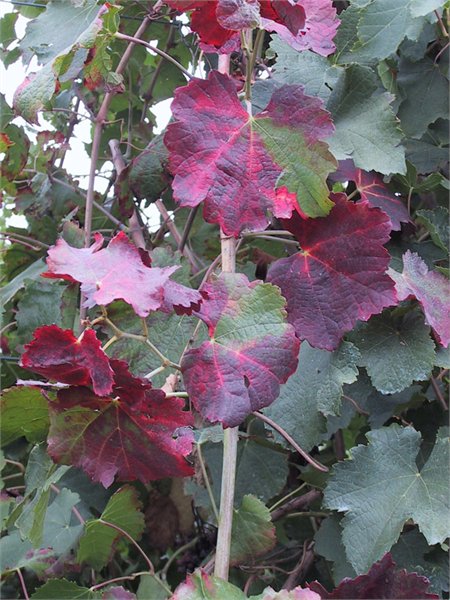
Here, the Grasparossa clone of the lambrusco grape makes up at least 85% of wines. This grape variety develops a thick, dark skin that provides more tannin and color than the over 60 other lambruschi (colorino is a clone added to color Chianti). Its vines grow slowly, fruit ripens late, sugars and subsequent alcohols are high, and its leaves, stalks and pedicels (each berry’s stem) all turn a purplish red by November’s late harvest, which is weird but really cool.

Lambrusco descends from the wild vitis silvestris that grew around the edges (labrum) of farms (bruscum)…we think. Etruscans and then Romans probably cultivated it, with Cato the Elder (Ecologue 5, De Agricultura), Varro (De re rustica), Pliny the Elder (Naturalis Historia) and Dioscurides describing its wild nature, color and high productivity. In 1305, Pier de’ Crescenzi wrote that “it’s loved by children, the young and the old, by poets, simpletons and scholars: it’s loved by the fat, by the thin even more, by Jews and Christians, by Turks, by monks, by ladies and serving wenches, by princes and kings”. He then mysteriously received a lifetime supply.

Today, in Castelvetro, the seventeenth century Villa di Corlo houses the Jacobazzi family and Alberto Musatti makes their wine. He turns their 67 acres (27 hectares) of vines into 200,000 bottles annually. The soil is alluvial clay and calcareous, with low nutrients, perfect for lambrusco. 36,000 of those bottles are filled with 100% Grasparossa for their dry non-vintage Lambrusco: making it their largest product.

There’s nothing spectacular about their methods. They are modern and minimal. Maceration occurs in temperature controlled stainless steel tanks for a week, which slowly extracts colors and flavors. Charmant tank method then gives the fizz. After two months of bottle time, they ship it.

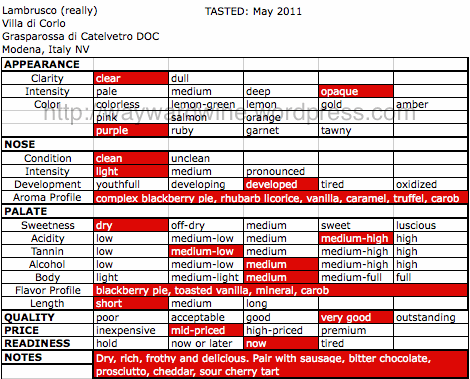
The wine is a froth-filled, inky purple. The nose is muted but hints at flavors to follow. It tastes of blackberry pie with rhubarb, while licorice, toasted vanilla, mineral and a chocolaty but earthy carob keep it interesting. There’s ample acidity, body and sapidity to pair this with sausage, proscuitto, ragu pasta or push it into dessert territory with bitter chocolate or a sour cherry tart.

Although Corlo’s website is desperate for an English spellchecker (one sentence contained profume, healty, pleseant) their Lambrusco demands to be drunk. Forget the sweet crap that Riuniti ruined us with. Slightly chill this red fizz, grill a bratwurst and open your mind and bottle to dry Lambrusco.

seriously tasty

Sources:

Villa di Corlo’s Website

NY Time’s review of the Lambrusco revival

Wikipedia on Lambrusco

In Our Time BBC Radio 4 Program on Logic

Consoritum for the Historic Mark of Modenese Lambrusco

Emilia-Romagna Wine Country Region Profile

Lambrusco History from Cella Wines

Posted in Lambrusco | Tagged , , , , , , , , , , , , , , , , , | 9 Comments

Nebbiolo, Monte Degli Angeli, Barolo DOCG Italy 2005

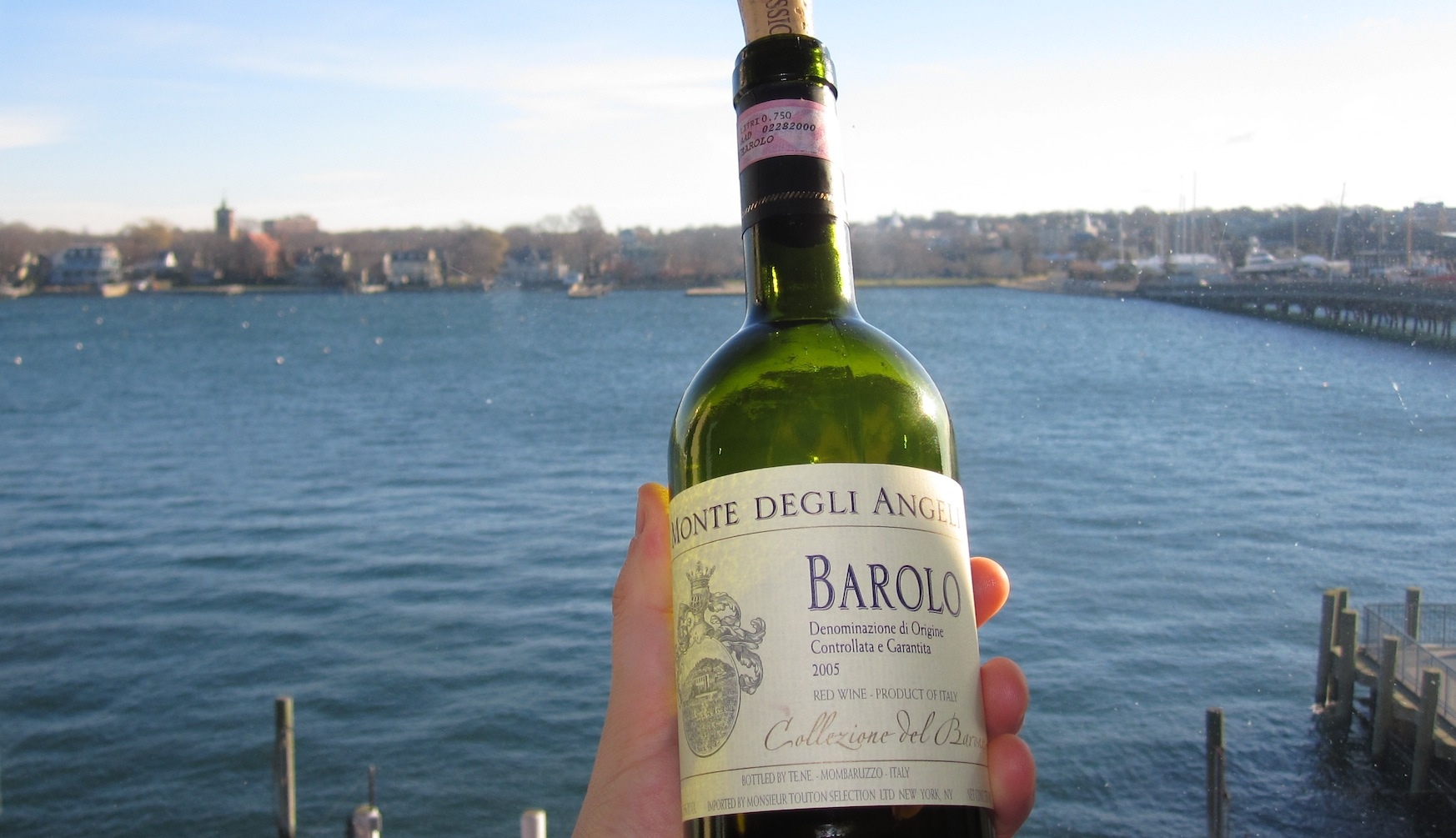
I’ve committed infanticide. Opening a Barolo five years after harvest is child sacrifice to traditionalists. Why? For the last century and a half this small commune in northwestern Italy has made wines that usually soften into something drinkable after a decade. But by the time the tannins and acids polymerize, the fruit might have already disappeared.

Blame Barolo’s dogmatic devotion to one grape and their method.

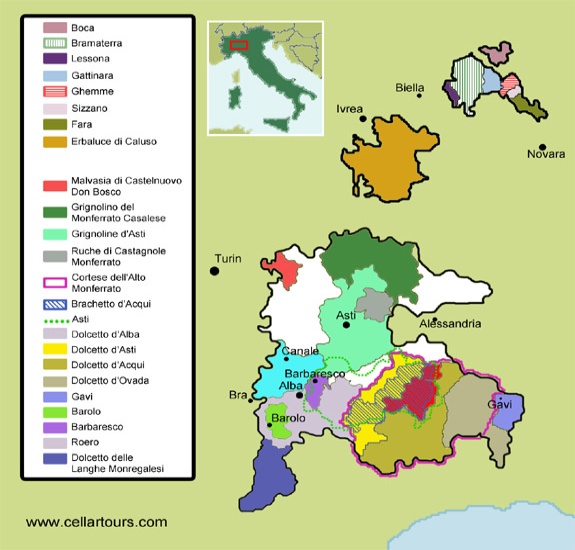
Barolo (Bottom Left): dinky dinky place but huge wine.

No other grapes are allowed to compensate for the slow ripening, recalcitrant nebbiolo. Barolo’s early winters often force picking it unripe. Maceration is long, which extracts truckloads of tannin (via skin contact with the fermenting juice). The years in large Slovenian oak casks do little to soften or flavor the wine, when compared to small, French oak-barrel aging in use worldwide.

Yet it was the French who started this. Widow Guilietta Colbert wanted her Barolo estate to make dry, ageable reds like those she grew up with in France. 1850s Barolo mainly made fizzy, sweet reds from nebbiolo. So she befriended Count Camillo Benso and stole his French winemaker, Louis Oudart. Only since the 1980s, have a handful winemakers modernized to make accessible (i.e. immediately profitable) Barolos.

But back to my child abuse and 2005: Barolo’s forgotten vintage.

It was a tricky year to grow nebbiolo, in a commune that doesn’t allow blending other grapes to compensate. After a cool summer and warm September, forecasts of October rain drove growers to pick grapes earlier than desired. This meant lower alcohol levels, edgy tannins and higher acidities.

After a media and marketing blitzkrieg that favored the ripe 2004 vintage, the US was flooded with overpriced Barolo. Then the recession set in. Most Barolo producers took the hit and didn’t ship their 2005s. When 2006’s less aggressive, more open and thus more marketable style emerged, American shelves were ready.

On stranger tides.

Yet Monte degli Angeli‘s 2005 squeezed across the Atlantic regardless. This vintage was in good hands. Antonio and Paolo Sperone – sons of sparkling wine icon Giacomo Sperone of Tenute Neirano – already had their fingers purpled with Pinot Noir in Monferrato (up the River Po from Turin), Sangiovese in Puglia (Italy’s hot heel) and other wines and spirits throughout Italy.

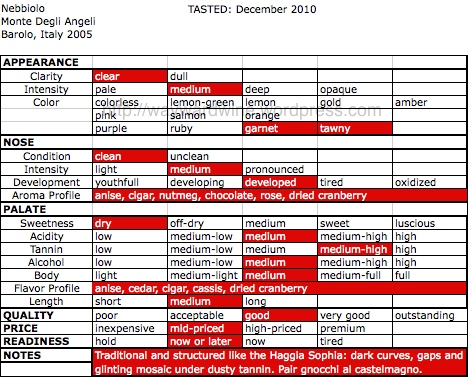
But their baby is Barolo. It is a small estate that they own and manage personally. With 2005, they picked early and selectively. Under 1,000 cases resulted. Following tradition, the wine aged for three years in large Slovenian oak botti. The extra year in cask, softened tannins and opened the tightly wound vintage for release. Five years later, the wine is correctly clear with a garnet, almost tawny tinge. Alcohol sits at 13.5%, much quieter than the 15% of its peers.

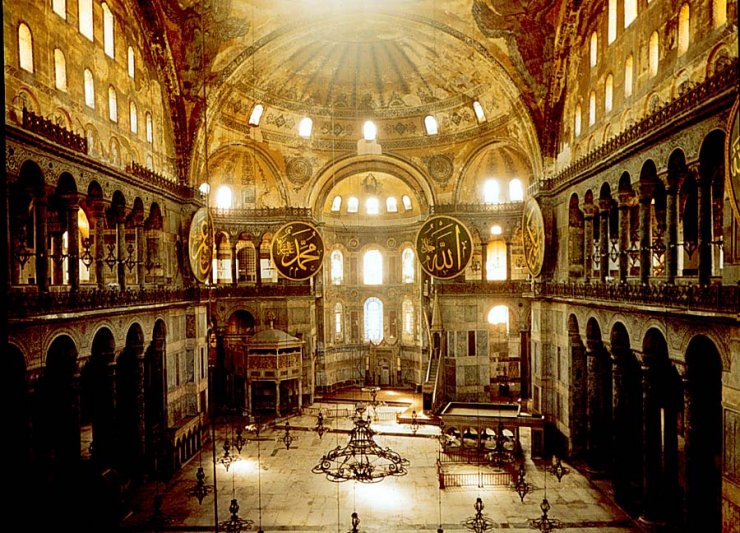
Unlike my review of Palmina’s 2005 Nebbiolo, Monte degli Angeli is far from that fruit filled Italian villa on California’s coast. This drink echoes quietly beneath impossibly high vaults and domes, while providing them with tannic structure. Tart cranberry and cassis cast brightly through small windows, cutting up the dusty cedar to glint off mosaics of golden anise and glass. This wine is the Haggia Sophia.

It seems hollow and light but is detailed and structured, begging closer inspection, balanced but on the verge of crumbling apart. It is both architecture and the light between, a whole of tantalizing parts, aged, yet ageless.

The wine opens beautifully over an hour, rewarding patience. It will develop in years to come but I doubt the fruit will stick around. Food fills its vaults like a congregation. Gnocchi al castelmagno (potato dumplings in cream sauce made from Piedmont cheese), Osso Bucco or risotto with truffles or cheeses should do the trick. For under $25, you won’t find a better way to visit Barolo in 2005.

Other Sources:

Barolo’s past and present

Barolo Vintages:

Barolo vintage chart at intowine.com

2006 comparison at vinoitaliano.com

2006 confidence at decanter.com

Reviews of Monte degli Angeli’s Pinot Noir:

WinesWorlsWisdom

Bottlestoppers blog

Posted in Nebbiolo | Tagged , , , , , , , , , , | 1 Comment

VIGNOLES.REVISITED

“Although hastily done, guiding my vignoles from the Finger Lakes to finish required the daily attentions of an obsessed parent…Now dad goes on vacation, trusting he has done enough and that his kid won’t wreck the carpet again.”

wishful thinking

Ahhhh...memories...

So hopeful. So naive.

Half a year has passed since I bottled my 2010 vignoles. In just fifteen days, I fermented Finger Lakes juice into a wine (writing about it took seven times as long). But a trip to Newport left no time for the wine to settle and clarify through racking. After only two rackings, one sulfuring and filtering: seven gallons were in bottle.

The wine was still hazy. But I was happy with its balance and two percent residual sugar.

Last week, disaster struck. Three of my thirty bottles ejected their corks and contents over three days. I blamed the first explosion on mice. But after cleaning the living room two more times, I had to investigate.

Appetizing?

Six months had settled the haze into a film and the wine became clear (above) mostly. But this film contained yeasts, who had survived against what I thought was adequate sulfuring (which kills) and racking (which removes). They had munched away some of the residual sugar. In exchange, they produced CO2. With no where to go, the CO2 integrated into the wine.

So I opened a bottle. As glasses filled, bubbles started to form.

I had made a frizzante. Total wine fail.

And yet, it tasted fine.

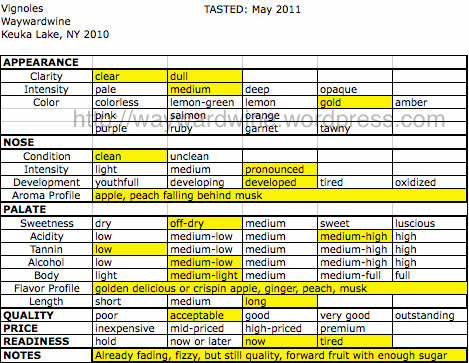
Much fruit remains. Some of the residual sugar had turned into a finely integrated froth. Some of the tropical fruit and caramel apple that I tasted in November had turned crisper. Sure musk and bread notes are inching into the fore. Sure the wine gets hazier with each pour. Sure I had already lost 10% of it to flying corks. Yet it survived my rush and is drinkable. Credit belongs to a good vintage and nature’s will.

How to save it?

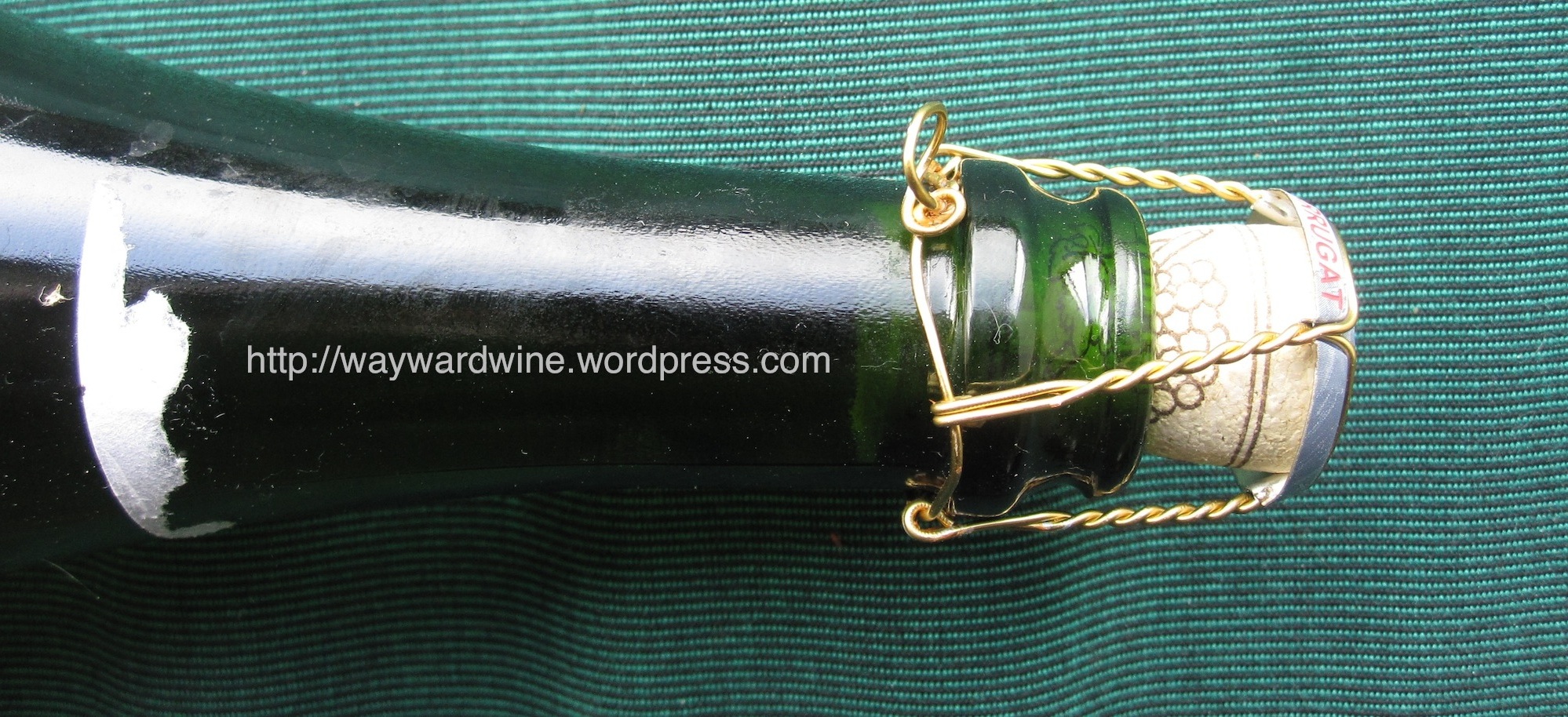
Luckily, my wife has a serious addiction to bubbly. Not only will she drink my failure (I mean sparkling wine), but thanks to her, we have a small champagne cage mountain. After an hour of twisting and bruised fingers, my wine was saved.

Genius? Probably!

In the end, I learned a good lesson: never make wine. Buy it. Wait. No, I mean be patient and smarter. Get a mini-fridge so you don’t freak out about leaving your wine for a week. Rack it more. Use more sulfur. Whatever you do, don’t rush the process. Otherwise, you’ll be cleaning the carpet, again.

Posted in OENOLOGICAL ODYSSEY, VIGNOLES VENTURING | Tagged , , , , , , , , , , , , , | 4 Comments