Cesanese del Piglio “Colle Ticchio” Corte dei Papi 2008

If you drive southeast of Rome on the A1, the hills fold, one upon the next, building into the Apennine Mountains. Along the way, Anagni, a medieval town, hangs on a ridge, encrusted with Roman stone walls and cinder-block apartments.

Below Anagni sits the vineyards of the Azienda Agricola Colletonno (Colletonno Agricultural Estate). Colletonno is serious about history. They titled today’s brand Corti dei Papi (Court of the Popes) in honor of Anagni’s past as birthplace and getaway for four popes during the 14th century (until Philip, King of France, moved everyone to Avignon). Today’s wine label bears a frescoed Romanesque/Byzantine vault, cropped into a pope’s miter, from the 13th century crypt (above) in Anagni’s main Cathedral.

Testamenting to books Old and New

Three vineyard-covered hills surround the Colletonno (literally “hill circled”) estate. The wine Colle Ticchio is named for the hill from which its grapes grow. Ticchio hill is 1,200 feet above sea level and consists of clay. Its elevation and soil lend the wine structure and complexity.

In blue on your center right: Cesanese DOCG

Although most wine in the region of Lazio (mapped) has become white (95%), Colletonno lives in the past. They make one of the few reds left to Lazio: cesanese (chay seh nay say). Today’s wine consists equally of two disappearing clonal types of cesanese: di Affile and Comune. Also feigning time-travel, Colletonno took old facilities and refurbished them to look old but work like new.

But don’t call Colletonno backward.

Their winemaker is Lorenzo Landi. Computerized stainless steel tanks control all cellar work. The tanks keep grapes fermenting at 75F. Mechanized pumps macerate juice with skins for 10 to 15 days: extracting gobs of dark color, tannin and flavor. Then, in new temperature-controlled tanks, malolactic fermentation kicks in and softens acidities. Finally, stainless steel vats and large oak barrels age the wine for 5 months.

All this tech lends winemaker Landi an exacting control. It ensures that cesanese speaks like cesanese, but in a modern tongue. Sure, the wine tastes of earth and plum but its modernity lies in its cleanliness, in its the moderated tannins, acidity, body: as you can see in my nifty chart below:
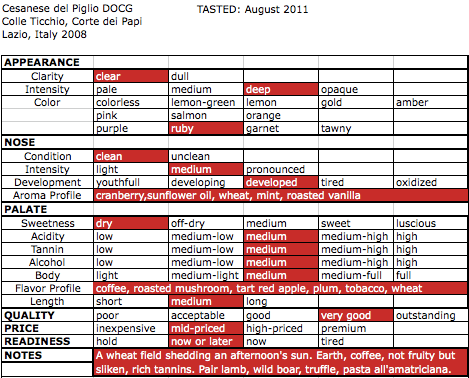
Like the town of Anagni, Colle Ticchio looks to the past. It presents an ancient, disappearing grape, rich with earth, roasted mushroom, and warm fields of wheat. For a moment, you think that you’re in Ridley Scott’s Gladiator: running your hands through your harvest, wearing Roman armor everywhere, and being at one with your land.

anochristically delicious

Yet, as hard as Russel Crowe furrows his brow or fakes a British accent, he’ll never learn Latin nor realize Emperor Commodus didn’t die in the Colosseum. Equally, all the restored walls, churches, and frescoes of Anagni won’t hide its apartments, asphalt, and supermarkets.

Anagni: bipolar present and past

Neither will Colle Ticchio resurrect the past. It’s too clean, balanced, and well, surprisingly good to do that. Instead, we should shed the fantasy.

This is a great wine, that while trying to fabricate antiquity, ended up creating something that matters now. Its flavors of wheat and earth overlay plum and tart red fruit, all of which sing alongside spaghetti alla ciociara, mole sauce cheese enchiladas, or anything with a bit of herb, black pepper, lamb or anything delicious with dark or salty flavors, especially at under $15.

SOURCES

Vias Wine Product Summary

Belvino

wine-searcher.com background on cesanese varietals

dedalus wine review of Colle Ticchio

The Compasionate Hedonist’s visit to Anagni

Posted in Cesanese | Tagged , , , , , , , , , , , , , , , , , , , , , , | 4 Comments

Baco Noir, Henry of Pelham Family Estate, Ontario Canada VQA 2009

A week into my Quebec vacation and I’ve yet to imbibe anything Canadian. The government owned wine-opoly SAQ, as reviewed last week, leaves few reasonably priced options beyond Southern France. So that’s all I’ve bought.

Sure a Côtes du Rhône and our attempt at poutine go fine together…

French fries, cheese curds, gravy, côtes du rhône and a heart attack makes dinner.

But for those of you south of the (Canadian) border, they make more than maple syrup and beavers.

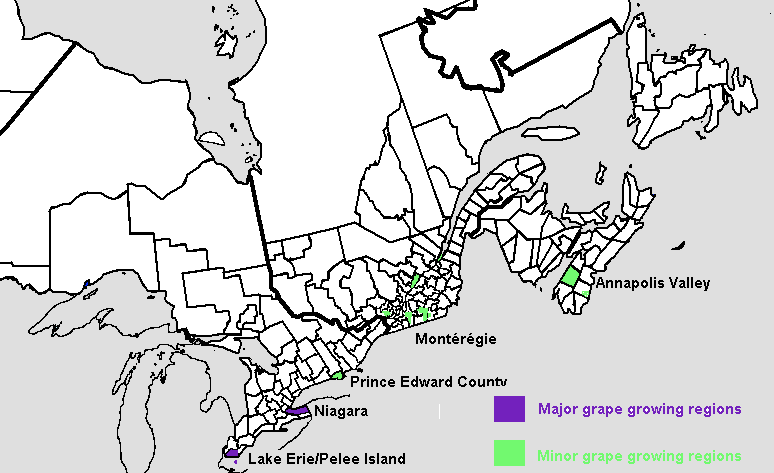
Places such as British Columbia on the West Coast and Ontario on the edges of the Great Lakes (pictured below) squeeze out just enough sunny, warm days to ripen grapes.

Deep waterways are a grape's last reprieve this excessively far north.

As in New York’s Finger Lakes, credit goes to the lake effect (heat reservoir, humidity and convection) for making grape-growing possible. If you’ve tried Canadian ice wine -that laborious and costly but delicious late harvest dessert- then awesome. But Canada makes respectable reds and whites for everyday consumption.

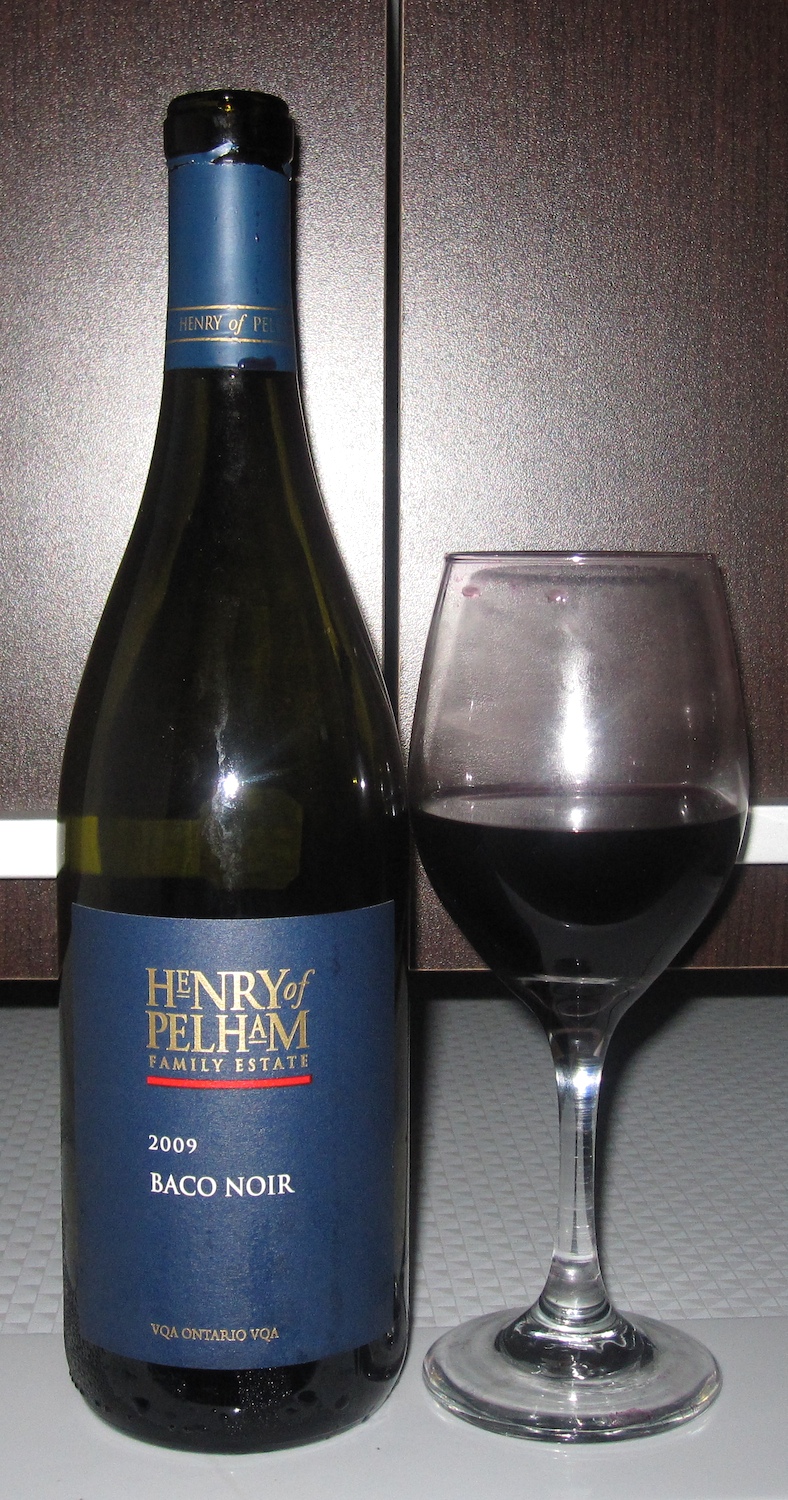
Henry of Pelham’s 2009 Baco Noir jumped at me, so I caught and bought it for $15.

Don't let the conservative lable fool you.

Henry of Pelham Family Estate Winery sits on the Niagara Escarpment along the sun-facing slope of Lake Ontario. They pulled Niagara and Concord grapes (known more for jelly than wine) back in the 80s and planted wine-ready vinifera classics like chardonnay, riesling and pinot noir and crossings like baco noir.

Baco noir began as a crossing a century ago by french-person, Francois Baco (no relation to Bac-o Bits). He created a vine more resilient to rot, mildew, phyloxera, and cold from an unknown American with the grape hiding behind Cognac and Armagnac fame: folle blanche. Since the 1950s, baco noir is grown from coast to coast across the north of Northern America.

But what about Pelham’s 2009?

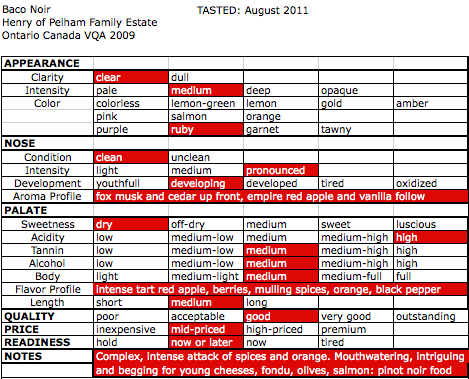
The chart below catches the basics of this extreme, northern red.

Once open, this wine doesn’t shut up. Like a teenager with ADD who hasn’t showered, Pelham’s baco is equal parts funk, fruit and nervous energy. It is dirty, spicy, yet edgy with high acid. The flavors are all over the place: with mulling spices, orange, red apple, and black pepper.

Against patient parenting with oak barrels, Canada’s cold climate gives the grapes here their acidity and spice.

Since I can’t disown it, I learn to like this problem child. The acid attack demands attention and cheese. Cheddar curds and olives curb it, but a fondu or Burgundy-friendly food (e.g. salmon) would sing it into submission.

I may not wake up Canadian…

But I understand it better.

Like New York’s Finger Lakes, this is as far north as grapes will grow. You won’t get the heavy, matronly, ripe fruit bombs of hotter places. Instead, rebellious youth and intensity will slash your tires, get an Anarchist tattoo, and challenge any food you throw at it.

SOURCES

Henry of Pelham Family Estate Winery

Posted in Baco Noir | Tagged , , , , , , , , , , , , , | 1 Comment

SAQ: When Government and Wine are One

Dear reader or two, please accept my apologies for the hiatus. But fret not, for my vacation to Quebec City was fruitful, or at least wine-filled.

Try to contain your excitement.

Immediately upon arrival, I popped into the Metro Plus grocery store. Past the beer, blueberries, beer, poutine mix, beer and maple syrups stood a rack of twenty or so wines. No bottle cost more than fifteen bucks. Reasonable enough. Most were European. Fine. Five were “Canadian”? Ah well. Fewer had a vintage. Ugh. One or two had a region appellation. Crap.

I caved. The 2008 Blaye Bordeaux from Laland Bellevue would have to do. At least I knew where, when, and what went into the bottle. The next day I bought the non-vintage Côtes du Rhône (no vintage and cheap usually translates into a winery or company’s entry-level, bulk wine). Both were drinkable but little else. (It turns out that grocery stores can only carry wines bottled in Quebec: limiting range and quality).

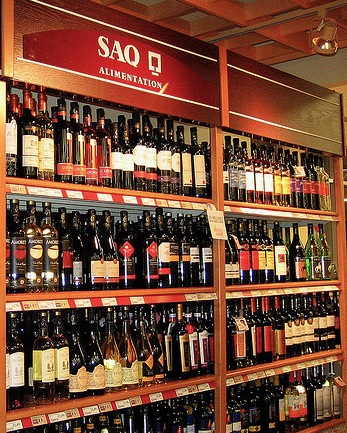
Experiment over, I gave in and went to SAQ. This inelegant acronym stands for the Société des Alcools du Québec.

Spawned from Canada’s dalliance with prohibition in 1919, Quebec enforced temperance instead by taking over all alcohol importations, distributions, and sales. Being very French Catholic, a customer ordered bagged, unlabeled wine hidden behind a confessional-esque screen one bottle at a time. The following decades peeled away these restrictions, and today SAQ allows customers 18 and over to shop like real, normal people.

As with healthcare and electricity, SAQ is a state run corporation. Quebec’s Minister of Finance holds all its shares. The government picks directors. SAQ’s select club of distributors send professional tasters to find wines for exclusive import. SAQ bottles and labels some of them, while world renown brands fill out the rest.

"aromatic and robust"

You can find many wines that don’t make it into US. Quality and price ranges are reliably consistent (few critter wines or plonk). Staff members know their stuff. Stores are clean, organized by region, and wines carry descriptive tags and color-coded circles that oversimplify flavor and style groups (e.g. fruity and rich). Tastings, classes and consultations happen frequently.

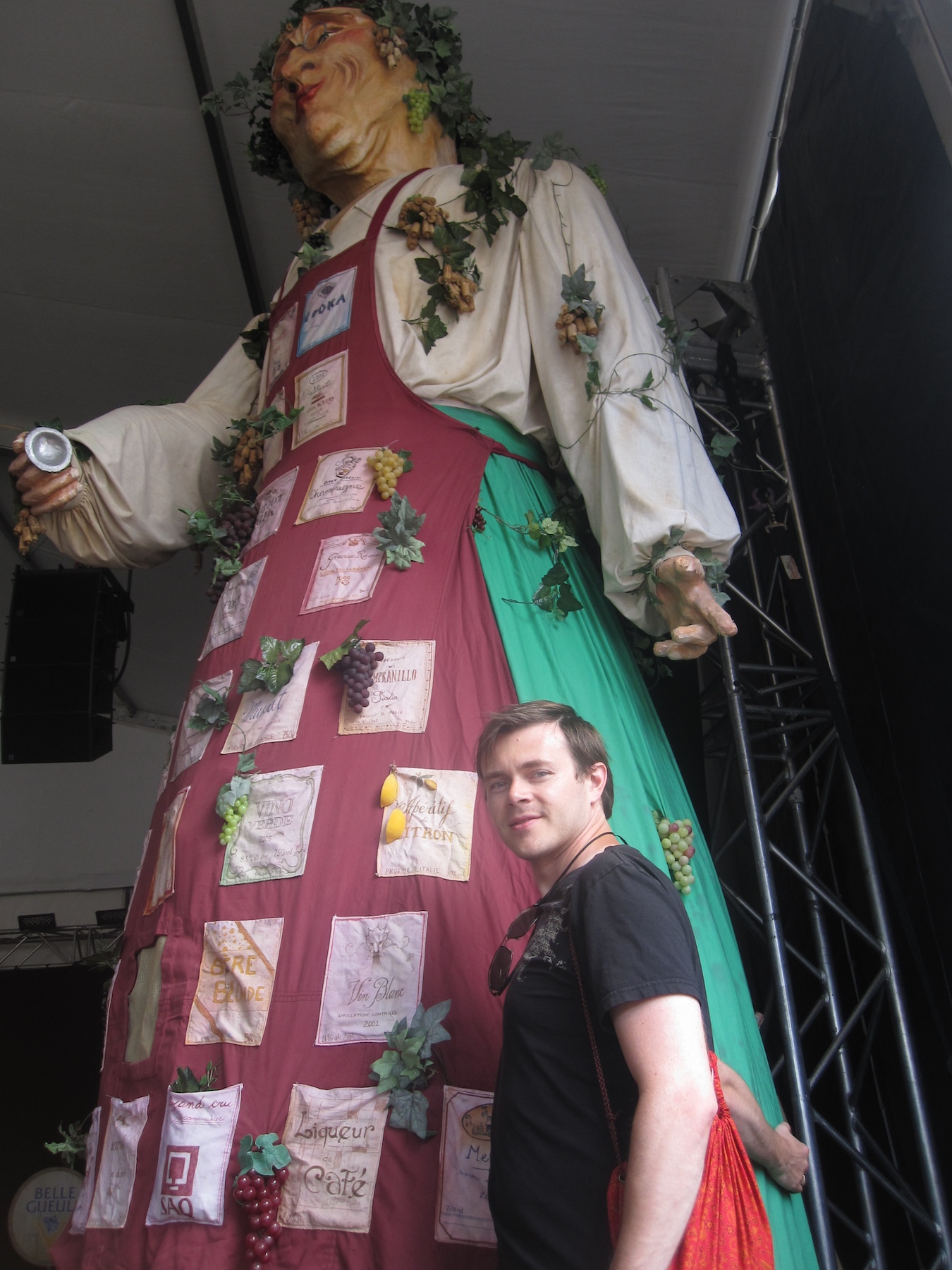
With a monopoly on wine, SAQ keeps face by sponsoring events for free throughout the year. Booze-fueled geek fests and performances, such as the SAQ New France Festival, which I gleefully attended (below), redefined how history and alcohol go together.

Quebec's tax dollars at work.

There is one problem: selection.

Nearly all wines in grocery stores, restaurants, and shops must be from SAQ. From one store to the next, the stock varies slightly. But it gets redundant. To create a false sense of variety, you can go to a SAQ Dépôt, Express, Classique, Sélection or Signature. They are like snowflakes, but more classist: similar but not exactly the same.

There's no wine after dark at the St. Jean street SAQ Classique.

Poor regions and strip malls get the Express. The SAQ Classiques I found on Rue Cartier and St. Jean had wider selections, tastings, and better dressed people in them. Fancy shelves, expensive bottles, and conscious staff were discovered at the SAQ Sélection on Boulevard Jean Lesage. The SAQ Signature in the Fairmont Hotel was a veritable crystal palace of wine, with 70 dollar ice wine free to taste, a winemaker lecturing, rare local wines and a full gamut of prices, styles and regions. Nevertheless, every store sells the same core wines.

SAQ’s prices are reasonable but feel fake. Like pretend capitalism, SAQ charges according to customer willingness. But it’s in a void. There’s no competition to lower prices. The SAQ down the street will cheapen its Beaujolais when people stop buying. The 13.5% tax further inflates the price.

But enough economics. Back to drinking.

I stuck with France. SAQ’s strength clearly lies with France, at any price (probably due to racism…I mean customer loyalty to Quebec’s mother country). Other wine regions are well represented but cost more than in the states.

Is that smoked pine?

At $14.10, Georges Vigouroux’s 2007 malbec from Cahors showed off solid body, an intense nasal attack of mint, pine and black raspberry, and a rich palate of spice, kirsch and black cherry. No complaints. Gourgazaud’s 13 buck Minervois (right) -made mostly of carignan grapes- was equally acceptable: with uniform acidity, tannin, body and length, and darker flavors of licorice, truffle, cola, pepper and black cherry. Botter’s Extra Dry Prosecco was a nice break from all the reds, but cooed and patronized with too much sweetness, dead acidity, and flagging fizz.

Quebec leads Canada in wine consumption. Since SAQ controls nearly all alcohol sales, they have super statistics. In a year, your average Quebec-er drinks half the wine a Frenchman does, not shabby, but more than twice your average, American Joe-sephine. 21.4 liters: that’s over two bottles a month, for each of-age palate. What shocks me is that with the isles and isles of beer, 77.9% of store bought alcohol is wine. At restaurants and bars, all you see are pints of beer. But wine clearly dominates kitchen tables.

Somehow, Quebec nearly pulls off the trick of making communism taste like capitalism. Their monopoly on wine seems diversified enough to meet the demands of its still very French population. SAQ educates its customers and elucidates the buying process. And yet, it’s a false freedom. Their selection is amazing for one company but redundancy creeps in. Prices inch higher than in the states. And taxes remind you to attend the next free, state/SAQ-sponsored performance.

Me and SAQ's wine giant for the New France Festival Parade.

But I can’t leave Quebec without drinking Canadian. Tune in next week.

SOURCES:

SAQ’s official history

Georges Vigouroux website

Château de Gourgazaud website

US and French Wine Consumption

SAQ’s 2009-2010 Annual Report.pdf

Posted in WINERIES WANDERED | Tagged , , , , , , , , , , , , , , , , , , , , , , , , , , | 4 Comments

Chenin Blanc “Triple Zéro” Jacky Blot, Domaine de la Taille aux Loups, Montlouis, Loire NV

I’ve wrestled with sugar before. No, not in that way. Grow up. I’ve introduced a dry Lambrusco, a dry rosé, a few dessert wines and fought to keep yeasts converting sugar with my own wines.

This week, a wine that redefines dryness: Triple Zéro from Domaine de la Taille aux Loups.

RAISING THE BAR

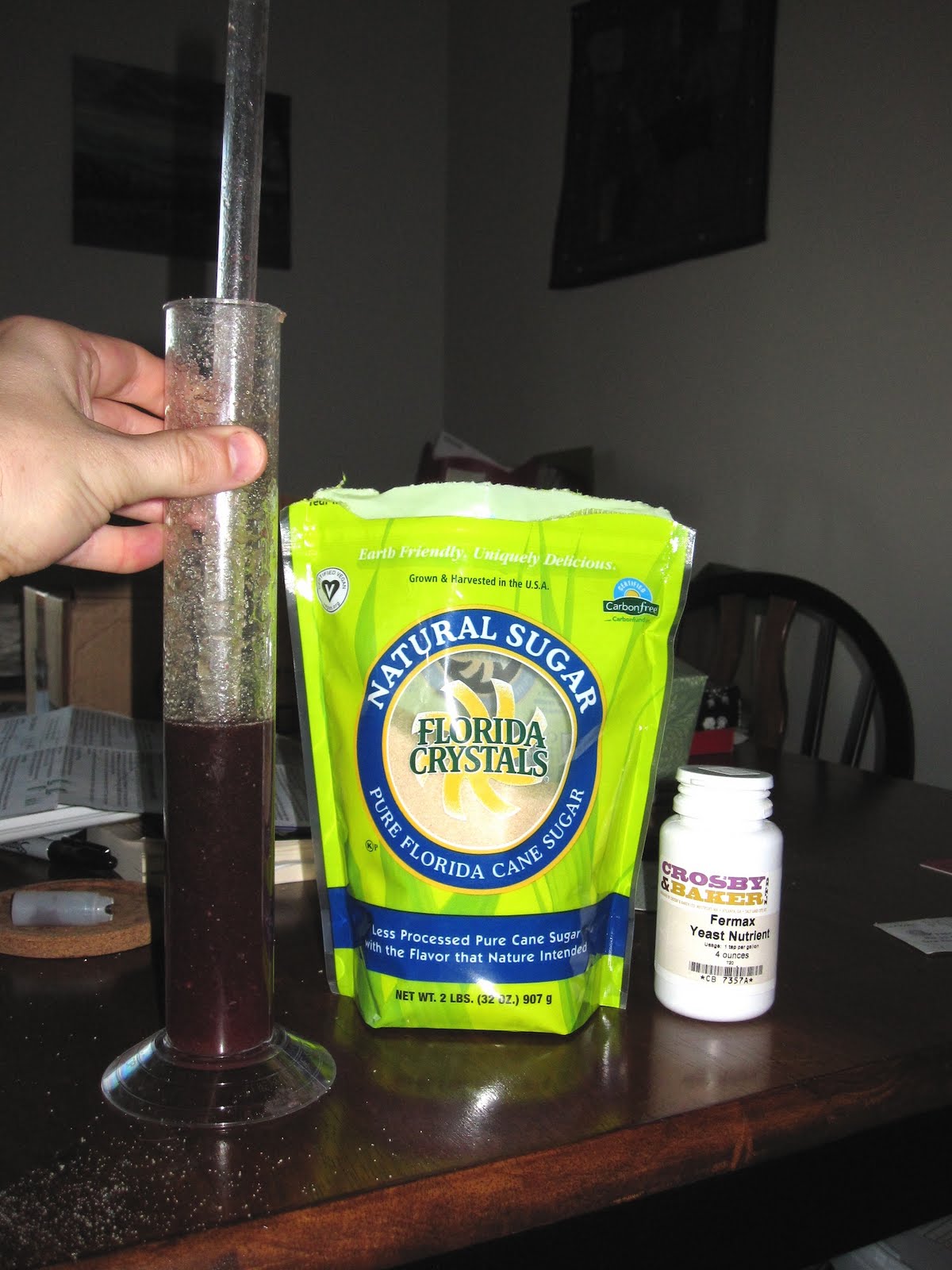
With my blueberry wine, I panicked. My yeasts were slowing and alcohol was low. I didn’t want blueberry beer. So I tried upping the alcohol by dumping raw sugar in

It's like natural alcohol in a bag...only cheating.

Sure, it worked, but I felt cheap. My wine will never taste of only the fruit I picked. Its artificially heightened alcohol mirrors my assumptions about what wine should be.

Yet this method happens all the time. It’s called chaptalization, after the French chemist Jean-Antoine Chaptal. He didn’t invent it, the Romans did. But Chaptal lucked out under Napoleon, gaining prestige enough to promote it, to make French wine stronger and thus more shelf stable.

Winemakers in cold climates with low ripeness loved it. Germans titled the process vebesserung, improvement, because crap seasons in the 1840s would have otherwise rendered their rieslings little more than water. But chaptalizing also meant that volume could be stretched by adding more water and sugar.

It took 900,000 protesters, the French army, six deaths and the burning of two prefectures in 1907, for the French to finally tax sugar and regulate chaptalization by region. Today, the EU limits chaptalizing according to Europe’s three main growing zones (the coldest get to tweak alcohol up 3% by volume, warm: 2%, warmer: 1.5%, warmest: zip%; with 0.5% ABV wiggle room for poor seasons).

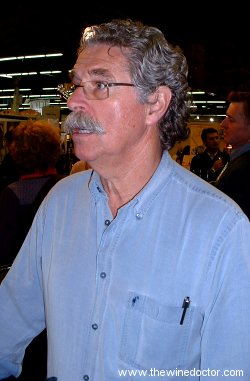
Is it the winemaker? Or the mustache?

But Jacky Blot doesn’t care.

In the Loire Valley, he could raise his wine two percent alcohol by volume. Yet he chooses not to. Instead, he waits. Late into the season, small teams hand-pick only ripe berries and toss rotten ones from each bunch, letting the rest ripen further. These first fruits are then sorted for Blot’s bubbly, Triple Zéro.

The ripe grapes have enough sugar so there’s no need to chaptalize, hence the first Zéro. Actually, at no point is there anything more than grapes and wild yeasts in Domaine de la Taille aux Loups’ old barrels or bottles.

Once alcoholic, a bubbly still isn’t bubbly. It is only a still wine or vin clair. The sparkly usually comes from the addition of yeast, sugary syrup (liquer de tirage) and no gap for CO2 to escape.

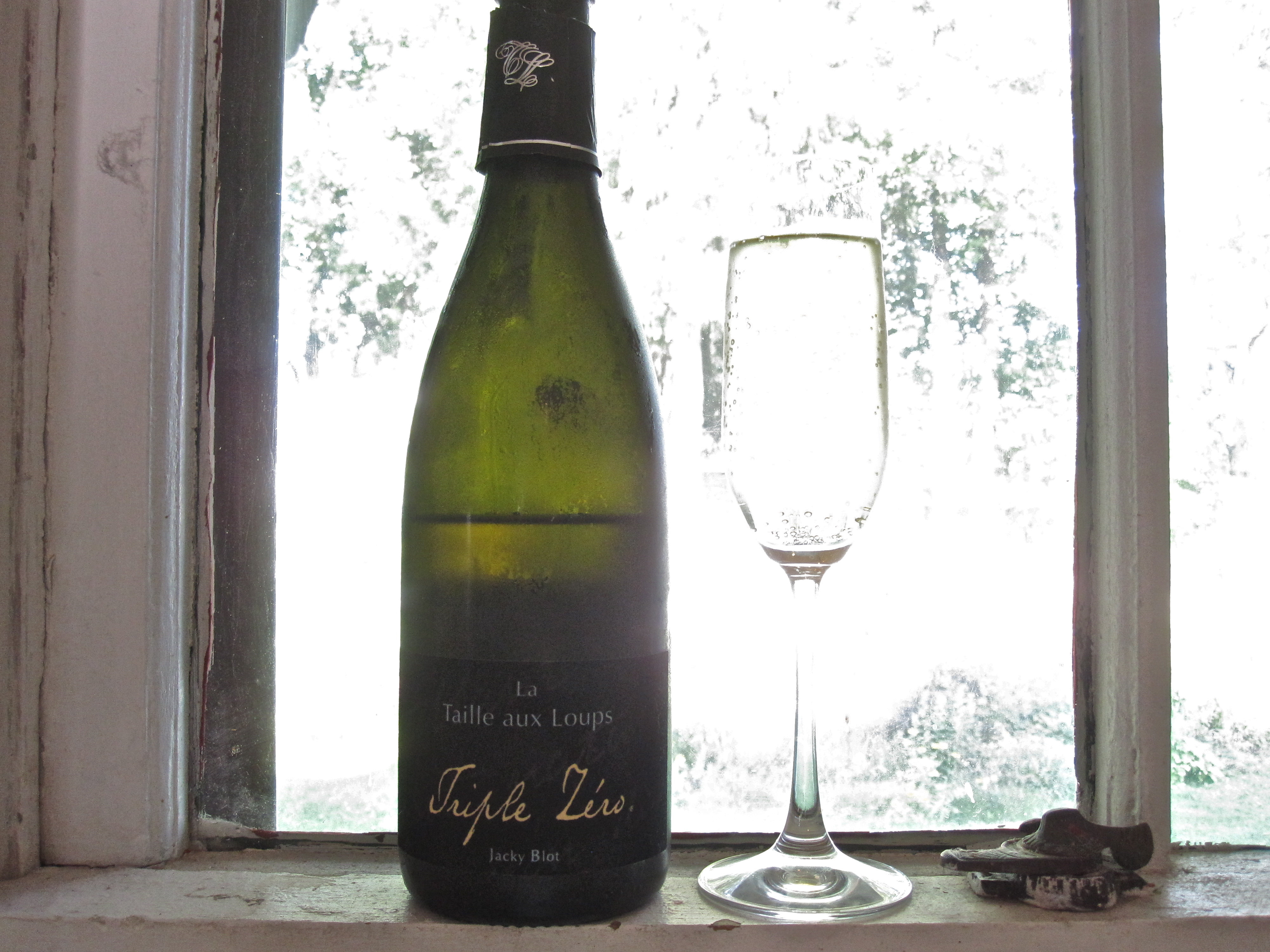
Disgorging the yeast popsicle: better than banana-flavored.

Triple gets its second Zéro from not sugaring to feed the yeast. Following the méthode ancestrale, Triple Zéro is bottled near the end of fermentation, with fourteen grams of sugar left. Blot waits fifteen months for that sugar to convert into CO2 in each bottle. The fizz isn’t hyper-vigorous, but more relaxed and constant, petillant, manifesting a mere 2.5 units of atmospheric pressure (half of most champagne).

Before most bubbly is bottled, winemakers often disgorge the yeast. In time, the yeast settles into the bottle’s neck. The neck is frozen. The cap is removed. Out flies a yeast popsicle. Then, sugary juice (liqueur d’expédition: a blend of wine, sugar, juice, sulphur even cognac) tops off the wine before recorking. Why? Bubbly is usually highly acidic. This minor sugaring can balance it or hide faults. But Blot flips le bras d’honneur to such dosage and just adds more wine and corks the thing after disgorging the yeast.

So if adding sugar is the antichrist, what actually goes into Triple Zéro?

The grapes are entirely chenin blanc. They flank the town of Tours in the Montlouis sector along the Loire Valley: chenin blanc’s homeland.

Montlouis: small, green, just East of Tours and West of my heart 😉

In 1988, thirty-year-old vineyards were bought and revitalized by Christian Prudhomme: viticulturist and oenologist for no-name wines like Mouton-Rothschild and Opus One. But his business failed in a few years. Jacky Blot took over and gave the vines endless attention. Pruning, low crop yields, and ploughing, forced roots into substrata of limestone, drawing minerality into the wine.

VINTAGE -VS- VINTAGE

Because fermenting without added sugar or lab yeasts takes longer, Triple Zéro hits the market two years after vintage. Even though Zéro has no vintage on the label, I likely tried the 2008 last June.

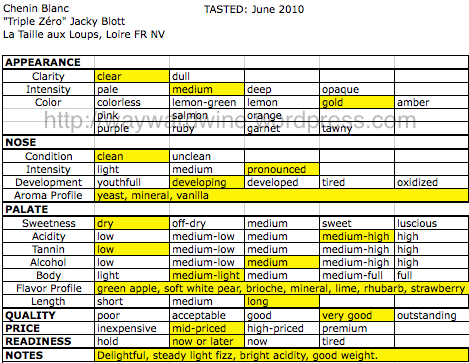
It was visually clear, steely gold. The nose intense with yeast, mineral, vanilla. Dry. The acidity was moderately high, typical of Loire chenin blanc. The body was medium light. The palate carried green apple, soft white pear, brioche, mineral, lime, while strawberry and rhubarb squeaked in. Great drink, fresh, focused yet complex.

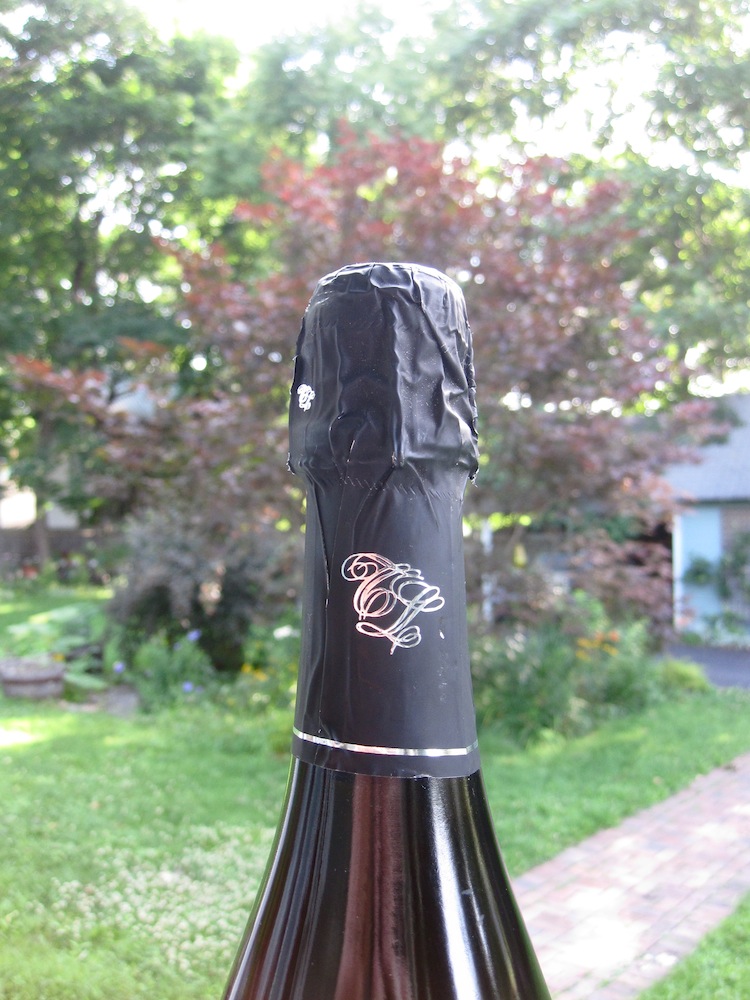
The old 2008 cap.

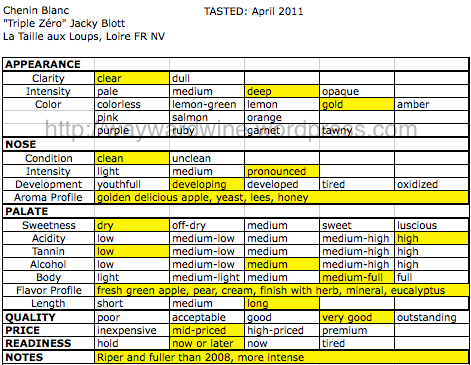
But then a new shipment arrived. The 2009’s foil was shorter but taped with a silver band (the 2008’s probably fell off). The code on the bottle was D061068. Curiosity made me crack it open in April.The acidity rang higher. The body weighed in fuller, richer. The nose of apple, honey and yeast was familiar. Apple and pear were still on the palate. But herb, mineral and eucalyptus wrapped up the finish.

It sounds new, but so am I. I’ve tried more wines since last year. I’ve read more. My palate may be the same. But my mind doesn’t taste things the same. The context changed as well. Hell, the bottle might be warmer. Even within the same vintage and lot, bottles vary. Was it from the bottom of the tank? Filled on a cold day? Shipped improperly? I don’t know.

Objectivity is impossible. The most we can hope for is some consistency and specificity. We should admit that both we and the wine evolve. No score is universal or eternal. Does the first wine Robert Parker rated still taste amazing? Will Wine Spectator’s Top 100 all be worthy, drinkable or taste the same by the end of the year?

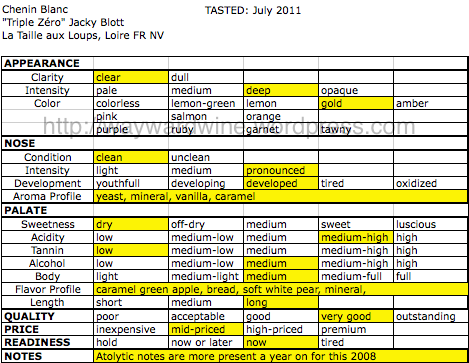
Now it’s July. I found the last bottle of the 2008 (F0806 14214) hiding in our understock. A year on, the appearance recalls the clear straw gold. But the green apple now also smells of caramel. All the acidity, medium body, length and steady fizz persist. Yet the wine tastes mature. Apple, even apple skin now face more noticeable yeast, caramel and bread notes.Maybe I set myself up. I know this wine is older, so of course I taste mature notes of caramel and yeast. Knowing these wines are chenin blanc from the Loire immediately cued anticipation for citrus, green apple and acidity before. So much of it is in my head.

But enough psychobabble. Triple Zéro tastes amazing. Between the three tastings, it is refreshing, complex and unforgettable. Jacky Blot’s method-maniacal scrutiny and fanaticism with dryness come straight to the glass. The fruit is stellar. Drink it alone (or with friends). If you can’t get comfortable with the acidity after a glass (and I mean glass, not sip), then pair it with fresh fruits, mild young cheeses or any foods you want a beer with. It will cool your world back down.

SOURCES:

1907 Languedoc-Roussillon Chaptalizing Revolt

Jacky Blot.fr

The Wine Doctor

winesparkle.com on méthod champenois

Action shots of disgorgement

Posted in Chenin Blanc | Tagged , , , , , , , , , , , , , , , , , , , , , , , | 1 Comment

Chardonnay, Hamilton Russell, Walker Bay, South Africa 2008

Chardonnay still brings this to most minds:

Butter. Cloying, yellow richness in a glass. But is it the grape’s fault?

Once alcoholic fermentation is finished, winemakers can add lactic acid bacteria (e.g. Oenococcus oeni, and Lactobacillus and Pediococcus species) to wine. Tart malic acid (think apples) converts into softer lactic acid (think milk). Winemakers employ this malolactic fermentation to soften reds and whites. Yet byproducts ensue.

Diacetyl is one leftover of malolactic fermentation (headache-inducing hystamines are

why?

another: see my article). You may not realize it, but diacetyl is already a familiar friend. Margarine, popcorn and the worst-jelly-beans-known-to-humanity would taste bland without the chemical. Chardonnay also tastes fairly neutral alone. It tends toward green fruits and citrus in cool climates, white melon in moderate climates, and pineapple in the warmer. Because it can grow in most wine regions, it has a prestigious Burgundian past, idiots can pronounce it, and it is malleable to blending and oak aging, chardonnay became the world’s second most planted grape (behind Spain’s airén).

Branded as buttery, chardonnay rose in popularity with the 1980s, replaced other vines throughout Australia, California and South America, and fell with Bridget Jones wallowing her misery in a big glass of yellow.

Born into this trend, I also grew tired of drinking butter. But we only had ourselves (and wine-critics) to blame. We bought the butter; and wine makers made more. Now, producers heed our turn to pinot grigio and sauvignon blanc, cutting oak and malolactic to varying degrees. This has spawned a panoply of relabeled chards: “unoaked“, “oak free“, “sans oak”, “virgin chardonnay”, “naked chardonnay”, “acero”, “inox”, “un-barrel fermented” et cetera. Brands are desperate to win us back and save acres of vine investments.

Hamilton Russell Vineyards ignores fickle fashion.

Since 1975, Tim Russell -followed in 1991 by son Anthony-aims only to perfect South Africa’s coldest site: Walker Bay.

The red bit is Walker Bay.

Their vines grow in a valley behind the old fishing village of Hermanus. The maritime summer rains slow ripening: ideal for chardonnay. It gains undeniable acidity and avoids flabbiness. The soil is stony, Bokkeveld shale, with clay, from which old, low yielding vines extract strata after strata of minerality: akin to a Burgundy from Meursault.

Since Anthony took over in ’91, there have been no reserve or entry-level lines to corner differing demographics. He also narrowed the brand to one chardonnay and one pinot noir. Why? Place and time. Through research, replanting, hand-havesting and other obsessive attentions (even barrels and bottles are local), each vintage tastes only of what its 52 hectares provide and what the weather allows for.

With 2005’s growth, Hannes Storm has made their wine. His 2008 chardonnay shows skill.

Pairs well with rocks?

Anthony once said, “If you cut corners on your barrels, you will ultimately diminish the quality of the wine.” Well, this chardonnay bows before the altar of oak. There is little malolactic and even less butter to be found. Instead, toasted almond and burnt vanilla take you into the woods.

Burgundy was inspiration for the barrel. But here, Hamilton Russell’s chard tastes distinct: diametric edges of precise lemon, lime and asparagus cut against smoke, mineral and toasted nut. Golden delicious apple fills the core.

The length is endless and saliva inducing. It begs for food. Roquefort cheese, fried tofu in hoisin sauce, grilled, even smoked salmon or duck would all mesh meaningfully with this wine.

Best thirty bucks I’ve spent in a while.

SOURCES:

Unoaked Chardonnay.com (…seriously?)

Blogger visit to HR

Hamilton Russell’s website via: South African Wine.co.za

Posted in EMPTIED BOTTLES, White | Tagged , , , , , , , , , , , , , , , , | 1 Comment