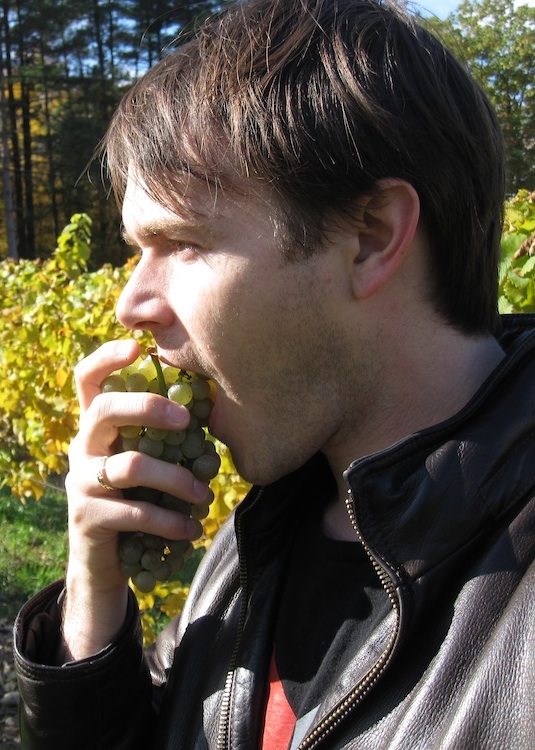
piNOT NOir, saratoga winery, LODI, NY 2009

No. No. No. No. No. No. No. No. No. No. No. No. No. No. No.

No. No. No. No. No. No. No. No. No. No. No. No. No. No.

No.

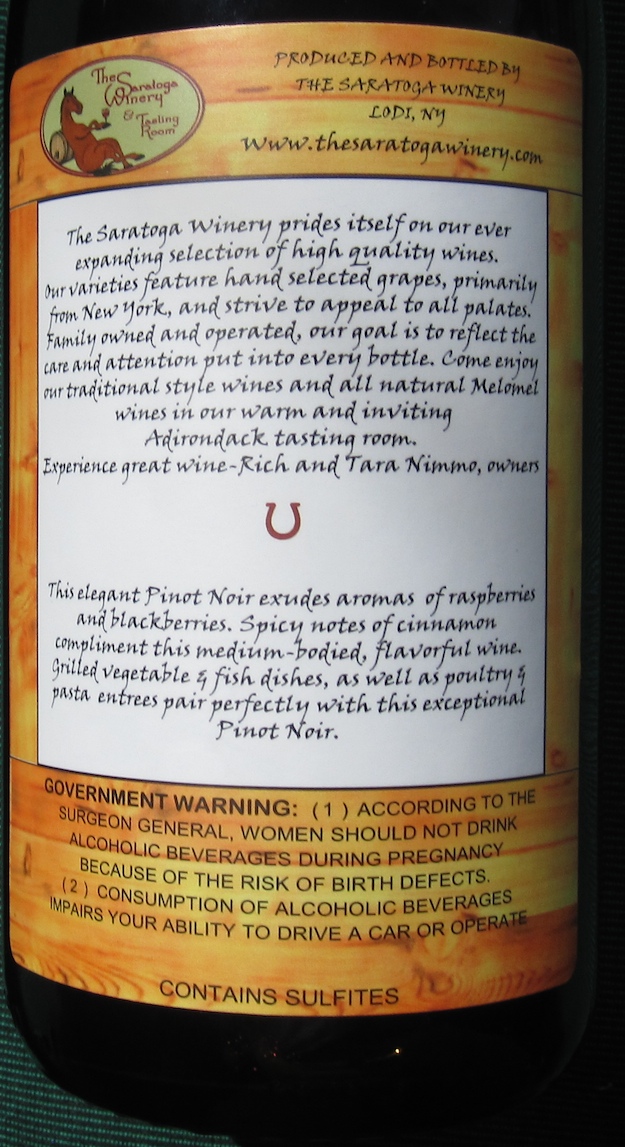
This is just wrong. A bottle of bestiality parading a pinot in order to pander to the puerile, lowest, and least in all of us. It’s not funny, not clever, and poorly printed.

I’m not reviewing the wine (the cartoon horse’s cigar must taste better).

But these concerns are secondary, superficial.

Flip the bottle. Ignore the rambling, adjective-burdened back (if you can even read that font).

Remember, this is The Saratoga Winery. It sells itself on being local. The horse honors (?) Saratoga’s rich racing history.

Tourists love local stuff like moths love flames and my sweaters. People feel that they can ground their touristic experience by supporting native producers. Their souvenir bottle with a horse on it will transport them back through space and time, to that mystical vacation, where they bet on horses, toured homes, tasted historic springs, and went to a barn with a tasting table and pizza oven.

It felt patriotic. It felt hedonistic, escapist, even elitist. It felt good for the environment, like recycling a Prius.

But it is all a lie.

And I don’t like being lied to

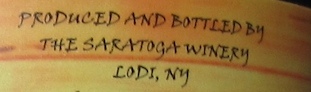
Look at the top of label…no, ignore the offensive logo of a drunken horse…look to your right of that atrocity…

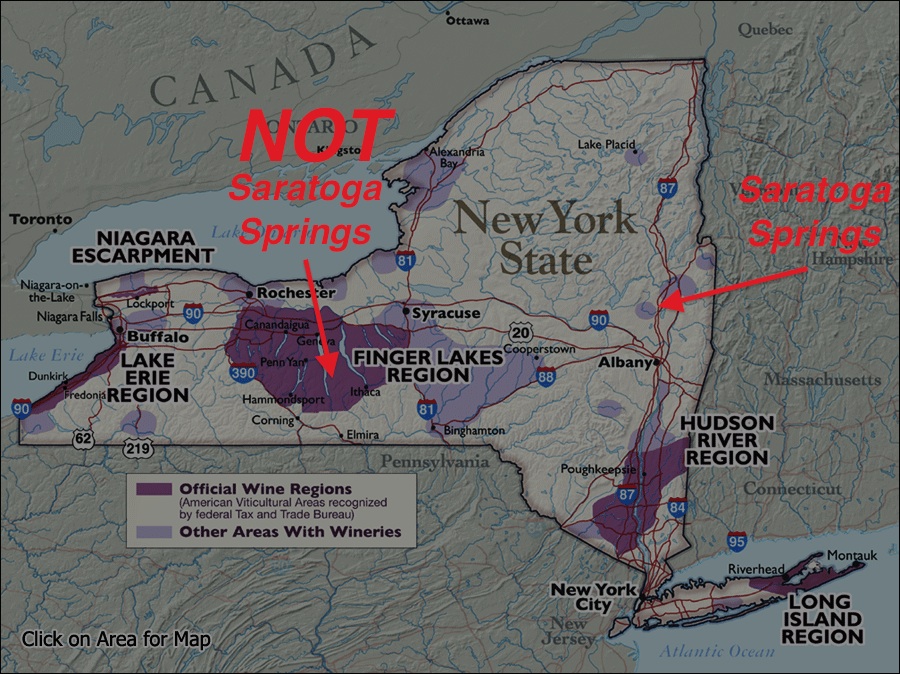
Now, I’m no genius, but I know how to use a map, and last time I checked, Lodi is not Saratoga Springs.

So this “local” winery bought grapes and made (or had someone make) their entire wine and bottle it 200 miles away. I at least made mine at home. Hell, buying Canadian beer would be more native.

Yet most wineries play this game. Names and labels are calculated to tap into our attachment to places. They foster our assumptions. But most winemakers import grapes from all over their state, even other countries.

We might even question whether the concept of homespun wine is real, since wine culture is an European import. Pinot Noir came from Europe and requires grafting onto other rootstock and endless chemical treatment to survive out here. While today’s styles have homogenized into “international” or “modern” forms.

Maybe, I’m giving some local highschooler a job in the tasting barn. Maybe, I’m helping their downpayment. Maybe, their presence in Saratoga will raise the prestige of the place. Maybe, their taxes will pay for Saratoga’s new fire truck.

But wait.

See that red A below: that’s the winery. See that grey shaded box: well, that is Saratoga Springs.


So I had to leave town, to drink a wine named after that town, that was made no where near that town.

Yet I went because I wanted a local winery. I wanted to experience what wine snobs call terroir. Share in the autochthonous traditions of vine and wine culture.

Instead, I got a label with a horse on it.

Posted in Pinot Noir, Red | Tagged , , , , , , , , , , , | Leave a comment

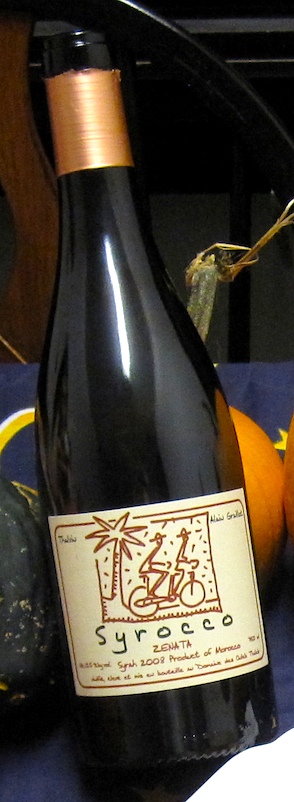
Syrah, “Syrocco” Domaine des Ouleb Thaleb, Thalvin (Alain Graillot), Zenata, Morocco 2008

Tunisia, Egypt, Libya, Syria, Yemen, Jordan and more to follow. While revolutions burn through Arabia and North Africa, one monarch has quietly avoided wholesale annihilation.

King Mohammed VI of Morocco.

His de jure constitiutional parliamentary monarchy kinda, sorta works. When the Arab Spring lit up, Moroccans peacefully protested. They blamed any violence on soccer hooligans. And surprise: constitutional reforms, referendum, and spring-cleaning of corruption were voted through with ease.

But Morocco has always been a bit different.

It was the first country to recognize the US as the US. The Ottomans never took it. Jews are welcome. Women can vote. The US and EU get free trade with this crossroad between Africa and Europe. And it served as limbo to expats, real and fictive, like Rick in Casablanca.

Here's looking into the distance, kid.

Wine is hardly different.

Islam forbids alcohol. Yet Morocco’s first Arab dynasty allowed Berber tribes around Meknes to make wine. And grape growing and wine drinking continued albeit quietly and sporadically.

Today, although Islamic law bans alcohol sales to Muslims, Morocco mainly enforces it during religious feasts such as Ramadan. Most young, affluent professionals drink wine in restaurants and bars. For many, the Koran is seen to restrict, not prohibit, alcohol consumption (Omar Aouad, Les Celliers de Meknes’s director general, quotes verse 67 sura 16, “And from the fruit of the date palm and the vine you obtain intoxicating drink and wholesome food. Most surely there is a sign in this for those who ponder”).

Why such tolerance? Blame the French.

France began colonizing and vinifying Morocco well before WWI. Prior to Morocco’s independence in 1956, it made and exported over 52 million gallons of wine from 135,907 acres (55,000 hectares) of vineyards. Annual wine festivals lasted days. Although most wine went to France as vins médicins to strengthen wimpier French vintages, it clearly became culture.

Then France left, and the EU (EEC) barred wine imports in 1967. Moroccan vines declined rapidly.

Hassan II: clearly a cruel dictator.

Only until the 1990s, did a plucky University of Bordeaux graduate (pictured right) decide to change things. He also happened to be King Hassan II, direct descendant of Prophet Mohammed. While democratizing Morocco, he attracted French investors to plant new vines and modernize wineries.

Today wine employs 10,000 people across 120,000 acres (50,000 hectares) of land. 40 million bottles sell to Moroccans, ex-patriots and foreigners from France, England, America, Spain, Germany and Italy.

But enough geopolitical, economic context. It’s time to drink.

Tonight’s cork-to-pull hides a syrah. This grape makes sense. It thrives in hot-ish climates like the Côtes du Rhône, Barossa, Paso Robles, et cetera. So why not Morocco?

The Atlas Mountains keep the Sahara Desert at bay, protecting Morocco’s northern, Atlantic coast. Here, winters are cold and summer evenings are brisk. It’s still hot as hell. And like other hot climates, three quarters of the output is red, twenty percent rosé, and the rest white. But the Atlantic’s chill moderates the climate enough.One day, a famous French winemaker was cycling the coastal hills of Zenata between Casablanca and Rabat (see map above). The nearby towns Rommani and Ben Slimane (Morocco’s “Green City”) are an ecomentalist’s paradise, lacking any polluting industries. Inspired, our Frenchman stopped by the Thalvin winery, owned by Domaine des Ouleb Thaleb.

A bicycle built for you.

Thalvin has made wine since the 1920s, ploughing and weeding manually, without resorting to herbicides or fungicides.

Meanwhile, across the Mediterranean our bike-ist, Alain Graillot, has repeatedly reset the bar for organic, 100% syrah in the Northern Rhône appellation of Crozes-Hermitage since 1985.

Impressed with each other, Thavlin provided Graillot with parcels of syrah vines, some young, some half a century old, that grow on black tirss soil.

Graillot made tonight’s wine from 2008’s grapes. It’s called, wait for it, ‘Syrocco’. Sure, the title is cheesy and the label is a bit cute (if also a bit historically inaccurate: who rides tandem bikes anymore?).

But cleverness aside, Graillot knows his stuff.

All grapes are de-stemmed and fermented in closed concrete vats. Once in your glass, it’s little surprise that fruit notes dominate the vegetative. Daily pump-overs and maceration last only ten days, which extract moderate color, tannin and density without making the wine thuggish. Fifteen months of aging begins in tanks, followed by small, brand new and one year-old, 225L barrels (from François Freres in Burgundy). A bit of filtering before bottling cleans up any sediment.

Syrocco is shipped nearly frozen. You can tell this from the tartrate crystals in the bottle and on the cork. They won’t hurt you (as some customers fear). They just signal that Graillot wants his bottles to survive Morocco’s heat.

I respect this wine. Clearly Morocco can grow good fruit while caring for the environment. Graillot’s involvement is confident, playful, but not straining to impress anyone, as shown by my chart below. His Syrocco shows off clean, modestly extracted cherry, tomato, and fig fruits. Acidity keeps this otherwise soft, ripe, modern wine in check. Oak merely tempers the hard edges and fringes them in spice.

Syrocco is Rick’s Café Américain: an alcoholic sanctuary in an Arab world; familiar, comfortable but decorated with a mixed, interesting, and at times, dangerous clientele.

At around $17, Syrocco provides easy escape from turmoils international or familial (especially with chocolate). Put this wine beside dishes with mushroom, or lamb kabobs, gyros, spicy hummus, or any meat a tajine has slow cooked to heaven. As Morocco has navigated the sea of Arab revolutions, Syrocco provides an even keel through meals amidst today’s tumult of overdone reds.

SOURCES

Importer Michael Skurnik’s Syrocco entry

Importer Michael Skurnik’s Alain Graillot entry

Morocco Travel Agency

Wine-Searcher.com “Morocco and Moroccan Wine”

Decanter.com article “Moroccan Wine and Muslims”

Gaurdian.co.uk Arab Uprising Timeline

Wine Institute Wine Grape Acrage

Posted in EMPTIED BOTTLES, Red, Syrah | Tagged , , , , , , , , , , , , , , , , , , | Leave a comment

RIPENING.RED

The clacking hooves of the four horsemen of the apocalypse are upon me.

I’ve screwed up.

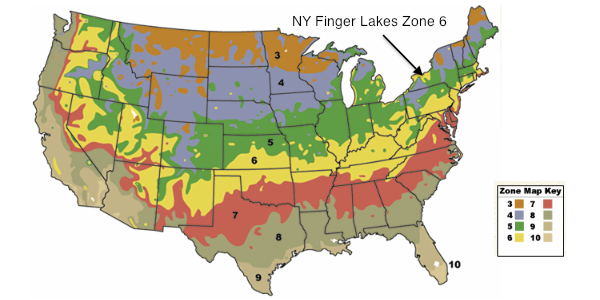
I just ordered 75 pounds of cabernet sauvignon grapes. That sounds normal (for me). But this ain’t balmy Napa. No, I bought cab. from New York’s Finger Lakes: the last region that should grow it.

You know those rainbow US maps on the back of seed packets? Well, grapes have them too:

That yellow splat is Zone 6 on USDA’s plant hardiness map

As discussed previously, New York is generally miserable, cold, and horrible for grape growing. Only regions with deep water heat sinks, such as the Finger Lakes, can protect grapes from frost, freeze and rot long enough to ripen into profit. Even then, only some grapes are possible.

Most are unrecognizable natives, hybrids, or crossings: like the vignoles I made last year (which still sounds like fake french). Well-known vitis vinifera grapes include those that already hail from cold places: pinot noir and chardonnay (Burgundy), riesling (Germany), cabernet franc (Loire), gewürztraminer (Alsace), and maybe, maybe, probably not, maybe, cabernet sauvignon (Bordeaux).

Yellow: as low as cab. can go.

The USDA recommends that cab. sauv. is only cold-hardy enough for Zones ranging from 6 (with annual average low temperatures of -10 to 5F) to Zone 10 (30 to 40F). Why? Cab.’s fruit ripens two weeks later than most other varieties, in a good year. Even then it’s vegetal, green pepper tones and tannin overwhelm the nascent fruit. If it flirts with late October’s frost, like me trying to hit on anyone, it fails.

Those yellow splats on that map on your right show the coldest spots this yellow submarine can sink. Fall Bright Winemakers Shoppe is on that edge. They’ve grow cab. sauv. on Keuka Lake for home winemakers since the ’80s.

But the last decade hasn’t been easy on king cabernet.

2003 and 2004 witnessed two nasty, wet summers. Cab. yields were reduced, berry ripening delayed, and vines and buds weakened across the Finger Lakes (see Cornell U. article). Already beaten, 2004’s winter killed 86% of Fall Bright’s cabernet sauvignon vines. Yes, vines, which continued to collapse through 2005’s summer. Fall Bright should have given up. Well, they did. Gamay noir replaced most of that cab.-land in 2007.

So why in Hades am I ordering cabernet sauvignon from them?

First, I want a red.

Second, the last five years have seen fine weather. Especially last season. My ’10 vignoles turned out drinkable, even against my worst efforts. 2010’s cab. sauv. had a Brix of 23.8. That equals 261.85 grams of sugar in a liter, which ferments to a respectably dry 13% alcohol by volume (the norm is a thin 11.5%). Acidities were also worthy with 0.705 titrable and a zippy pH of 3.2 (actually mild for any Finger Lake red).

2011 is shaping up almost as decently, like that hot twin who is only a touch crazier than their sibling.

Sure the winter was longer and colder, delaying bud-break. It was mild though. Sure Spring didn’t dry out until May. But that was followed by drought, which drove growth. Thus far, the harvest is two weeks ahead of average and only a few days behind last year.

Cabernet franc, merlot, carmine, gamay and pinot noir will all ripen the first weeks of October. But I work then. Therefore, I wait until my birthday weekend: October 22nd-23rd, when that late-ripening problem child of cab. franc and sauvignon blanc, will be ready. Probably. As long as it beats the frost…and rains…and hail…and hungry animals…and rot…and mildew…

I could order Californian cabernet. Some wineries do in upstate New York.

Wait. No. That teaches me nothing, is bad for the environment, and the local-ish economy. Worse, my mail-order bride would arrive sterilized, bruised, or frost-bitten.

No. I go local, with a grape that shouldn’t be here.

SOURCES

Fall Bright Winemaker’s Shoppe 2004 Crop Report

Fall Bright Winemaker’s Shoppe 2005 Crop Report

Fall Bright Winemaker’s Shoppe 2007 Crop Report

Fall Bright Winemaker’s Shoppe 2010 Crop Report

Cornell University article on difficulties with vitis vinifera reds

Accuweather.com’s Finger Lakes 2011 report

Wikipedia’s Cabernet Sauvignon entry

WineMaker Magazine (it exists) on cold growing climates

Posted in CABERNET CRISES: MY FOURTH WINE, Cabernet Sauvignon | Tagged , , , , , , , , , , , , | Leave a comment

VIGNOLES.VS.VIGNOLES

So I made this white wine last year. It turned out flawed, hazy, and unexpectedly fizzy. The last third of each bottle is a yeasty murk and somewhat undrinkable. Corks shot from bottles until I caged them. Luckily, I like bubbly.

Fall Bright Growers: right bank, center. Yates Cellars: unmarked up top on the 54a.

But how bad is it really?

We need a point of reference.

Back when I bought the juice from Fall Bright growers, I also visited a few wineries on Keuka Lake (right).

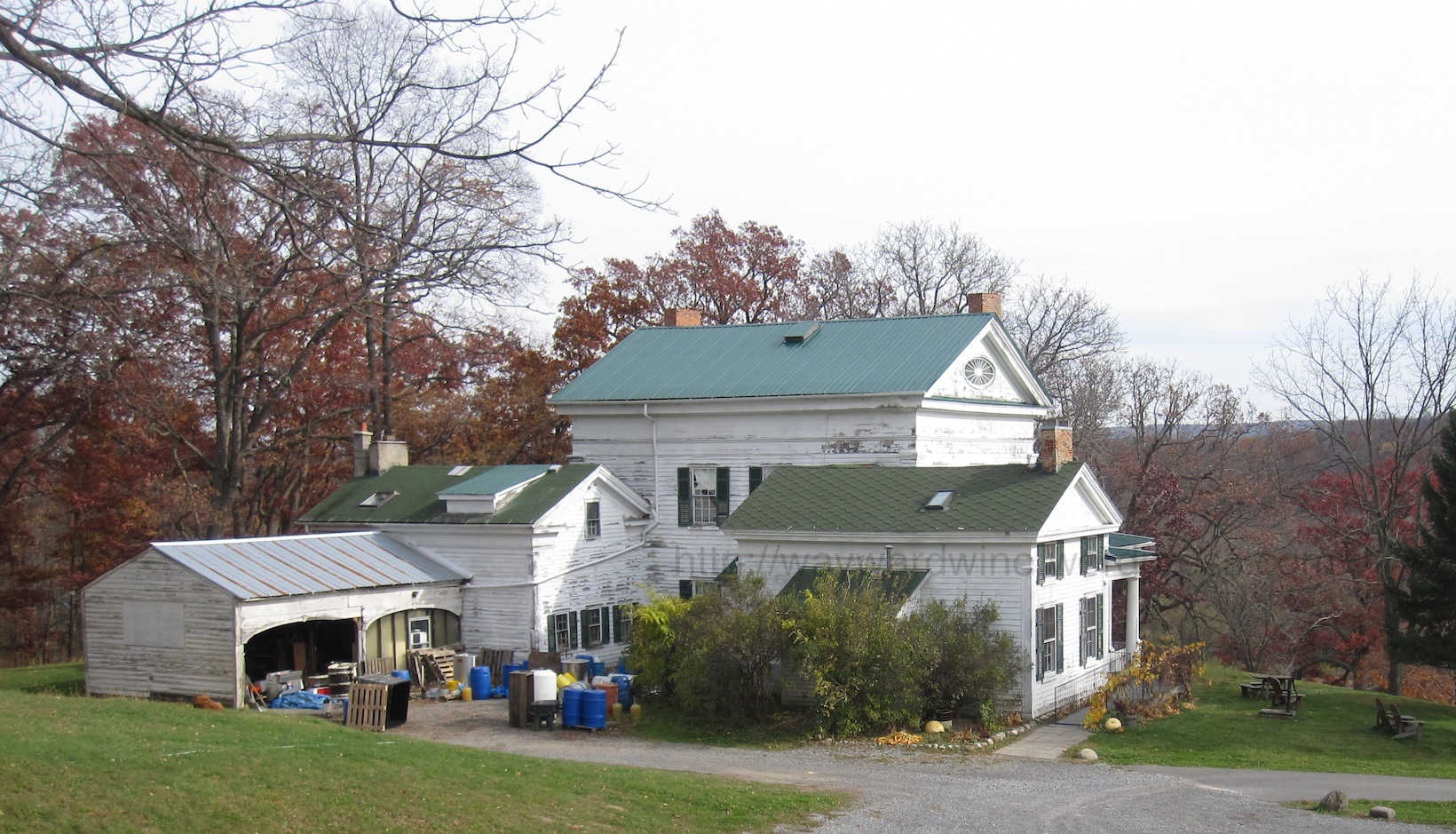
Between the rods of this tuning-fork-shaped lake sat a white, neoclassical mansion.  The tanks and carboys fermenting out back and grape vines looming above it were the only tells of a winery.

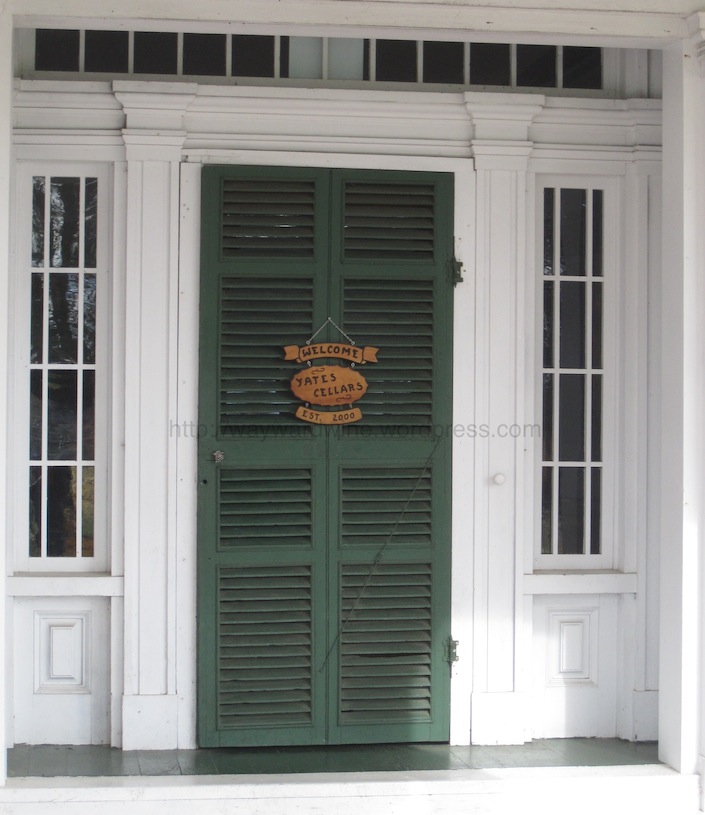
The door claimed this was “Yates Cellars“. Firstly, you have no idea how desperately I need to add a possessive apostrophe to Yates. Also, why is it “Cellars”? There’s one garage, no cellar, let alone multiple.

Imposing? No. Inviting? Maybe. Apostrophe...ed? Ugh...

Once through the entry, a bare wood interior hollowed open before us. A young lass greeted us from the other end of the cavern. Her unlit counter had a view, not out on the lake or rolling hills, but into a dark kitchen and/or wine lab.

The wines tasted equally unpolished. Yet some things were drinkable, or at least interesting (a dry, single varietal vincent? Geek-tastic!). Credit goes to any winery that’s only a decade old and growing its own grapes.

  • Real garage wine, not some alternative cover band.

Charmed, pitying, or just curious, I bought their vignoles. It had residual sugars roughly near where I wanted my vignoles and was from the same lake. It would provide comparanda, when I finished my own.

With another Fall at hand, and half my vignoles drunk, I open Yates Cellars’ vignoles.

Now comparing wines is wrong. It’s like comparing children. Not only might it traumatize the tikes, but it reveals more about my own biases than any wine’s inherent qualities.

But Yates is special.

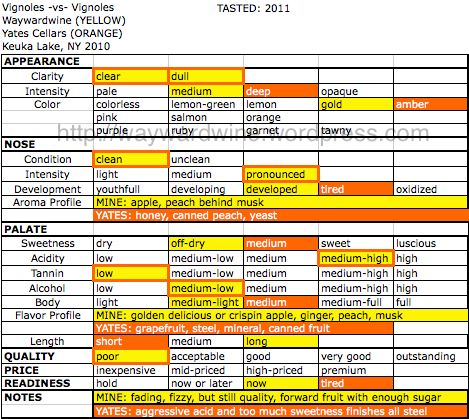
The chart below reveals many similarities in the orange-lined-yellow boxes. Both wines start clear but develop floating particulates by bottle’s end. Both noses are highly intense and clean of major faults: very vignoles. The medium-high acids reveal their cool climate origins. Tannins are low and the sweetness keeps the alcohol moderately low.  The quality verdict for both is poor.

Where we diverge is more interesting. My wine is clearly a year younger: its color is less deep or browning, its nose remains fresh. Mine has less clinging sweetness and seems lighter. Its fizz might help that.

I’ve drunk other vignoles. King Ferry Winery‘s vignoles was also poor: 9% residual sugar with 12.2% alcohol made a jammy, musky, dull desert. Fulkerson‘s “Ravat 57” was actually good, albeit swamped with sweetness.

It seems like a draw. Yates provides little for the palate to play with beyond jagged, steely grapefruit acidity countered by too much sweetness. Yet however much my vignoles is flawed and fizzy, it is still an enjoyable tasting drink.

The proof that mine is the winning loser: Yates is the first wine in memory that I couldn’t finish.

It's either me or the bottle who gets trashed.

Posted in Keuka Lake, New York, VIGNOLES VENTURING, White, WINERIES WANDERED | Tagged , , , , , , , , , | Leave a comment

BLUEBERRY.REOPENING

A year is a long time to wait. Even labor takes a paltry nine months. But birthing my blueberry wine deserved patience.

Its conception was awkward, messy, and frustrating.

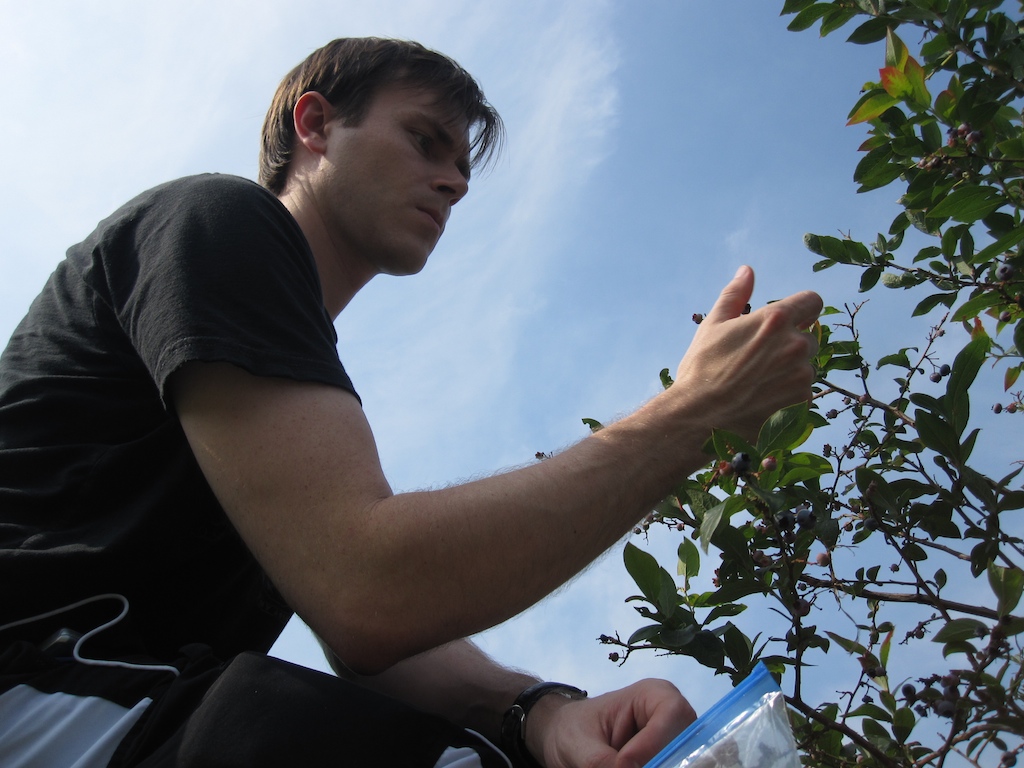
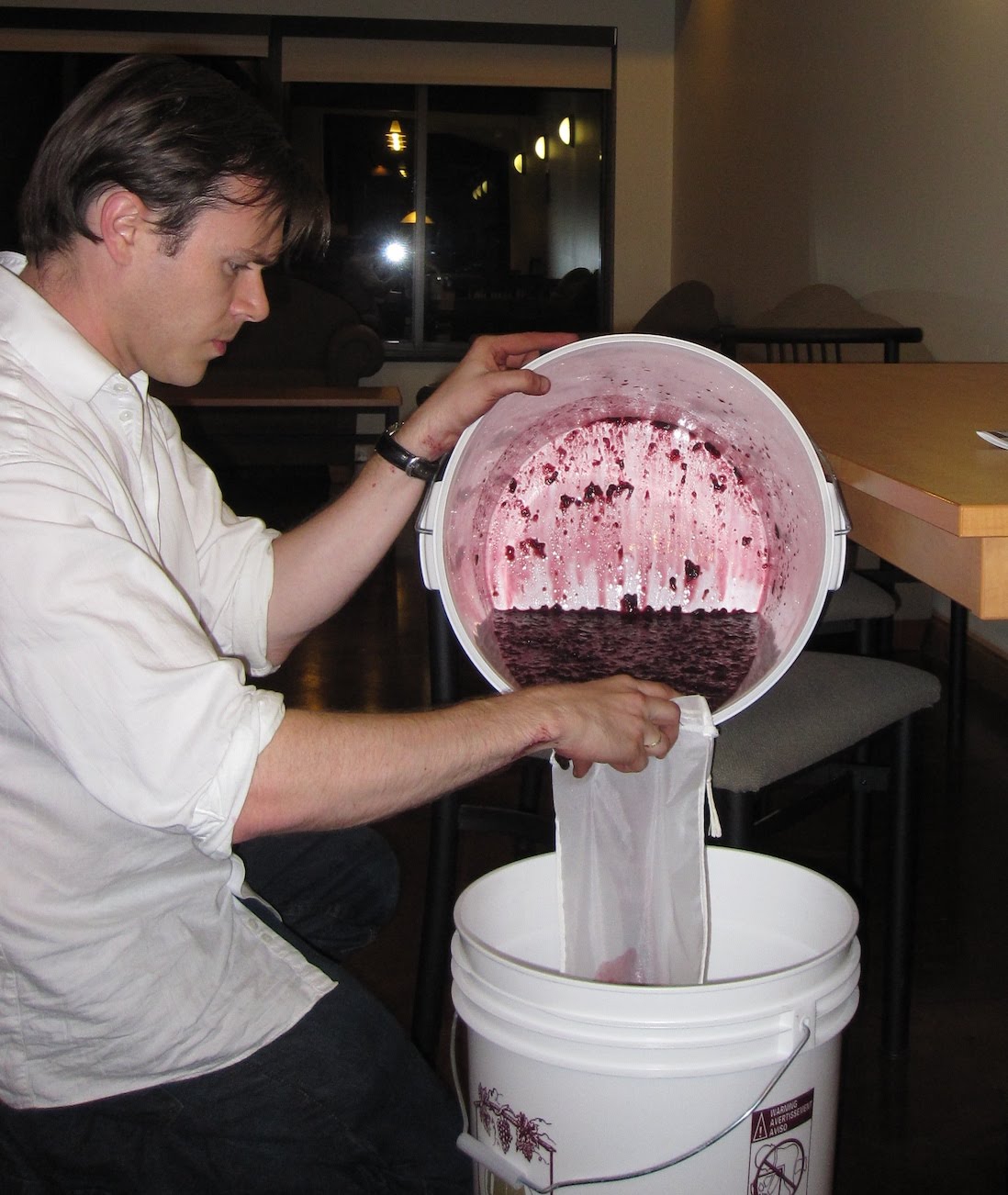
Kit winemaking was for beginners. So last August, I picked ten pounds of blueberries. This time I wanted to complete the circle: picking, pressing, macerating, fermenting and bottling. Along the way, I hoped to understand the challenge of crafting a wine from scratch.

It was a nightmare.

So young, so naive.

Harvesting was exhausting. Those ten pounds only gave me a gallon, or 7.5 bottles of wine.

crying on the inside

Pressing the berries by hand nearly killed me. Fermentation took days to start. Alcohol was low and required chaptalizing with sugar. Record highs, lows, and a broken AC nearly ruined everything. And even after multiple rackings and finings, the wine was still hazy.

It's sedimentary my dear Watson.

Severus Snape as an alcoholic makes so much more sense.

I needed to age the wine.

A few webpages and books told me that fruit wines improve with time in bottle. They sounded trustworthy, or at least reasonable.

“Real” wines are released upon the market after at least a few months of aging in bottle. This gets over short term effects like bottleshock. No, not the boredom of watching a movie about wine, where the only redeeming factor is the presence of Alan Rickman (one point for Slytherin!). Bottleshock is a wine’s reaction to oxygen exposure during bottling. It freaks out chemically, muting flavors until the oxygen dissolves.

Down-time also lets phenolic compounds like bitter tannins bind, group and sink to the bottom. Their harshness dissipates with age, much like that cranky grandma who got nicer once senility set in.

So, I waited a year, made another wine, drank through my first kit wine, and generally forgot about how hard blueberries had been.

Now nostalgic but fearing the worst, I chill a bottle of the blueberry, hoping the cold might mask my mistakes. My latest vignoles white became unexpectedly fizzy yet fine: thanks mostly to good fruit.

But there’s only one way to know.

It looks like wine.

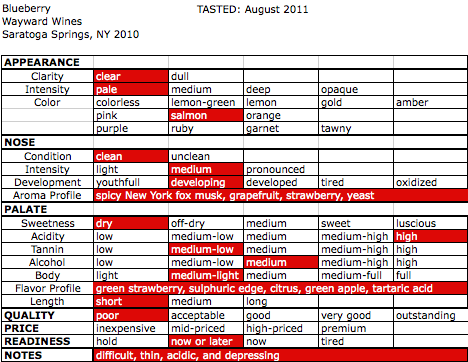
The wine looks fine (just ignore the bottle’s half inch of sediment). It shows a clear, pale ruby with salmon tinge: akin to a rosé with age. Yay!

For real.

Its nose, well, to put it gently, sucks. There’s a bit of grapefruit and strawberry, but musk, earth, and yeast crush the fruits as if they were Japanese people running from Godzilla.

This is why you smell a wine first. You need to know if a musky, yeasty Godzilla is going to ravage your palate like downtown Tokyo.

For the sake of science, I sip.

*SNAP*

Once my brain rattles back into consciousness. I try the wine again.

*SNAP*

Brass-knuckled acidity whips me in the face again. There’s nothing else there. All sweetness is gone. What remains is a thin, acidic glass of difficulty.

Sure my goal was to make a dry red, but I expected some fruit to hang around. All I can tease out is green strawberry, apple, citrus, sulfur and some spice. My chart below can’t hide my disappointment:

So where did I go wrong?

The delayed fermentation and mold allowed for wild yeasts and/or bacteria to contribute the foxy, musky earth tones (although that might just be the blueberries).

One lump or two?

I also should have macerated the skins and juice properly.

Most red wines spend one to two weeks with pumps or manual punch downs circulating the skins. That extracts more color, sugar, and flavor esters. Exhausted, impatient and lacking pumps or siphons, I just bagged the skins as if they were tea.

Chaptalizing was my other mistake. Blueberries have 65% (9.96g/100g) of the sugars of grapes. That translates into 35% less potential alcohol than wine (since sugar ferments into half its weight in ethanol alcohol). I wanted something wine-like at around 12% alcohol. So I dumped in cane sugar and yeast food.

My blueberry is clearly up to wine-reminiscent alcohol levels (e.g. it will get ya drunk). But raising them masked any fruit.

I also need a pH acidity tester. While still a berry, the blue’s sugar balanced its acids nicely. Like fresh lemonade: you need sugar.

If had I trusted the fruit and just fermented it, there might be something left to taste. Most blueberry wine is made into dessert wine for a reason. Dry, it will hardly taste of blueberries.

Aging the wine further won’t help either. There’s no core fruit flavors to hold out, when tertiary tones of earth and saddle take over.

Next time, I’ll stick to grapes.

Posted in BLUEBERRY BOUND: CRAFTING MY SECOND WINE (AUGUST 2010) | Tagged , , , , , , , , , , , , , , , , | 3 Comments