
Source: #MWWC21 Time to vote!
Every Monday, discover new wines, regions, and ways to understand this fermenting sea.
-


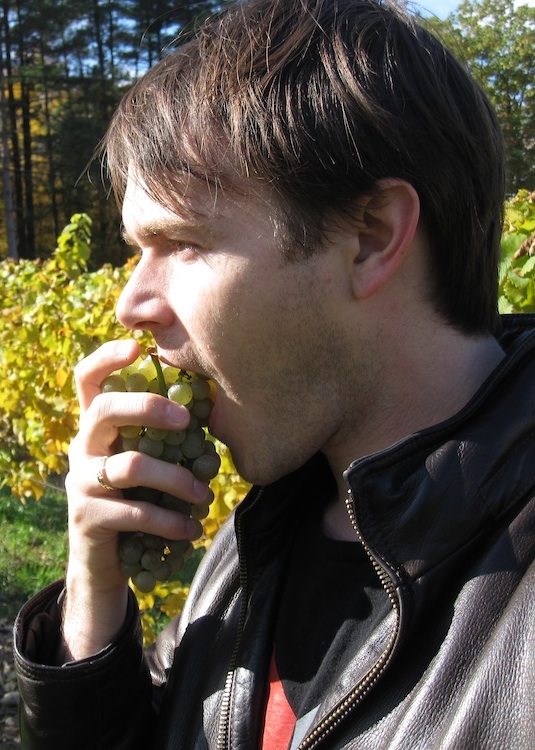
Munching Vidal Blanc on Keuka Lake, New York
Source: #MWWC21 Time to vote!

It is time to do your duty to Wayward Wine-land. Vote for the greatest word-smithing upon the topic of pairing:
#MWWC21–Time to Vote! | mwwcblog
https://mwwcblog.wordpress.com/2015/12/08/mwwc21-time-to-vote/
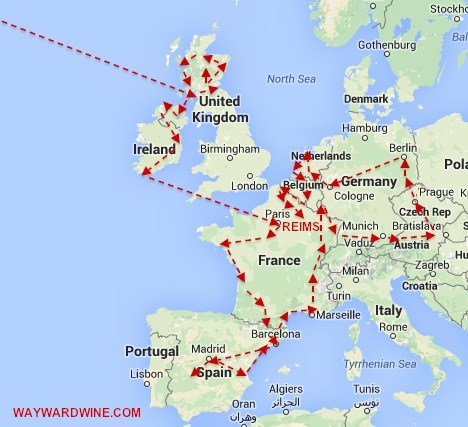
Champagne. We cannot end our seven month, thirteen country EU Austerity Drinking Tour without stopping in Champagne. The beer in the Czech Republic, Germany, Holland, & Belgium have revolutionized our thinking.
However, Champagne is Champagne. My wife dropped her Diet Coke habit for Champagne. No other region manages to make a product as expensive, iconic, and controversial as Champagne. So, goodbye Amiens. Hello Reims!
It may be the dead of winter, but finally, through obscuring trees, we sight our first grape vines.
We settle into the cozy home with two fantastic lesbian hosts and their black cat. They set to work advising us on which sights and Champagne houses to visit. They also snap at us to pronounce Reims as “Raunce”, so we only make moderate fools of ourselves.
We start at Reims’ heart: Notre Dame Cathedral:

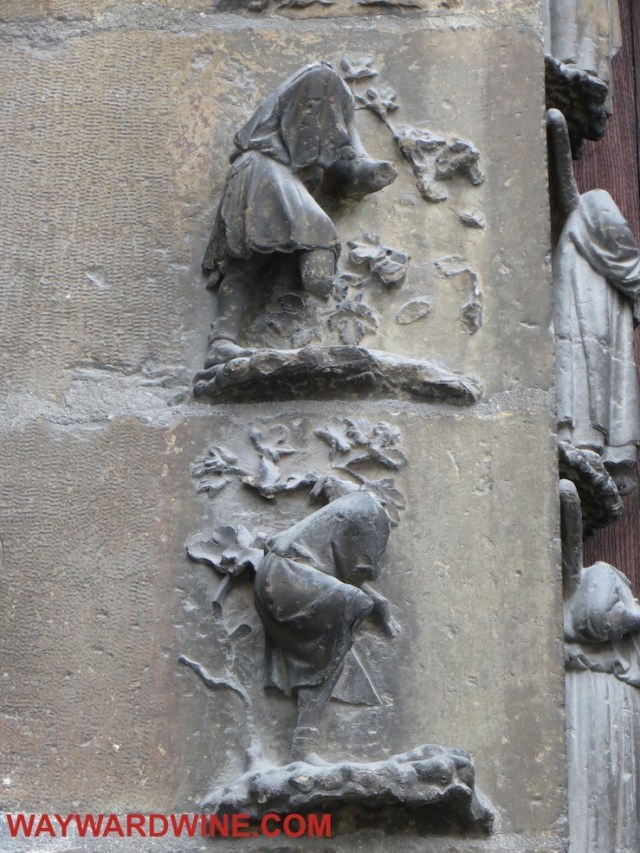
Originally Roman baths, these later became a basilica, and here, in 496, Clovis, the first Frankish king was baptized. It then became THE site for all French kings to be crowned at. Yet hidden amid royal religious splendor, proud local sculptors snuck in barrel makers and grape pickers:
 Direct German shelling in WWI ruined the Cathedral. Luckily, the Rockefellers and Monuments Historiques restored it. Today, although a bit jumbled and devoid of detailed flair, Reims Cathedral asks for your awe:

Even Chagall added a touching swirl of stained glass to the burnt choir:

We ramble between quiet brick and plaster buildings, worn by world wars. Art Nouveau survivors sprinkle the streets, including this masterwork from 1898: the cellar gate to Champagne house Mumm (later owned by Veuve and today by Jacquart).
Deeper we find a chance survivor, the Renaissance, Hotel Verdeur:
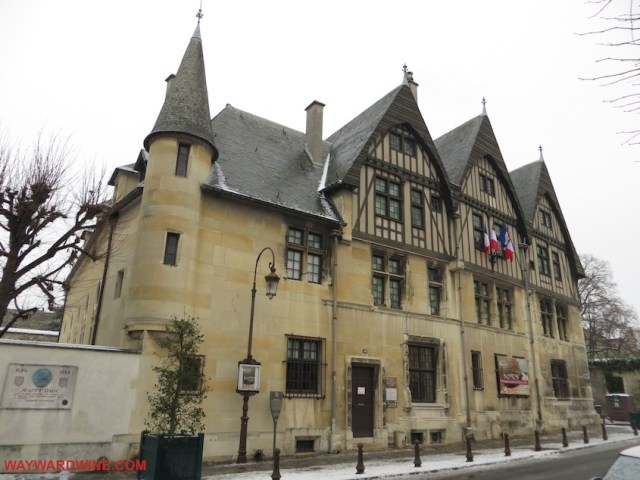
Here royalty stayed enjoying immense and immaculate gardens. It also faces the remains of the Roman Forum. At center, the mercantile cryptoporticus:
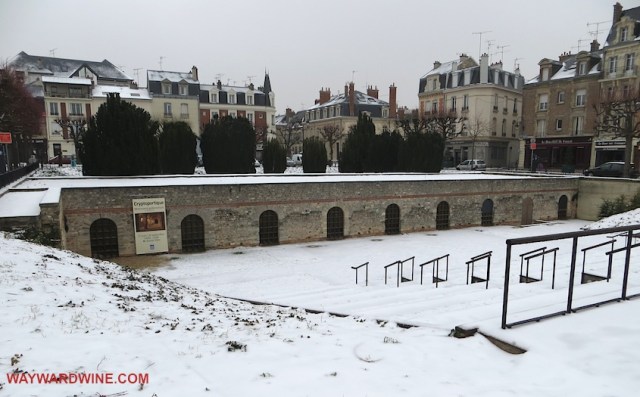
Reims, evidently, has always been a city of craft and business. At the Forum’s corner, we spy a sign glowing red.

It leads to a courtyard of parked cars…not encouraging:

But down a narrow, dingy hall, we find the most fabulous wine shop. Here, Billecart-Salmon Rosé is a mere 49.90 EU. Here, rare and strange, small and huge producers pile every corner.
€6.00. Yes, €6.00 gets us a bottle of François Arnaud’s 2009 Grenache blend from Cairanne, France: a rich but balanced ruby red, with medium intense aromas and flavors of young prune, dried black cherry, tomato, headed by a stony, pencil lead-like minerality and mint: Very good (4 of 5).
From Touraine in the Loire we grab Yves Markevicinte, Vignoble de l’Ebeaupin 2011. It looks a clear ruby purple. It smells of black cherry, black pepper, chalk, and vanilla husk. Dry, twangy acidity, oodles of chalky tannin, mild 12% abv, and a medium body swap to flavors tart cherry, chalk, and orange peel of medium length. Very good (4 of 5).
But we came for Champagne. So, for an Austerity-friendly €24.90 we buy Daniel Savart, L’accomplie, Brut, Champagne Premier Cru, France. NV

Daniel Savart is an adorably new, small grower, who grows only 2 hectare of vines around Écuel. Their L’Accomplie is a first pressing, mostly from the present vintage (blended with two years prior) and aged 50% on lees in vats and 50% in barrels with partial malolactic fermentation.
It looks clear, lemony with fast, small fizz. Aromas smell youthful and zingy with tart strawberry, wildflower (chamomile), and fresh biscuits. It feels dry (7g/L), with extra acidity, an unexpected medium plus body (thanks Pinot Noir), and a lovely chalk dust yet fat and chewy fruit texture that clings to the teeth. Flavors of tart strawberry and violet candy lead to a long citric, chalk powder finish. Savart’s L’Accomplie is very, very good (4 of 5). Can drink now, has potential for aging.
The next day, after our hosts make a fab and undeserved quiche for us, we visit Reims’ Art Museum for their rotating exhibit on…Champagne. Small rooms wind about with posters, paintings, and wares from the region. All celebrate the posh hedonism that is French bubbly:

*Ahem… Also, there was an original portrait of lady Clicquot, and a 170 year old bottle from a Baltic shipwreck, possibly from Veuve en route to Russia:

Back outside, we swing past Art Deco homes and shops on the edge of town and stumble onto another Roman ruin:

Bullet holes riddle this monumental arch. Today it faces entries to caves of Champagne houses. School children run about it doing a scavenger hunt. We even find Romulus and Remus at la Lupa’s teets, signifying this city’s connection to imperial Rome.
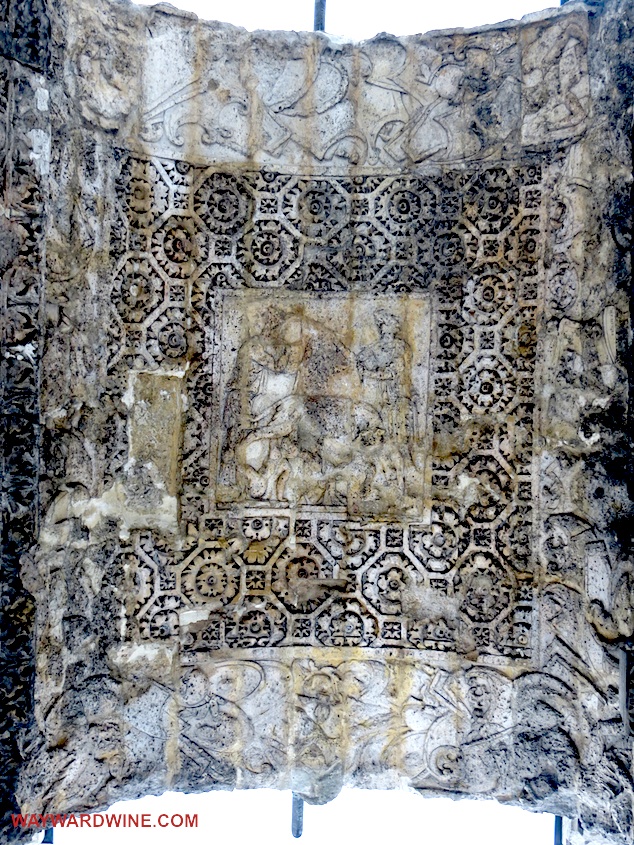
Not to be outdone sits a nearby WWI memorial:

It was cut from the same chalk caves as the Roman gate, which is also where Champagne ages.
But the Champagne houses can wait for tomorrow (aka next Monday’s post). It is cold so we head back to base. Empty Art Nouveau buildings glitter as we pass.
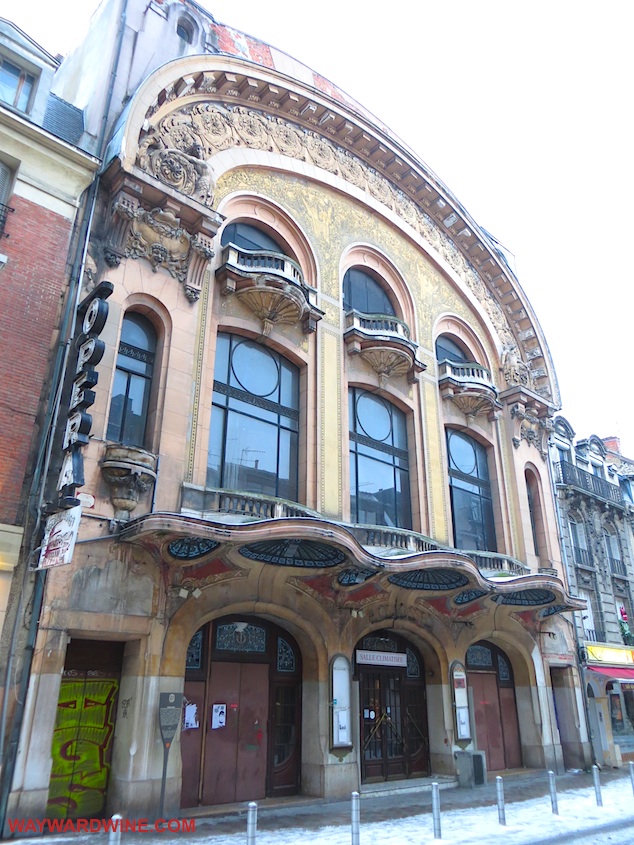 For this is the essence of Reims above ground. An ancient, artful, aspiring, mercantile city damaged by wars economic and military.

Wayward Wine leaves Lille for Amiens. This is industrial Northern France, where your le Creuset pots come from. Soon our public transport crawl will reach Champagne. But for today we explore this snow-bound spot.
 Our bus slaloms to our house-stay at the edge of town. Our young hosts provide a cozy, clean, petite place to stay. The highlight includes a rabbit, well, more like a warm fluff ball:
 After a warm night, we layer our travel-tired clothes to crunch through Amiens. Aside from the stolid train station, the town fills with quaint, very French apartments and this fabulously unnecessary clock:
 The town is asleep, everything is closed, so we cross the river Somme (yes, that Somme, of the infamous battle), with the Cathedral looming over all.
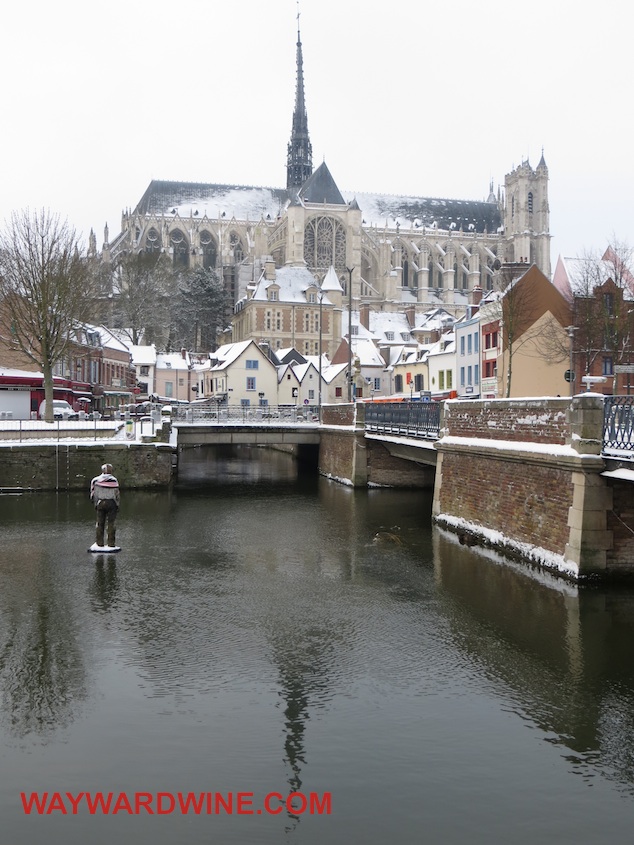 We discover battlements with a hospital built into them. Wild rabbits shuffle in and out of snowy hovels. I steal a bottle of Bordeaux left in a parking lot.
Climbing back into town we find an outstanding indoor market: Halles du Beffroi. We find a long line at the end of the hall. We stand in it, cold, famished and wait a half hour…for Julian Planchon’s fantastic cheese.
 We go local and get their native cheese: mimolette. Magic orange rondles with various ages glow in the cool box. Chunked off with a credit card into a baguette, this nutty, hard cheese is salty magic. Madness, the US banned it because it is made with mites. Whatever, mimolette is delicious.
We check out an abandoned medieval monastery atrium…
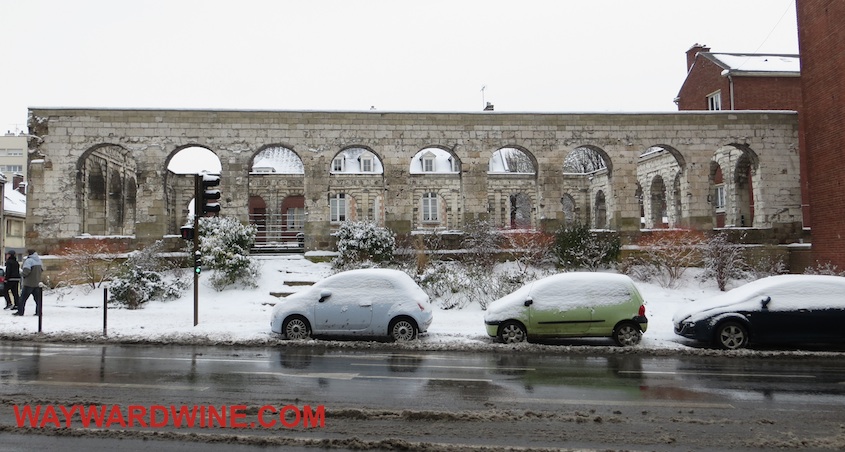
Finally, Amiens Cathedral is open:
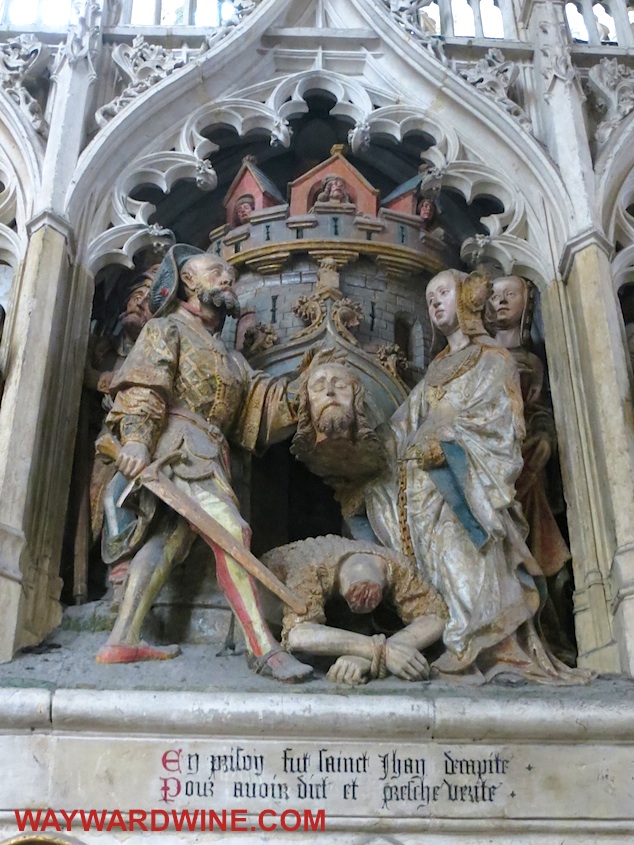
 It is the tallest (138 feet inside) and most spacious (260,000 cubic yards) in France. It also served as a hospital for those wounded at the Battle of the Somme. We planned to visit the battlefield, but snow halted buses. Inside, WWI memorials litter the Cathedral, giving it a strangely secular, warlike tone. More impressive are the deep reliefs depicting St John the Baptist:
 Even more fantastic is the Labyrinth, meant for on the knees penance for those incapable of pilgrimage.
 Outside, an ebuliant Mary and child look out:
 Enough of the past. Let us visit the future… of the past.
Back a mere 86 days into our trip, yes 100 days ago, we visited Nantes: birthplace of Jules Verne (reread here). So, let us visit his last home:
 Inside are many small rooms recreating Verne’s worlds (a ship captain’s room?), inspiration, and the media rebirth (many, many board games, movie reals, and posters), along with personal effects.
Snow dumps all night. We share our pilfered Bordeaux with our guests. I pet the cats. Allergic wife pets the rabbit.
We wake to buses still shuttered. Our kindly guests drive us to the train station in their BMW. We then spend hours waiting for the only train. We freeze outside, hugging to pillars to avoid wind chill. But this train is taking us to Reims, Champagne.

This being Thanksgiving, you probably are hiding from family right now and dawdling online. Well, here is 2015’s Beaujolais Nouveau from iconic producer Georges DuBoeuf.
Just in time for turkey day: Beaujolais Nouveau!
Appearance: clear, but medium plus purple with crimson highlights and a narrow rim.
Aroma: clean, mild granite, dried oregano, tomato leaf, oh, and raspberry, cherry skin.
Palate: It dry, tart, with mildly dusty tannins, adequate alcohol (13%), making for a medium bodied, fine grain textured red.
Flavors: medium, easy bright cranberry, cherry skin, noted mineral dust, tomato leaf, light vanilla. Medium length.
Conclusions: 2015 was clearly warm and kind to Georges DuBoeuf. This Nouveau has more alcoholic warmth than I have seen in years. Just enough to get into trouble. Mineral and herb fladies and snappy acidity keep this serious enough. Good (3 of 5) and entirely serviceable for today’s turkey.


 WAYWARD WINE