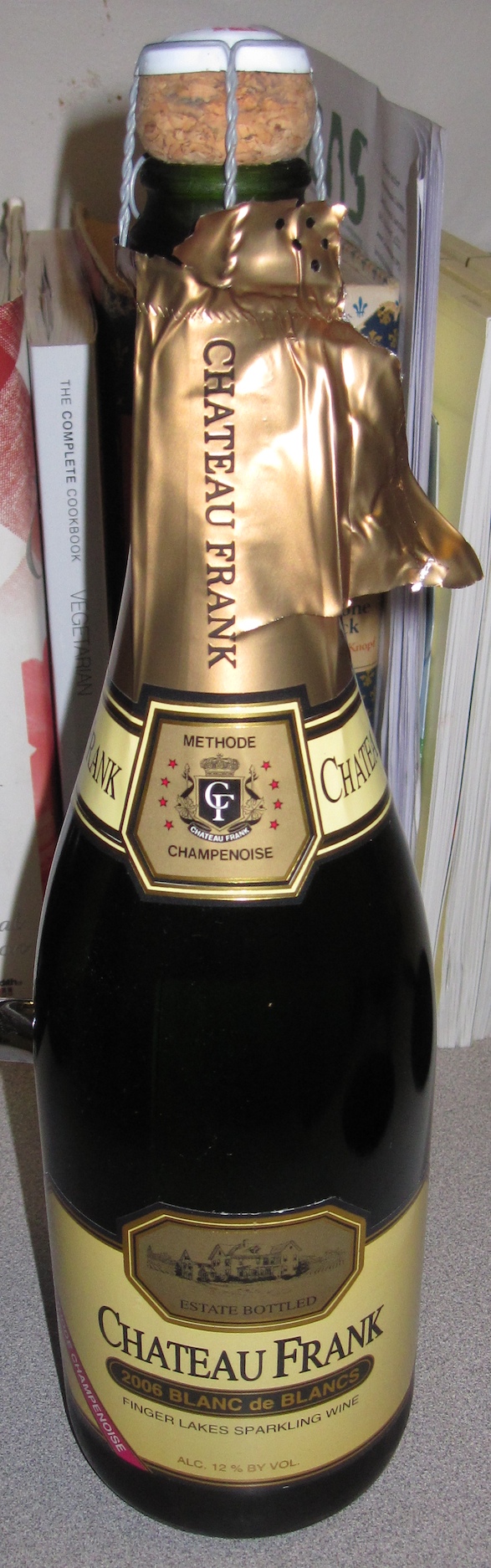
Chateau Frank, Blanc de Blancs, Finger Lakes, NY 2006

New York sparkling wine might sound oximoronic. But some of the best places for bubbly
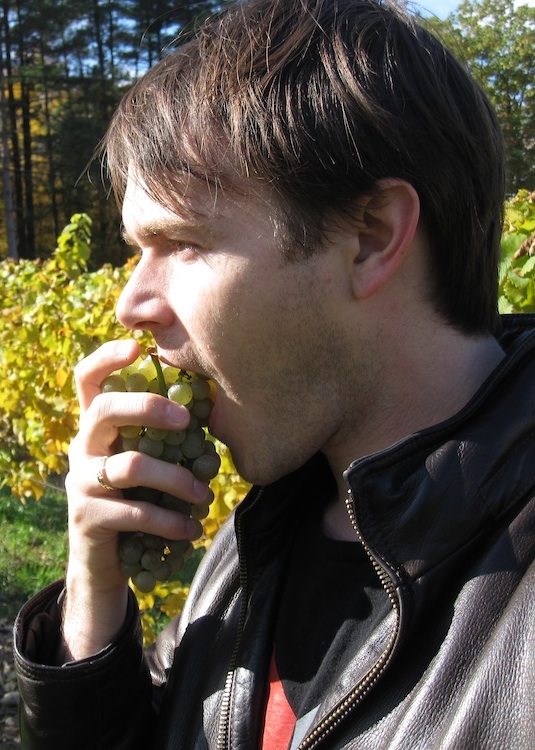
A willing victim.

are cold and miserable. Take the region of Champagne, for example. It sits around latitude 49. The average temperature is 50. The Finger Lakes are slightly closer to the equator at latitude 43 but slightly colder on average at 48 degrees. Grapes from places like these can be bitterly green thanks to the limits of ripeness this far north. But that acidity and sprightly fizz, in tandem with the atolytic notes of bottle and malolactic fermentations can reach perfect pitches.

Since 1962, Dr. Konstantin Frank pioneered planting vitis vinifera grapes in New York. He convinced the world that the cold East could compete with Europe by stepping away from the native grapes (vitis lambrusca) of concord, niagara and catawba and growing vitis vinifera, such as riesling, chardonnay and pinot noir.

In the 1980s “Chateau Frank”, with all its French pretensions, became the side project of Willy Frank, who forged a solely sparkling path in the shadow of his father’s still wines.

The Franks (now under Freddy) only make bubbly from estate grown vineyards on Keuka Lake. Their 2006 Blanc de Blancs consists of Chardonnay and (oddly for New York) Pinot Blanc.

As the foil, the top, and both labels will tell you, this is “Method Champenoise”, which is similar to the champagne “méthod” just without the accented é. The feigned french refers to the fact the wine is bottle fermented. Once they have an alcoholic still wine, they chuck in yeast and sugar (liquer de tirage) and cap the bottle until the yeasts integrate their by-product: CO2. This gives a fizz that is finer and longer lived than tank fermented wines (e.g. prosecco).

Enough talk. I’m thirsty and ready to celebrate. But, while pealing back the foil, any fun or pseudo-francophilic romance is drawn to a halt.

But I'm thirsty!

Hoping I have won something, I search the bottle until I find the litigious explanation:

Translation: Please don't sue us!

With the safety of “people” (and Frank’s lawyers) now firmly in mind, I uncork New York.

Pretensions and prohibitions aside, this is enjoyable bubbly. Nothing seems out of place. The balance between citrus and cream is there. Imagine key lime pie: tart but soft. The wine also remains unforgettably New York with a slight saline, mineral finish of limestone.

Posted in Keuka Lake, New York, Sparkling, WINERIES WANDERED | Tagged , , , , , , , , , , , , , | 5 Comments

FAUX.STABILIZATION

Cold stabilization: refuge of the weak-willed winemaker. Simply chill the wine to near freezing temperatures for a few weeks. It should sink haze and lower tartaric acid and potassium, which means better stability along the bottle’s journey to the shelf. Sounds great.

But most winemakers cold stabilize because people freak out. When they find those glassy crystals in the bottom of a bottle or cork they return it. But they will not kill you. Just decant it or slow your pour. The potassium bitartrate salt is the same stuff you ice gingerbread houses or make whipping cream with: cream of tartar. It just precipitates when the bottle gets too cold during shipping. Cold stabilizing precludes this change by mimicking it beforehand in the cellar. As crystals, the tartrates and potassium can be racked or filtered away. Easy.

I want to try it and understand what happens.  However, I don’t have a dual-walled, stainless steel tank with adjustable coolant at my computer’s fingertips. I have something cheaper: my brains.

Witness my brilliance.

That’s right: with window ajar to winter-y elements, I have plunged my glass carboy into the ferment tank, which is filled with ice and water. Its plastic thermometer starts diving from the sixties into the forties. Not cold enough but better.

Cold-ish stability here I come!

One unforeseeable flaw to my genius: ice melts. The days see me waking to squash my face against the tank, suck water and add more ice. Not glamorous, and no, you don’t get a photo or video of that.

As the days crawl, I wonder, why do this?

Most winemakers cold stabilize because it fulfills fashion’s need for clear, stable wines with less acidity. It also removes some risks of losing product to the vagaries of international transport.

However, if we actually care about terrior and expressing a vintage and place, then removing the natural tartaric acid is a lie. Softening that edge dulls the wine’s native character. Yet that style sells.

Whatever, I just want to see if this is all talk by people who never make wine.

A week of fashionable sucking and ice-adding goes by. I am fairly confident that none of this is working. The outdoor temperature is dropping into the twenties. Time to sell out for real…

Posted in OENOLOGICAL ODYSSEY, VIGNOLES VENTURING | Tagged , , , , , , , , , | 5 Comments

POST.EXPLOSION

There is not a moment to lose. The yeasts are now on their last reproductive leg. The  violent stabilization via a sorbate/metabisulphite cocktail should have worked. But I need to make sure the yeasts stay asleep for good.

With the window cracked, I shove the carboy into the refrigerator of an office and close the door. The chill should send the yeasts back into hibernation. If the spawn-fest has stopped, then the wine should still stick at two percent residual sugar…

Gravity has already started to separate the yeasts and heavy compounds:

Nice try gravity.

That is fine, but the earth will not spin fast enough to sink the solids. Like most winemakers, I have other pointless projects to tackle. Impatience turns me to a chemical shortcut: fining.

For winemakers this cheat is a means of crafting profit…I mean product, as quickly as science will allow. A hazy wine is as unfashionable as a Master’s in Art History. An unfined wine might risk re-fermentation with some yeasts still floating about, awaiting their second coming. Waiting on gravity and racking also takes time, which takes money, which sucks. So, to give my vignoles the business major’s edge the world wants of it, I open a bottle of dirt.

My addition of jazz to video has blinded you from the fact I cannot stir such a full jug.

Posted in OENOLOGICAL ODYSSEY, VIGNOLES VENTURING | Tagged , , , , , , , , | 2 Comments

NATURAL.SELECTION

After blowing up my wine, followed by breakfast, I go to the fridge. Inside, the remaining half-gallon of vignoles juice awaits me. I need to top off the carboy again, now that the carpet is wearing wine. But then…

This is why everything in your fridge is pasturized.

If you find bottles that mention wild, indigenous, or naturally occurring yeasts, or natural fermentation, this is what they are talking about.

Wild yeasts live nearly everywhere from between your toes to the deep sea. Humans and animals first discovered wine thanks to wild yeasts thriving on grape skins and vines. When the grapes were stored or even collected, the skins broke, and wild unseen microbes devoured the sugars. The fizzing and alcohol that resulted seemed magical becoming a part of rituals, offerings and civilization’s second great discovery: drunkenness.

Unlike laboratory-isolated yeasts, the wild ones can ferment erratically. Up to 16 strains vie for supremacy in the pursuit of sugar and oxygen. Without a steroidal lab yeast to dominate affairs, the mix of natural yeasts creates not only unpredictable alcohol levels, but varying flavor compounds, acidities, sulfides and other bi-products based on each strain’s survival throughout the fermentation process.

Since wine-making is expensive, producers usually want reliable returns on their investment. Nothing should spoil, tanks need to ferment fast and easily to be ready the next batch, and the wine should taste similar to last year’s. Laboratory-isolated yeasts ensure quick, consistent results.

Wild yeasts can take a week to start because their populations start small: with one in a thousand grapes carrying any traceable yeast. Once waiting for them to propagate, ten to twenty percent of a harvest can be lost to spoilage. The final range of flavors is more variable, with natural selection running the show.

Yet with the rise of organic agriculture, natural fermentation has become fashionable: like owning a Prius or driving a hybrid purse dog. Brands that have differentiated themselves with the buzzword include, Kistler, Ridge, Tenscher, Sterling, Frog’s Leap etc. While old world producers -by ignoring the tide of trends- have gained notice for already using wild yeasts.

Thanks to native yeast branding, wines can claim to express their place of origin (terroir) more literally than the big brands. This means more variation from site to site and year to year. Greater complexity is possible, as are higher prices. Some consumers will pay out of curiosity, most won’t, for fear of disappointing their expectations. They want Coca-Cola-level consistency from wine not confusion.

Be mindful that naturally fermented wine is not healthier for you. The yeasts are the same. Laboratories have merely isolated and propagated one for its results. But search out the risk-takers and keep an open mind.

In the end, I decide to not add the half-gallon. Adding fresh juice might start a new fermentation that needs to stop. I will see where the wild ones go and let my science project take its own course.

Check out:

Jordan P. Ross

This interesting, detailed, albeit rambling, e-mail interview with Paul Draper of Ridge.

Posted in VIGNOLES VENTURING | Tagged , , , , , , , | 2 Comments

Champagne, Lanson Black Lable Brut, Reims France NV

Lanson began in 1760. It is one of the oldest Grandes Marques (big brands) Champagne houses. It is the fourth largest today. Even Queen Elizabeth II awarded them a warrant to supply the royal family. Who can argue with a queen who likes corgis?

Having found it on sale for $30, I opened a bottle of Black Label non-vintage: their most renown wine.

The Black Label draws on 50 to 60 crus (growers) and blends across vintages to ensure a consistent style like most major champagne houses. Pinot noir makes up half of the blend with chardonnay at 35% and pinot meunier providing 15%. The intense fruit reflects the dominance of pinot but grass and lime are not far behind thanks to the chardonnay. The wine is aged for at least three years, providing the loud atolytic notes of bread and rich mouthfeel.

To their credit, there is no malolactic creaminess, just clear cut acidity. You will need a soft creamy cheese or sauce to handle it, but once paired, the intense fruit, yeast and rustic aged notes will stand firm against most dishes.

Posted in Champagne | Tagged , , , , , , , , | Leave a comment