Paso Robles 6: Firestone Walker Brewery Review

Wayward Wine takes a wine break for beer during our tour of Paso Robels wineries. Although Paso finds fame from its wines, Firestone Walker Brewery has seen tremendous growth in their 20 years. An English expat and his and American brother-in law started at the Firestone family vineyard in Los Olivos in 1996, moved to Paso in 2001, expanded twice since then, adding a sour program in Buellton. We visited just after they partnered with Belgian Duvel.  Their new found wealth built a canning line. They are now California’s fourth largest brewery.

We don the plastic goggles of Californian safety regulation.  Our young guide manages decently, if vaguely, to walk us through disjointed room after room and fill in questions. Firestone looks tidy, casual, but big.

Firestone Walker

Firestone still dances that fine line of being a 150,000+ barrel brewery with nationwide distribution, while still having a closet for a lab and a sparse handful of people working the floor.  But looking around, we only see men with varying amounts of facial hair. Bored with fermentation questions, we breach the gender question. Aside from the bar and lab, its a man’s world…sigh.

But Firestone’s beers maintain a house style often lost when breweries expand. They taste quite hoppy, herbaceous even, but they balance bitterness adequately with ample, caramelly malts, and rich English esters.  They have each foot firmly in England, Europe and the US.  Their PIVO: a hoppy Pilsner, tastes snappy, bright, green, yet lightly honeyed and medium bodied thanks to lagering. Their Union Jack American IPA gleams with powdery pine, grapefruit, and lime, but malt sweetness keep these in line.

Part of Firestone’s secret is their barrel program. This is where Adam and David began.

FIrestone Barrel Program

Barrels gurgle away at the heart of the warehouse, surrounded by massive stainless tanks and bay doors.  These 227 liter casks ferment Firestone’s Double Barrel Ale, Pale 31, and others. Although our guide muddles this, Firestone is one of two big breweries in the world to utilize Burton Union fermentation. Basically, pipes cycle fermentation foam out and keep beer in the barrels. Invented in the 1830’s, it avoids air filling head space, keeps healthy yeast in production, and ferments evenly and consistently.
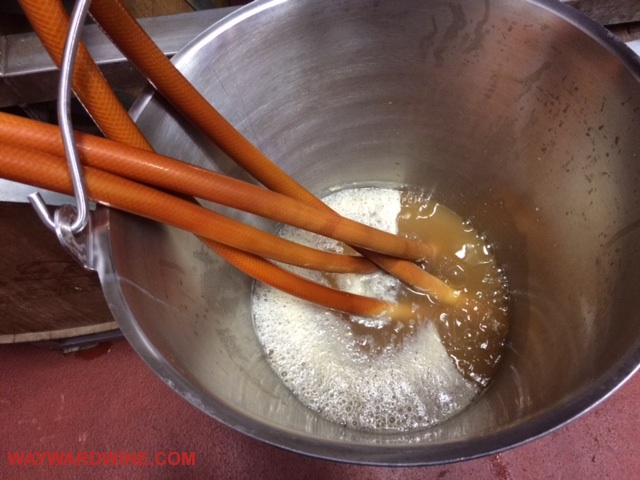
Burton Union Fermentation

We try their 2015 Russian Imperial Oatmeal Barrel Aged Stout: Parabola. It is silky black velvet ink.  The body feels huge, alcohol warm, yet decently structured, that if sipped slowly, you can survive its onslaught of toast, coconut, vanilla, and dark cacao.

Their snazzy bottling and canning line ends our tasting. Hungry, we cross an alley to the steel and timber restaurant, where more beers and food await us.

Firestone Walker is well worth a visit. On a hot (i.e. normal) Paso day, I would stick to their light beers such as 805 or PIVO.  They make fantastic, rich, monsters that win awards, but seem hard to work into one’s daily drinking rotation in such a climate.  Their beers are emblematic of the West Coast but without forgetting that hops and malt must balance each other.

Next Monday, we return to the gravel back of Paso Robles’ wineries.


Posted in Uncategorized | 1 Comment

Paso Robles 5: Austin Hope Treana Tasting Cellars

Wayward Wine continues its exploration of Paso Robles wineries. One day starts in search of wine for a wedding. An up-scaled, wood-planked warehouse sits between biotech buildings and similar sheds. Inside, large indigo walls fly up two stories, splattered with animal heads and art.  Lipstick red metal chairs frame the reclaimed wood bar and tables.  House-sized curved wood panels mimic sliced barrels dividing the space.  This is not a winery, it is a tasting lounge for the hip. Welcome to Austin Hope’s Treana Tasting Cellars.

The Hope family came to Paso four generations ago. Austin got into wine at Cal Poly, under Chuck Wagner (Caymus), and after a stint in the Rhône Valley replanted the Hope family vineyards with Rhône grapes for the Treana and Austin Hope wines served here.

They start us with a 2012 Austin Hope Roussanne. The label looks painfully minimalistic. Grapes arrived hand-picked entirely from their family vineyard in Paso Robles.  This 100% Roussanne saw seven months on lees all in French barrels. The APPEARANCE looks a pale golden hay. AROMAS smell heavy of wax, apricot, eucalyptus, and salt. The PALATE is meaty, full, viscous with mild acidity. FLAVORS taste of golden raisin and apricot.  Austin Hope’s 2012 Paso Robles Roussanne is good (3 of 5), at $20 a value, pleasant, warm and soft but myopic, wanting more structure and complexity.

We try Treana’s 2013 white, which sticks to Hope’s Rhone grapes with an equal split of Viognier and Marsanne. Its label (like the Chard below) is stylish and wedding ready. The AROMAS and FLAVORS power on with apricot, gold raisin, and white flower. The PALATE feels sweet, ripe, and full but with brighter acidity than the Roussanne.  Overall, a respectable good (3 of 5) for $24: perfect wedding white.

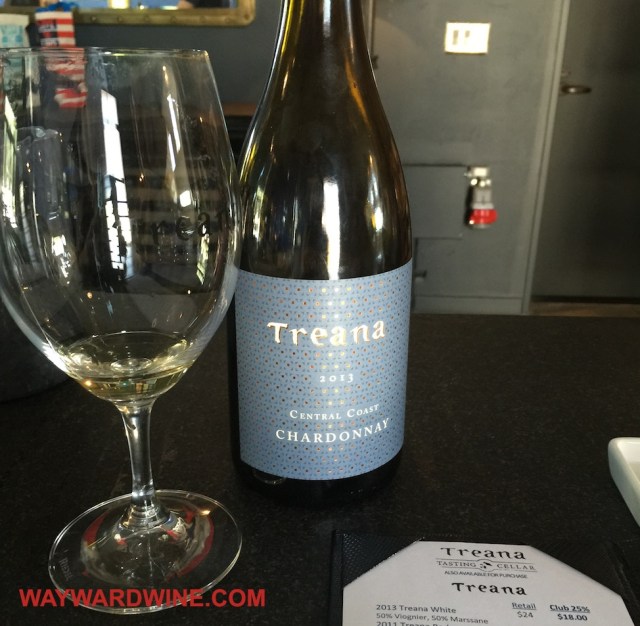
Treana’s 2013 Chardonnay flaunts a similar, modish, sparkly label: a huge improvement on their older designs.

Treana Chardonnay 2013

This all Chard show from Central Coast fruit (so, South of Paso) lived 10% in new French oak barrels, allowing fruit to come to the fore. It feels soft, fat, and mellow with ripe, tropic pineapple and honey dew melon flavors of medium length. Another solid (3 of 5).

To Rhône reds.

Toublemaker Blend 8 mixes the kitchen sink with Syrah, Grenache, Mourvedre, Zinfandel, and Petite Sirah. It smells and tastes of compote, nutmeg, and candied cherries. It is sweet, plump, soft, and yet dusty and acrid on the finish. There is acidity, but it feels added. The whole thing feels torqued, forced, and masked with sweetness: acceptable (2 of 5).

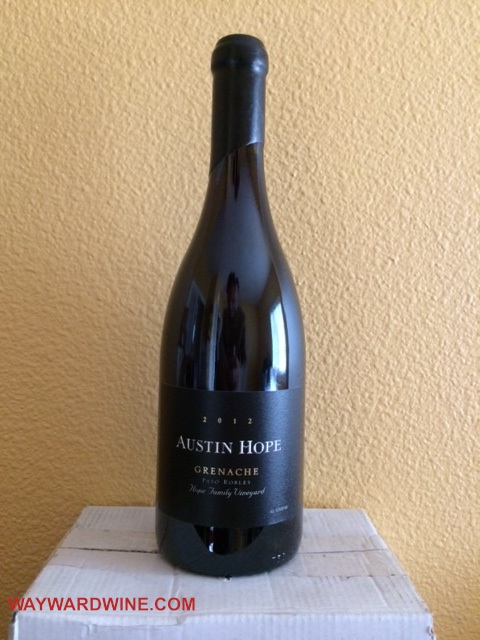
Austin Hope’s 2012 Grenache, another Hope Vineyard wine, saw 10 months in mostly new French oak from all over (Boutes, Claude Gillet, d’Aauitane, Remond, Meyrieux and Vernou). Only one racking kept it concentrated.

Austin Hope Grenache 2012

Pleasantly surprisingly, the APPEARANCE looks a clear, mild but bright ruby. AROMAS smell moderately of dried violets, potpourri, cherry skin, and light pepper. It is dry, big, and viscous, with ample alcoholic heat, but enough acidity. FLAVORS burn with vodka, dried cherry skins and dried florals again that last a medium length. At $42, Hope’s Grenache is very good (4 of 5), showing interesting restraint, enough so that we buy one.

Austin Hope’s all estate, all Syrah shows a deep, purple heart. Its aromas and flavors blast on about black cherry, dark raisin, and light tobacco. Its dryness, low acid, medium tannins, higher alcohol, and bigger body make for a hot, edgy, mini monster. With a longer length but oodles of imbalance, their Syrah is good (3 of 5) when in the mood.

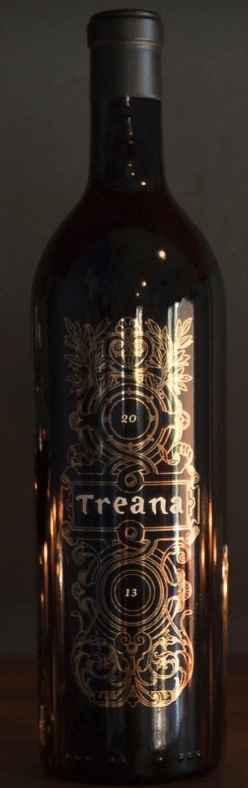
Next, Treana’s 2013 Red. A blend of 75% Cabernet Sauvignon and 25% Syrah sourced from Paso. Give it one thing, the screen-printed gilding is sexy.

Treana REd 2013

What we have here is purple ink. AROMAS pound the pavement with gum, cassis, jam, raisin, tobacco, and smoke. The PALATE feels tannic, big and chewy, dry and dusty. FLAVORS taste way too young, with cherry pit, cherry skin, cherry jam and cocoa. Treana’s red is very good (4 of 5), $45, but too young.

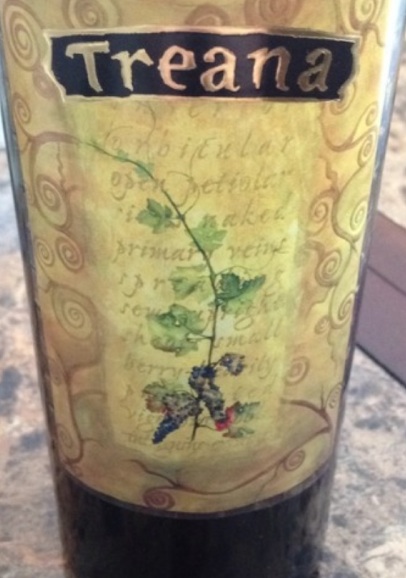
Luckily, Treana’s 2011 Red tastes readier (and looks retro, if you missed the nineties).

Treana Red 2011

This 62% Cab 38% Syrah mash up smells similar to 2013, but more open, spiced, with caramel and toffee aromas. Tannins have softened. Flavors still carry dark fruits, but dried petals have snuck in. It feels agreeable, mellow, lighter and very good (4 of 5) but should be drunk now.

Like Treana’s tasting room, Hope’s wines show an easy, clean, modern style that comes off mildly eclectic, if safe.  I think I obsessed over labels and room design because, as with the wines, the Treana and Hope ranges are finding a unity of style, purpose, and quality. That will come with time.  Austin Hope can make very good stuff. It is meant to please not challenge you.

Posted in Uncategorized | Tagged , , , , , , , , , , , , | Leave a comment

Thirsty Thursday: Olianas, Perdixi, Isola Dei Nuraghi, Sardinia Italy 2012

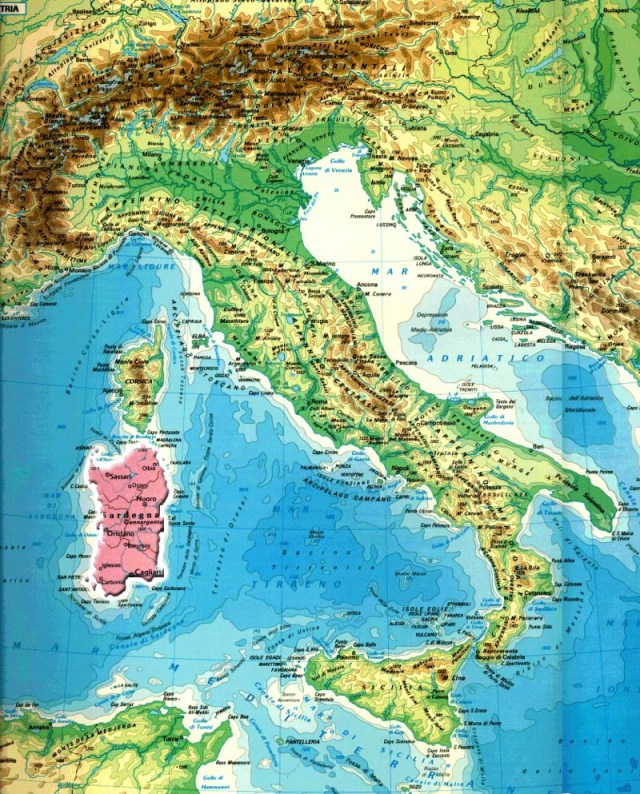
Happy Thirsty Thursday everyone. The weekend draws near. To help get us there, we travel (metaphorically) to the island of Sardinia.

Sardinia Map

Just South of Napoleon’s Corsica, Sardinia has been the Mediterranean’s Scotland: isolated, occasionally invaded, but fiercely independent. Interestingly, grapes from Southern France and Spain, not Italy, trickled down here.  Carignan, Grenache, Syrah, Cab, Rolle dominate plantings.

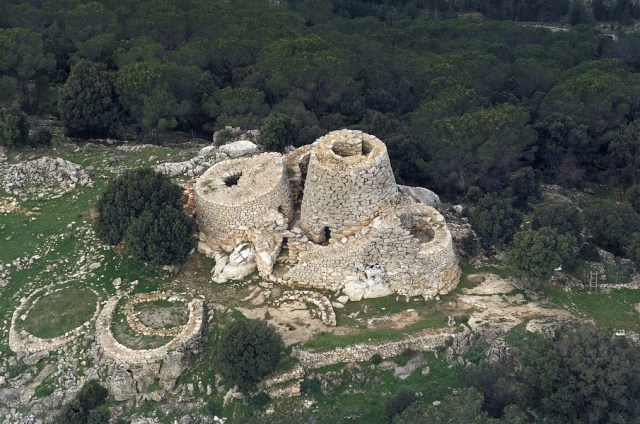
The IGT “Isola dei Nuraghi” confuses nearly everyone but Italians.  It covers the whole island of Sardinia. These Nuraghi are ancient towers, some 7,000 survive from a pre-phoenician civilization (1900 BCE to 730 BCE).

Nuraghe Sardenia

They are cool towers but have little to do with wine.  This IGT exists to keep grapes varieties off labels and free winemakers of the more restrictive DOC rules. And thus Olianas’s winemaker, Stephano Casadei ferments 50% Bovale (aka Graciano), 25% Carignano, and 25% Cannonau (aka Grenache) separately, blends, and then pops the wine into French bariques for a year.  They call it Perdixi: Italian for partridge. Let’s try it.

Olianas, Perdixi, Isola Dei Nuraghi, Sardinia Italy 2012

Olianas Perdixi Sicily
Its APPEARANCE looks a clear, medium plus ruby rimmed color with a purple core. AROMAS smell of plus intense, layered kirsch, dried blueberry, lavender, ginger snap cookies, tobacco, and salt. The PALATE feels dry, with medium acidity, soft tannins, a moderated, warm alcohol akin to slow-burning stones at a spa. The body is medium plus and texture feels smooth, modern, yet somehow lean. FLAVORS are medium intense but complex: black cherry, iron, hay, dark sugar, raspberry, and candied orange peel.

Olianas’ Perdixi  is a modern, slick, well-balanced yet not boring red with ample complexity for grilled meats, lamb, funky tempeh, aged hard cheese, garlic, tomato magic.  Very good (4 of 5).

Posted in Uncategorized | 2 Comments

Paso Robles 3: Deovlet Wines

So we may be back in Paso Robles, the hot home of big reds, but the Central Coast followed us (read Laetitia post). Tucked behind Cypher Winery, at the crossroads of the 46 and vineyard drive, hides Deovlet’s tasting room.

Ryan Deovlet (the o is silent) makes wine in a warehouse in San Louis Obispo. Inspired by farm to table coffee, he sources single vineyards throughout the Central Coast for Chardonnay, Pinot Noir, and some Cab and Merlot. The Deovlet tasting room sheens white with a marble countertop, surgical stainless, and buttoned servers.

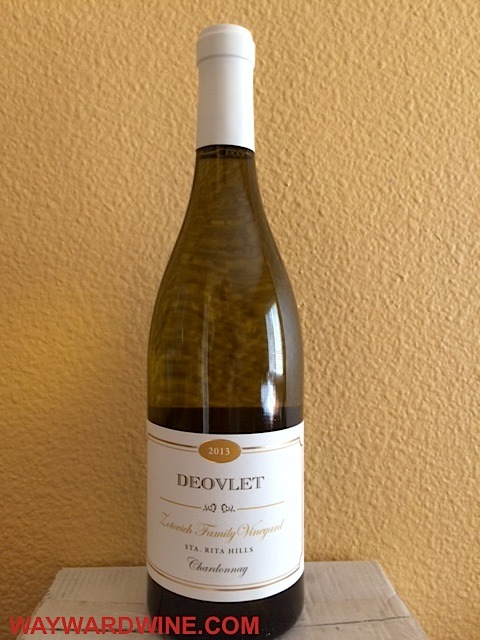
We start with Chardonnay: Zotovich Family Vineyards in Sta. Rita Hills:

Deovlet sta rita hills Chardonnay 2013 Zotovich

Zzzzziiiiiiinnggggg! Forget whatever Rombauer-tainted, butter bomb nightmares you have of Californian Chardonnay. Think Chablis in a warm year. The APPEARANCE looks a pale hay. AROMAS lead with lime, white pear, salinity, and a whiff of vanilla. The PALATE feels dry, with mouthwatering, medium plus acidity, and lean alcohol and body. FLAVORS taste briny like oyster shell braced by lime peal, white pear, pale oak, and apple that last a medium plus length. For $40, Zotovich Chard is very good quality (4 of 5) with years ahead of it, so we nab one.

Deovlet’s 2013 “Solomon Hills” Chardonnay comes a bit north in Santa Maria Valley.  Energy and vibrancy shine again center stage here. Flavors tend toward slightly riper, deeper, softer tangerine backed again by lime, pear, and salinty.  15 months on the lees and in 10% new French oak lend it a nutty complexity. Their Solomon is very good (4 of 5) but lacks the linear focus of Zotovich.

What a pleasant surprise.  However, Pinot Noir is Deovlet’s main medium. The Santa Maria Valley’s Bien Nacido 2013 arrives in our glasses all sexy and spiced with potpourri and ripe raspberry fruit. Medium acids and tannins stand it up, a slight mushroom and lead minerality flake it with interest, but this Bien Nacido is not serious stuff. It wants to snuggle (while whispering about architecture). It is very good (4 of 5), fruity and silky but might be more interesting in a few years ($55).

Back South to Sta. Rita Hills’ John Sebastiano Pinot Noir 2013, we find darker, denser fruits with more body. Think black cherry dusted with cinnamon, clove, and light tobacco. The quality seems good (3 of 5) but its youth hides future complexity ($48).

2013’s Santa Barbara County blends the above SMV and SRH AVAs into a smooth pleasure pot of Pinot. 15 months in 30% new French oak barely fazes the ripe, red fruit. We like the light toast and tannin that the oak adds, but pinot this ripe and clean, with such moderate acid, slips seamlessly past us. It is good (3 of 5) and we would drink tons of it without blinking ($40), if we could afford it.

Deovlet’s 2012 Sonny Boy mixes 60% Merlot with 40% Cabernet Sauvignon from Santa Barbara (Happy Canyon AVA). It ages for shy of two years all in French oak, 40% of which is new and toasty. Big, fruity, and smooth, warm blackberry and plum dominate aromas and flavors, supported by sliced black olive and a dusting of cocoa, tobacco, and tannin. It is good (3 of 5) ($40)

Deovlet avoids the oak trap with elan.  Fruit thankfully leads all his wines. The only quibble is that his Pinots seem too perfect, too clean.  I want to try them a decade from now. Maybe as they start fall apart they will show more complexity and the true nature of each vineyard.

His Chardonnay provided welcome relief though: tight, clean, and defiantly mineral, I wish more people went this direction. Great work.


Posted in Uncategorized | 3 Comments

Thirsty Thursday: M. Chapoutier, Chante Alloutte, Hermitage, France 2012 marsanne

This Thirsty Thursday we open a white wine from Hermitage: a region in the Northern Rhone Valley of France famed for its rich Syrah (so rich, that Bordeaux once “hermitaged” its reds with wine from here).

image

Times have changed.  345 acres of vines cling to steep slopes, producing intense, tannic, Syrah that can age half a century. But rare whites from Hermitage can be equally fantastic (if pricy).

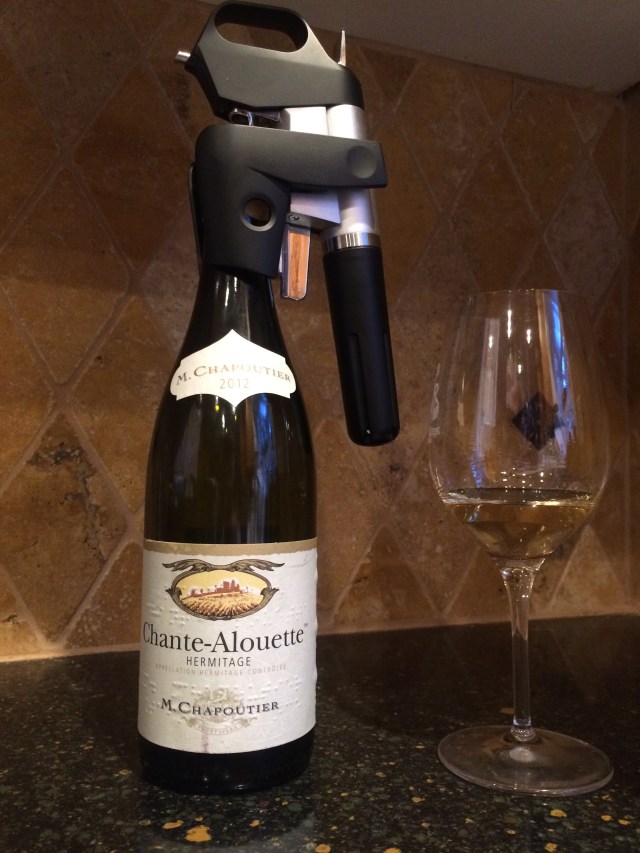
The ever-animated Michel Chapoutier produced today’s biodynamic white, oddly, from 100% Marsanne grapes (forgoing Roussanne, because he dislikes it). They arrive, hand-harvested from his Chante-Alouette vineyard of clay and limestone soil. After all kinds of gentle fermentation, a third in large barrels, tasting, lees stirring and nearly a year of aging, the wine find its way into my fridge. Since it costs around $90, I tease it out with a Coravin.

image

The APPEARANCE: looks an easy, clear, golden color, with a wash of glue for legs. AROMAS: exude clover honey, gold pear, shaved almond, ginger, and saline solution. The PALATE: jumps at us, dry, with medium acidity, a warm but medium 13.5% abv, and a medium plus body.  What matters here is texture: it slips, viscous and smooth, yet the finish seems sprightly, assertive and dry.  FLAVORS: coat and last a lifetime, with deceptively soft gold pear, honey, ginger, and hay.

Chapoutier’s 2012 Hermitage Blanc is one of those rare, seemless sunsets over a hay field. At just the right moment, every inch glows an intense yet warm gold of varying hues. It is outstanding (5 of 5) and has decades in it to go. But, right now, grill a chicken or slice some ripe pear or toss golden raisins on a salad with goat cheese and be happy.

Posted in Uncategorized | 2 Comments