Graves Open Doors 3: Château Caillivet in Bordeaux

Today continues our exploration of Graves: Bordeaux’s diverse, left-bank, value region that struggles in the shadow of famed and pricier Haut-Médoc.  A white van has toured us around the village of Langon, visiting its wineries for free (this is an EU Austerity Drinking Tour after all).

bordeaux-mapWe leave “Château” la Croix‘s rustic charm.  A new driver asks for our next winery.  The local girls say something.  I blankly agree.  But my wife’s glare cuts me down.

“They don’t like you”, she growls. “I know. But it doesn’t really matter which winery we go to.” “Yes, but you choose one, they don’t want us around”. “Fine”.  Angry, tipsy, and both of us sick and stuffy we continue to whisper/fight.

Luckily, our van stops at a huge winery.  People bus about the parking lot. Cars, trucks and off-road buggies fill it.  Excited, thirsty, and annoyed, the threesome leaves us.

We drive on.  Graves is not rich compared to the Medoc.  There are few fancy châteaux.  Really, most are barns/wineries who all persist at calling themselves Châteaux.  Towns look small and simple.  Some homes look abandoned.  Really, farmland and an airplane assembly plant provide Graves’ wealth.

CaillivetBarn

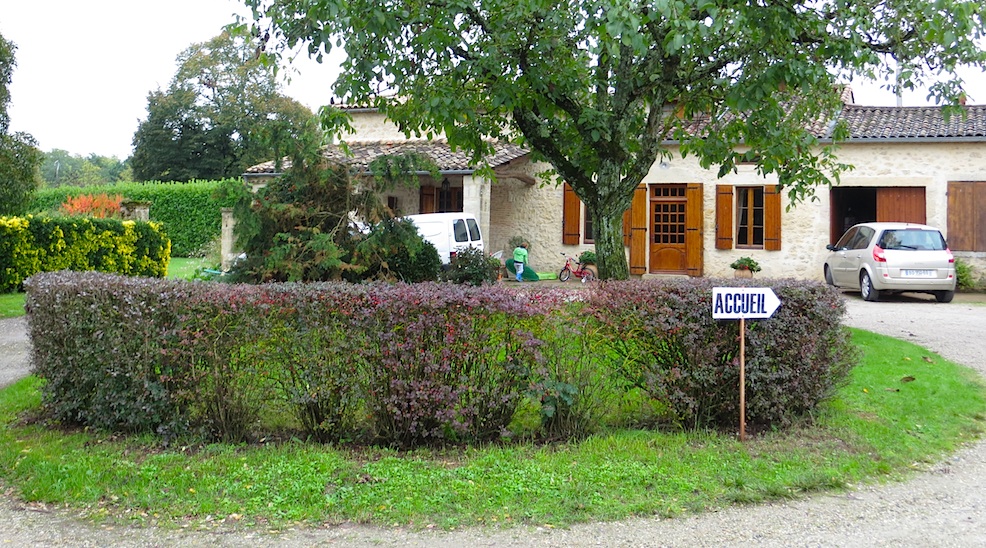
A “Château”

Our guide makes every winery we pass sound like the same cute husband and wife, grower/maker of white, red, and whatever.  I choose one that only makes red: Château Caillivet.  My wife dishes up more flack for choosing the second-to-last winery.  But palate fatigue and illness are catching up to us.

The van twists between small hillocks, stuffed with trees.  Finally, it strolls up a manicured slope with golden green vines on our right.  A clean, modest home sits on top, shaded by trees.  It seems very still here.
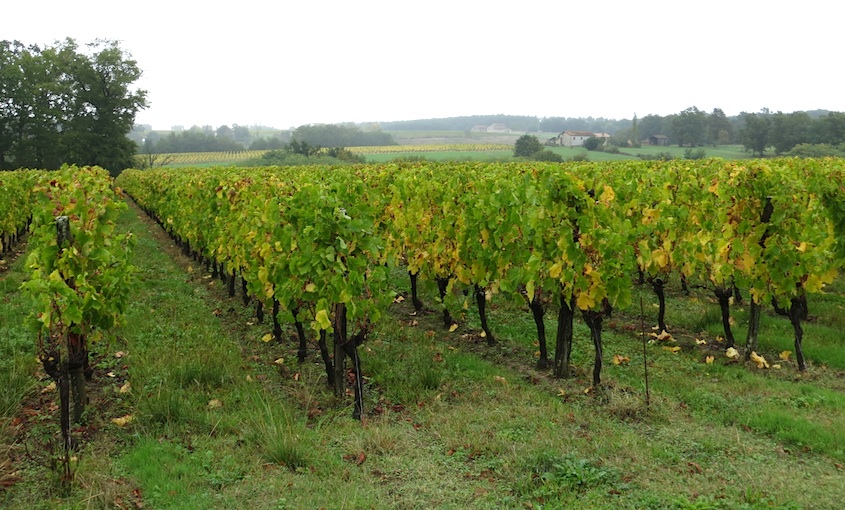
CaillivetVines

Tidy vines.

Célia Carrillo greats us.  She lets us finish our avocado and bread lunch, while explaining how her father Philipe and her brother Antoine began planting and building in 1997.  Antoine was a Bordeaux U grad, who lived above vineyards while studying.  Today, they have just 20 acres.  They only grow Cabernet and Merlot (but whites are coming).  Célia runs the business.  Although young, at least they have 2010 under their belt (and in bottle).

As the rain picks up outside, Célia tastes us through it:
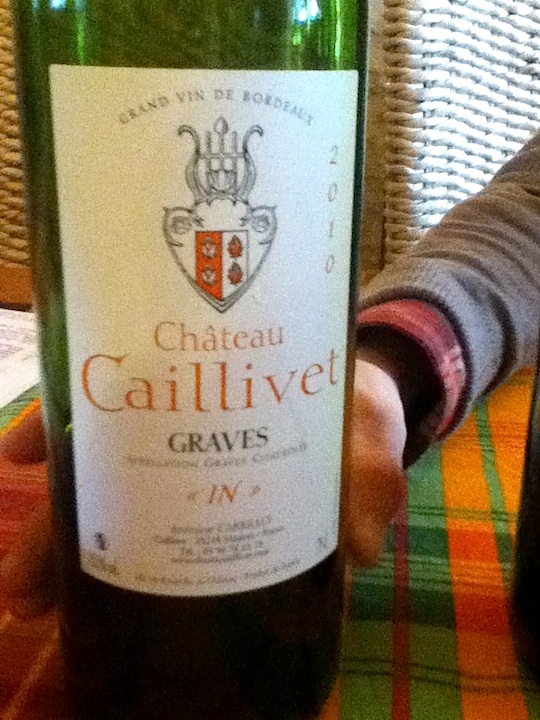
CaillivetIN2010Graves

Are you “IN”…?

Château Caillivet, “IN”, Graves, 2010

This is their attempt to draw “in” a young crowd (sorry).  It looks a medium ruby with noticeable legs.

Aromas smell youthful but strongly of black prune, clay, and calcium mineral.

The palate feels dry, zippy, decently tannic, and medium bodied.

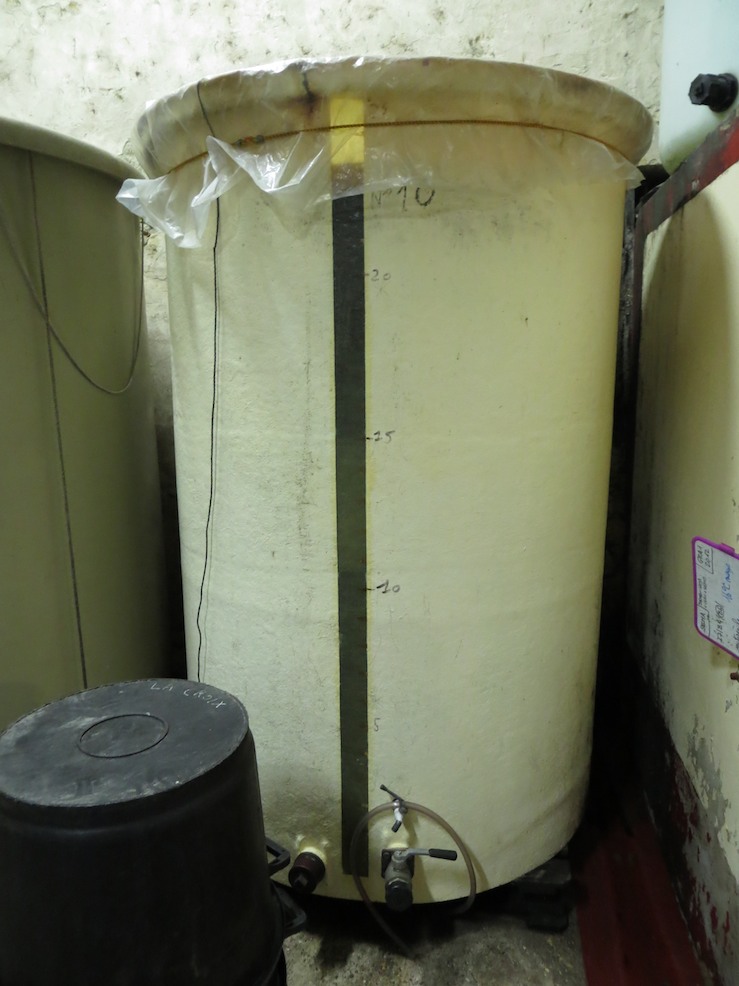
Average flavors taste of tart black fruit and clay mineral.  The culprit behind all this simplicity and cleanliness: stainless steal tanks (below).  Nary a barrel sees this wine, which also explains why it costs 7 Euros.

The medium length, and medium-ness make “IN” a functional, good, all around wine (3 of 5).  It wants food with so much tannin and acid, but nothing too saucy or heady.  Appetizers.

CaillivetTanks

Tidy, sharp, and clean.

Next up: Château Caillivet’s oaked 2010 Graves 60% merlot 40% cabernet sauvignon.

CaillivetGraves2010

Oak!

Already, this looks deeper in color, with a shorter clear rim: serious.

Still nascent aromas smell of ripe, red cherry, black plum, and tobacco.

Better fruit means less acidity, more ripe tannins, and a medium body.

Gorgeous, medium-plus intensity flavors of dried black cassis, mint, salt mineral, and tobacco carry for a pleasant, medium-plus length.

Eight months of used barrel time has made for a very good (4 of 5) bottle that only costs €12 at the winery.

I would set it down for two more years.  Woody tannins and that strong minerality need time to cool down.  But thank you barrels for bringing some interest.

CaillivetBarrels

Woody.

Finally, we reach Caivillet’s last wine.  Wait! Just three?  Yup.
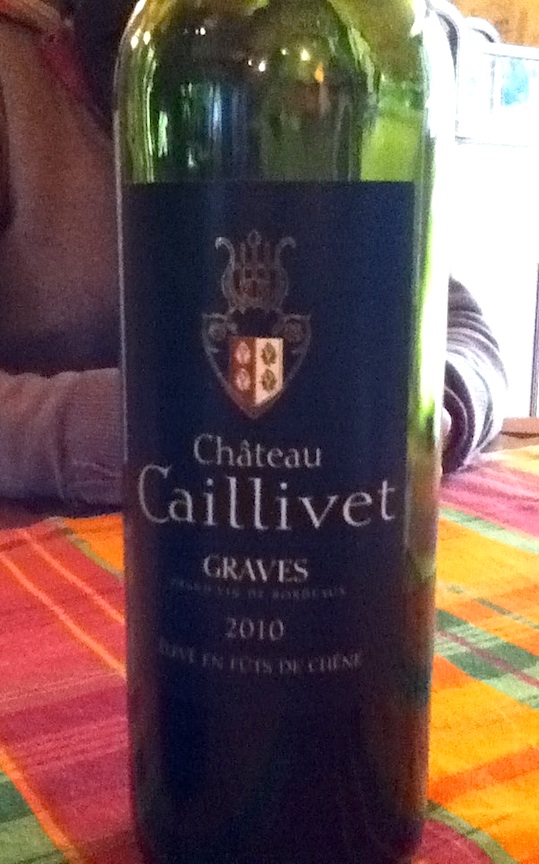
CaillivetGrave2010

Technically, the black label is the only visible difference.

The only discernible difference is its black label (they could use some product differentiation).

As before, this 2010 looks a deep, dark purple.

Aromas smell of a quieter but more complex range of ripe red cherry and black plum, dry rose petal, and ash.

Like before, the firm, tannic backbone and medium body show that they are serious.

Complex, powerful flavors of dried black cherry, raspberry, and red licorice start it off, followed by a mint, salt, pine, cocoa-powdered finish.  The length is pretty long.

8-12 months in second use barrels makes this black-label very good (4 of 5).  It tastes ready to drink, but a bit of decanting or aging would not hurt it.  It’s so good (and only €8) that we buy one.

Caillivet’s U of Bordeaux background shines in how painfully pure and clean their wines taste.  Only growing Cabernet and Merlot seems a bit simple, even risky, given how wet and cold it gets here.  But they make it work.  They have oodles of potential.  Just clarify your range.

Next Monday we wrap up our Open Doors tour of Graves at a behemoth of modern, stylish wine-making.

Posted in Uncategorized | Tagged , , , , , , , , , , | 5 Comments

Torbreck, Cuvée Juveniles, Barossa Valley, Australia 2010

Forget Yellowtail. Forget Crocodile Dundee. Forget everything you know about Australia.

Instead, put your mind in Paris. Get off at the Pyramide Metro, not far from the Louvre. Wiggle your way to 47 rue de Richelieu, and then, behold: Juveniles:

Juveniles Bar

Oui!

Now think of Scotland.  Because inside you will find fantastic British farmhouse cheese, charcuterie, and Haggis always on the menu.  Tim Johnston, a Scot ex-pat, founded it decades ago.

But now, turn to South East France, because Juveniles is a wine bar, and gained its cult following for pouring the Rhône Valley’s best wines.  But then, Tim shocked Paris.  He poured Australian Shiraz.

Your head may be spinning, but follow the thread.  Australia grows Syrah, Grenache, Mourvèdre, and other varietals typical of the Rhône Valley.  Many vines predate the French (thanks to dodging phyloxera).  And what would pair better with haggis for cult Rhône drinkers than Shiraz.

But then, in walks Dave Powell, an Australian of Scottish heritage.  Dave fought Australia’s early 1990’s “Vine Pull” pogrom by partnering to save old-vine growers.  He founded Torbreck.  A desire to make restrained wines like the Rhône led him to visit France, often.  Inevitably, Tim and Dave hit it off.

By 1999, Tim asked Dave to make him a wine.  So Dave blended the Rhône’s main players (Grenache 60%, Syrah 20%, Mourvèdre 20%) from 40-150 year old Barossa vines.  Each vineyard was fermented separately, then blended, aged in stainless, allowed a natural malo-lactic fermentation, and finally bottled without filtering or fining.

But something was missing.

The walls of Juveniles are colored with paintings by Carolyn, Tim’s daughter.  So Dave asked her for a label.

TorbreckJuvenilesLabel

Bold.

She took Dave’s pale, white labels with trees and created a label worthy of the wine.

Tonight, we crank the screwcap off of 2010’s Cuvée Juveniles.

APPEARANCE:

It looks like beet juice: opaque purple and ruby-rimmed.

AROMAS:

It smells quite complex.   Fruit dominates, akin to raspberry compote. But that morphs into ripe, sun-warmed leather.  Musk is there.  Then somewhere, bright eucalyptus and lilac sneek in.

PALATE:

It is dry, with moderate acids.  The body is fulsome and meaty.  Only at the end do lean but grippy tannins and alcohol (14.7%) beg for a haggis.

FLAVORS:

It taste firmly of fig newton, cherry, orange peel, and dark black berry, pencil dust, and cigar.  I am sure there is oak here, but Mouvèdre’s spice tricked me.  It seems all blackness and brooding youth, yet remains snappy.  The medium plus length makes for a very good wine (4 of 5).  $15-$25.

Nothing could fuse Paris, Barossa , Scotland, the Rhône, and who knows what else into one bottle.  Yet Torbreck’s Cuvée Juveniles manages the trick because it tastes so complex yet seamless.  New and Old World traditions almost tear it apart.  But this is a wine with a foot in both worlds.

ADDENDUM:

Owners booted founder Dave Powell in 2013, although by then he had become a figurehead.  Since 2006, Dave had hired Craig Isbel to take over wine-making, so he could promote the brand.  Isbel, with 20 years of wine-making, carries the torch of Torbreck, and sticks to the recipe of top fruit, minimal intervention, and perfected blending.

Posted in EMPTIED BOTTLES, Grenache | Tagged , , , , , , , , , , , , , , , | 1 Comment

Getting Dirty in Graves: Château la Croix

We pick up last Monday’s EU Austerity Drinking Tour post south of Bordeaux, sick, but thirsty.  Our free, Open Doors, van tour of Graves had started decently.  Château Pont de Brion let us taste a mini-enprimeur of 2012’s just-harvested varietals.  They were tidy, well-branded, but too clean to be outstanding. Then I kicked a dog (accidentally), and they kicked us out.

Today, our van bounces to its next stop: Château la Croix:

Chateaux La Croix

Chateaux? Sure…

The word Châteaux clearly gets applied to anything in Bordeaux.  A child plays with gravel in the driveway.  A stable-winery glares orange.  The center tree shades a large, black dog who greets with a lazy bark.

But superficiality be damned.  We came for wine, not glamor.  Our van clatters off, leaving us and three, twenty-something ladies in the parking lot.

Finally, a round Napoleon emerges. Mr. Espagnet takes us aside. No English? OK by us. Vineyard tour or winery tour?  Our three black-haired girls waver. They just want a drink.  But the rain holds off, so I ask for vines.  Mr. Espagnet nudges his black and neon-green glasses up his short stub nose, smirks, and off we go.

Chateaux La Croix Vineyards

Graves’ gravel!!!

Graves’ famed gravel, its Garonne river, sloping hills, and all things drainage are explained.  Then the vines.  Those gnarly vines.  Mr. Espagnet’s dirt gray fingers grab a cluster of grapes. They’re Sémillon: usually a white grape, but Mr. Epagnet smiles and says god is color blind.

GreyRotGraves

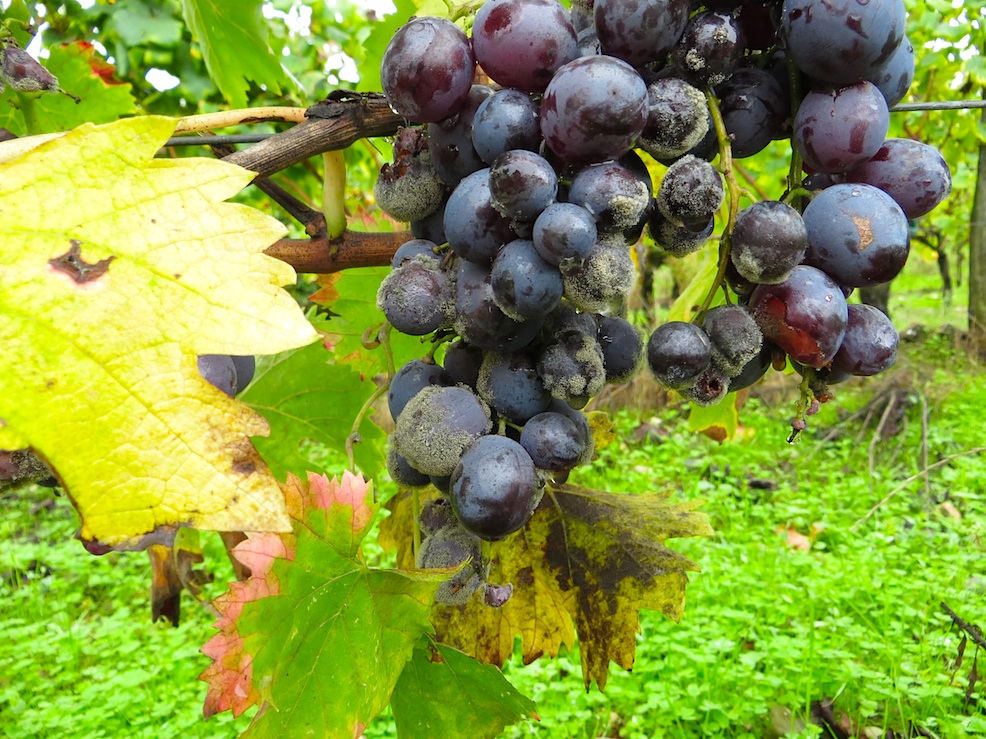
FUZZ!!!!

Blue-grey fuzz peppers these black orbs. Our guide pops one in his mouth. The girls squeak. He proclaims them nearly sweet enough for Sauternes: that most-golden of dessert wines. His earthen fingers squeeze another. It splits along a fuzzy seam, oozing a greenish gold.

Botrytis cyneria, a bacteria, is the culprit.  Known as “Noble Rot” when it attacks grapes after they’re ripe, bad “grey rot” when before.  The bacteria pierces grape skins, gradually desiccating them, concentrating sugars.

Graves’ rolling hills trap morning fog from its rivers. This damp, cool morning is perfect for growing the bacteria on grapes. Although rain threatens, usually afternoon sun dries and slows Botrytis from overdoing it.

Mr. Espagnet grows Sauvignon Blanc and Muscadelle to balance his dessert wine and also make whites.  For reds: the Cabernets, Merlot, a bit of Malbec, and a two hectares of Petite Verdot grow here.

He likes our poorly formed questions.  But the girls furrow their brows at our invasion. So we head inside his converted stable.

Ten foot high, composite plastic, open top tanks bubble merrily.  Taller stainless tanks loom.  Wine-stained tubes and pipes dangle along walls.

CroixTanks

Modernism finds its way anywhere.

His aging room contains two more fermenters, with red wine splashing continuously over it’s skin cap.

CroixPlasticTank

Sanitary!

Barrels sit atop each other in the far corner, and opposite, a wall of more cement tanks for aging red wine. He uses all French oak, but has a few American barrels for kicks.

CroixBarrels

Small scale.

I then ask a question about fermentation.  Everyone in Graves uses laboratory cultured yeasts for consistency, Mr. Espagnet claims.  Egg whites and gravity are also de riguer for fining reds. Graves may be in the limelight of St. Emilion or the Medoc, but it follows what works.

Sober and thirsty, we go to the tasting stable.  A large table lines up bottles alongside paper plates of fois gras, mussels, and cured meat.  The challenge: find which vintage wins covering over a decade:

Whites first: Château la Croix, Blanc, “L’Acacia” 2010 6 EU

ChLaCroixAcacia2010

White!

A white blend of Sémillon, Sauvignon, Muscdelle. Bright yellow colors lead to a panoply of young citrus and grapefruit aromas.  A tart, light body is punched up by flavors of grapefruit and sea salt, which sends us to the mussels.  This is sharp, characterful, medium plus length, and good (3 of 5).  A refreshing, lively aperitif, great with grilled fish or seafood

We then try a 5-year-old 2007, Blanc Sec fûts de chêne (4 years of oak aging):

Extra golden colors lead to strong nose of candied fruit and vanilla. Bright acidity still tightens a round body.  Powerful minerals, pear, lime, mint, and soft vanilla fill the palate. We try the horrid-but-delicious fois grois.  It makes the wine lighter, citrusier, and more complex. The only lack is the length. Still, this is very good (4 of 5). Oddly, this has a decade ahead of it. And only 7.50 EU!

On to the reds! Time to pit ripe, famed 2009 against 2008: “L’Acacia”, Rouge, 2008 vs 2009:

Both ’08 and ’09 look dark ruby. Both smell of red and black fruits, although 2009 shows a hint of bell pepper.  Structure-wise, 2008 feels more acidic than 2009. Tannins feel meatier on the 2009. Both bodies feel medium in weight.  2008 tastes of tart red fruits, while 2009 tastes riper and blacker, but both share a lovely line of chocolate.  The 2009 is riper and chewier. Both are solid goods (3 of 5), especially under 10 Euros.

Time to up our game to Croix’s “Premium” Red range.  2008 and 2009 Acacia were nice.  Let’s see how 2006 and 2007 Premiums hold up.

2007 already looks a garnet, ruby.  Strong, angry, charred vanilla aromas lead to minor black and red fruits.  Dry, bright acids make for a lean, structured, limestone mineral, burnt wood wine with a bit of tart dark cassis.  The length is long.  2007 is good now (3 of 5) but desperately needs cellar time.

2006 still looks a lovely ruby. Aromas express bright red fruit, cassis, cigar, and even floral tones.  Fresh acids, upright tannins, and a medium body show promise.  Flavors of ripe red and black fruits get checked by cigar.  An impressive length makes this very good (4 of 5).  Yet only 8.50.

Brace yourselves.  Our palates dive a decade into the past: 2001 -vs- 2002.  Do they taste like undergrad???

We start with 2001. Very exciting!  No color remains but a pale garnet.  A confident nose holds out with toasted vanilla bean, fall leaf, and cranberry.  Alive acids and balancing tannins head straight into bold flavors of fall leaf, cigar, and black fruit. But they are fading.  This is becoming a pure oak show, yet still vibrant. The length is medium. The quality remains good (3 of 5). For 8.10 EU buy it.

Now for 2002.

ChlaCroix2002

Getting fuzzy…

A deeper garnet fills our glasses.  Still young, moderate aromas of mocha, red, and black fruits shine.  More acid, more tannin, more body, and more flavor prove that 2002 is more alive than 2001.  Chewy chocolate, cigar, black and red fruits fill the palate for a lengthy while.  2002 is very good (4 of 5).  We wanted to love the 2001.  But 2002 is just better.

By the end, my wife and I are starving.  Rain pours outside. It is probably 2 pm. We devour half our baguette and avocado, while the girls dart angry, hungry glances.

Mr. Espagnet and his “Château” La Croix makes credible, real wine in Graves.  He charges nothing for them.  We start to realize that Bordeaux, at least here in Graves, can make real, daily wine for under $15.  Because we’re horridly sick, we buy his rosé and get ready for the van.

Check back next Monday. We continue our Open Door tour of Graves with Châteaux Caillivet.


Posted in Uncategorized | Tagged , , , , , , , , , , , , , , | 4 Comments

Mähler-Besse “Cheval Noir” Grand Vin, Saint-Émilion, Bordeaux, France 2009

It is Thursday. Work-weariness be damned. I could use a drink.

Since we reached Bordeaux with Monday’s EU Austerity Drinking Tour, nostalgic, I decide to crack open a Bordelaise stateside.  Tonight’s entry derives from Saint-Emilion: famed sub-region on the Dordogne River’s right bank.

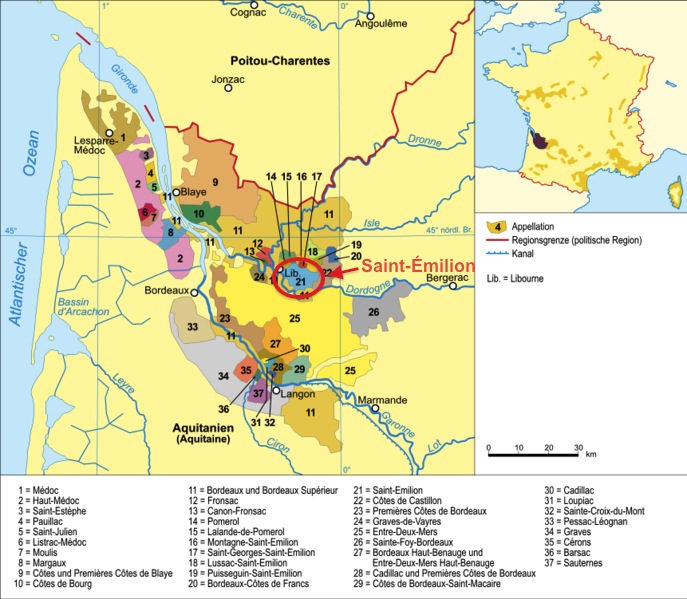
Saint-Émilion Bordeaux Wine Map

That blue blob #21 is Saint-Émilion

The world drinks and grows Merlot because of Saint-Émilion.  Veins remain in its chalky cliffs, cut by Roman vine roots nearly two millennia ago.  Sideways may have tarnished the grape and drunk Cheval Blanc from a paper cup.  But wines from Saint-Émilion steadfastly remain the most expensive and collected worldwide.

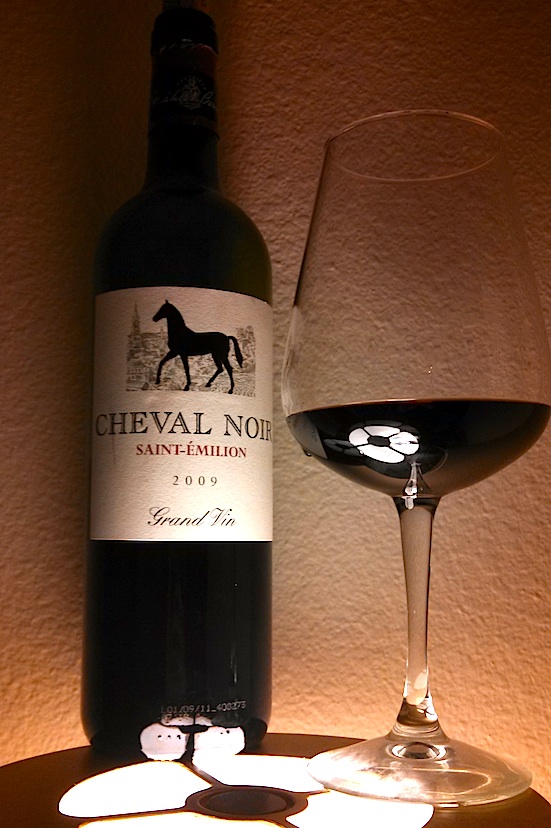
Tonight, we drink 2009’s Cheval Noir (no relation to the famed Blanc).

ChevalNoir2009The established négociant Mähler-Besse produced it from sustainably grown grapes.  70% of them are Merlot, followed by 20% Cabernet Franc, and 10% Cabernet Sauvignon.

Appearance: The wine looks filtered, clear, with a deepish ruby core and a moderately clear rim turning the clock towards garnet.

Aroma: It smells moderately intensely of plum pudding and rye bread, with hints of warm kirsch sneaking up from its core, framed by a wafer of vanilla and a bit of earth and musk.

Palate: The dry palate has decent acidity and some tannin. However, this is ripe, plush, medium-plus bodied stuff.  2009’s famed warmth and easy growing season shine here. Tannins tighten down this big ship nicely though.

Flavor: Decently complex, moderately intense flavors of fig newton, kirsch, and tart bramble fruit vie against newspaper ash, nettles, and pencil-like minerals for a medium length.

Conclusions: I don’t want to like Cheval Noir.  Yet I appreciate its attempt to be taken seriously.  The char, earth, and tannin somehow keep all that ripe fruit from becoming too New World.

Cheval Noir is not classic or textbook.  But it manages to please yet engender respect.  Very good (4 of 5).

This black sheep mimics and mocks it’s famed roommate, Cheval Blanc (one of only four Premier Grand Cru Classé “A”, averaging over $700).  But it knows what it is.  A less-austerely self-titled “Grand Vin”, that costs under $20. A red for us masses, who know enough to spend a bit more on AOCs like Saint-Émilion, rather than generic Bordeaux.

Posted in Uncategorized | Tagged , , , , , , , , , , | 2 Comments

Open Doors in Graves: Château Pont de Brion Bordeaux Deconstructed

Day 93 of EU Austerity Drinking finds us sick, stuck in bed, in Bordeaux, and worst of all, completely sober.

But “Portes Ouvertes dans les Graves” is happening.  Basically, free buses will carry us from one free winery tour and tasting to the next, until we have soaked in all that Graves has to offer.

Graves Portes Ouvertes

Chef wine glass? Oui!

So I drag my flu-riddled wife out of bed.  We miss the first train, after hacking and coughing our way to the station.  We catch our breath, and hop on the next.  While we chug out of Bordeaux, here’s some context.

Graves is a subregion of Bordeaux.  It covers vineyards that surround the city and run South along the Garonne River’s left bank.

bordeaux-map

Graves: that peach blob on the bottom.

Its name has nothing to do with dead people. Graves (sounds like, “mauve”) refers to the soil, made of fine, well-draining, gravel pebbles that glaciers churned out of the Pyrenees during the last ice age.  This gravel can go 50 feet deep. Which is a good thing, because this valley is flat.

Graves Train

Like a vinous pancake!

This valley is also miserably wet.  Without drainage from Graves’ gravels, the place would be a swamp.  Swamps make grapes angry.

After a half hour, we land in Graves’ southern tip: the village of Langon.

TrainGraves

Adorable!

We meander, stuffy-headed, until we find Graves’ tourist office.  They beam with excitement: the rains clearly have dampened turnout.  In little time, we pile into our chariot: a white minivan with a fairly chatty driver.

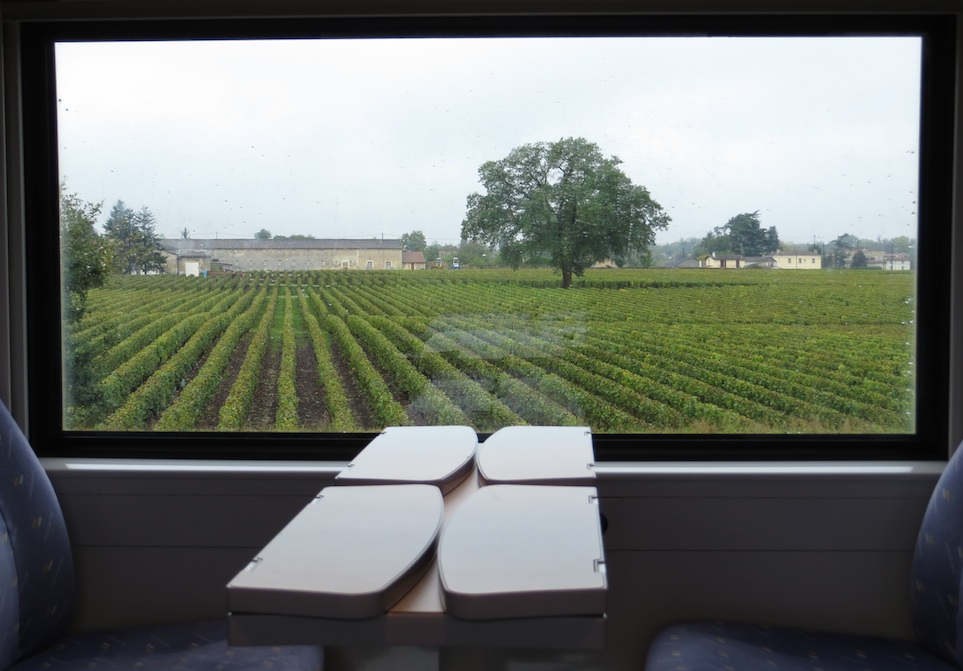
Soon outside of town, our tin can rattles into Château Pont de Brion’s gravel parking lot. Green and yellow vines stretch in soft rolls around the complex.  Two, orange-tiled, yellow-painted, single-story buildings face the center lot.

Pascal and Chantale Molinari greet us with awkward English.  Pascal, tall, grey-haired, and sweater-vested, then walks us shortly through three rooms of sharp, stainless steel tanks, a handful of strewn-about barrels, and between large cement cubes, inside whose ports we see yellow enamel lining for his red wines.

PointDeBrionTanks

Compact!

We end up in a hall with five bottles. Each has a sticker with a grape type. A young couple wafts in and out of the room. He gets more glasses. We start tasting.

BlankBottles

How exciting!

These are just-fermented, single varietal wines from this 2012 harvest.  Pascal has yet to filter, fine, blend, or age these Bordeaux-to-be.  What better way to understand some of the world’s most complicated blends, than with its wine deconstructed?

Sémillon:

It looks a hazy, light lemon color.  Young, moderate aromas smell of Asian fruits, mango, clove, and cinnamon spice.  The palate is dry, with adequate acid, alcohol, and body.  Flavors of cinnamon, cardamon, and tropical pineapple last for a medium length. Clearly, Sémillon is the soft, spice box of a Graves Blanc blend.

Sauvignon Blanc:

This other major player in white Bordeaux blends looks a bit greener in color.  More powerful, youthful aromas of green bell pepper, grapefruit, and a slight honey emerge.  It feels dry, with notably more acid, but average alcohols and body.  Again flavors of lemon and grapefruit, grass, salt, and yeast assail the palate with more vigor than the Sémillon.  This is where Sauv Blanc snaps and structures the blend.

Cabernet Franc:

Parent to Cab Sauv and second string in most Bordeaux reds, 2012’s Cab Franc looks a hazy, medium intensity, dark purple.  Strong aromas remind us of beets and pomegranate.  The dry palate perks up with bright acidity, noted tannins that average out to medium alcohol and body.  Flavors taste moderately of pomegranates, beets, and stones. This is too young, but Franc clearly brings Bordeaux’s aromatic punch.

Cabernet Sauvignon:

Cab ripens later than most varieties, and Pascal harvested this only six days ago.  I just stopped fermenting.  It looks hazy, and a deeper purple than the Franc.  Aromas smell moderately again of beets and black fruits or berries of some sort.  Highish acids match the Franc, but more robust tannin grips our gums.  Young flavors of black fruits, and that ripe, bloody beet ring again like all their reds.  Cab Sauv’s thicker skins add color and tannin.

Merlot:

Again, hazy purple.  Medium aromas of wet earth, beets, and hot-mashed black fruits smell pleasant.  Acids step back and let fairly rich tannins and body dominate. It tastes of leafs, beets, and black fruits.  Merlot, that staple of Right Bank Bordeaux (but much derision beyond), tastes fairly complex and would add heft to a blend.

Petit Verdot

Lastly, this wine looks deep, dark, and blue.  Turbo-charged aromas of bull’s blood, red apple, chocolate, and all spice mess with our noses.  Big tannins and body through their weight around.  Bold flavors of raw beef, red apple skin, chocolate, and all spice pop up again. This would immediately beef up any blend, like espresso added to milk.  But Pascal, like most, only grows 1 hectare.  Petit Verdot is a pain to ripen.  He also doesn’t mess with Malbec or Semillon: used occasionally in other mixes.

These wines are in their infancy.  The quality is fine now but hard to judge.  Only time and craft-full blending will morph their dense, young, beet-like flavor into something more complex.

We move to the main tasting room.

PontdeBrionBottles

Showing off the famed 2009

A table bears twenty open bottles.  We try a handful.  The whites with a few years on them seem good.

Looking at their range and prices, Southern Graves works hard in the shadow of more-famed regions like Margaux or St Emilion.  However, Pascal seems relaxed, normal, unburdened by the past.  His packaging looks modern and his wines taste equally approachable.

But before we get very far, a brusque nobody and his wife with dog crash into the room, reeking of cigarettes.  They flaunt opinions at each other, posturing and puffing casually after each comment.  Pascal bends over backwards.  Slowly, we slip into obscurity.

Then our white tin can chariot rambles into view. We rush out.  I accidentally trip over the dog, apologize, and hide as our van lurches to the next winery.

Next Monday’s EU Austerity Drinking Tour post will visit a wholly different winery in Graves. Check it!

PontBrionBarrels

Posted in Uncategorized | Tagged , , , , , , , , , | 6 Comments