Last week, a 2009 Bordeaux pissed us off. In desperation, only food could tame its barking tannins. But this week, we flip the script and flip the river bank. We have a Left Bank, Haut-Médoc: famed for Cabernet blends and alluvial soils.
Ready your glass and soul for a Bordeaux that pleases right out of the gate (hopefully):
Chateau Malescasse, Haut-Médoc, FR 2009 $17-$20
Once again, we time travel to the giving 2009 vintage. Malescasse sits on the Haut-Médoc’s highest hill. Although founded in 1825, Malescasse’s winery and vineyards have had a total makeover. Stainless tanks and technology should make for a pure, pleasing, modern red. They do all those things wine nerds nod our heads to in unknowing approval: slow, cold maceration (“mmmhmm”), three weeks of controlled fermentation (“mmm”), MLF 35% in new wood (*nod), 12 months barrel aging on fine lees (“of course”). The blend is nearly half and half Cabernet and Merlot, with dashes of the usual suspects: Cabernet Franc and Petit Verdot.
Does this make an easy-pleasy wine?
The APPEARANCE looks clear but sits on a deep core of black cherry red, rimmed by garnet.
Flakes of AROMAS glow with medium plus intense kirsch, dried blackberry skin, light raspberry, cedar, tobacco ash, flint, light soy, and a waft of vanilla.
The dry PALATE sings merrily along with medium acidity, meaty tannins, medium alcohol, a medium body that feels plump, muscular, yet smooth.
Rich FLAVORS lead with plump boysenberry jam, dried mint, plum, torquing into cedar, light caramel, wrapping with Highland Whiskey.
Malecasse ’09 is very good (4 of 5). Food need not necessarily apply. But brisket, mold dishes, slow-cooked meats with light spice, mushroom or truffle risotto, and young hard cheese will play nicely with this Bordeaux.
Ever try a wine and hate it? Yeah, me too. But before we blame the wine, maybe give it a second chance. Actually, give it some food.
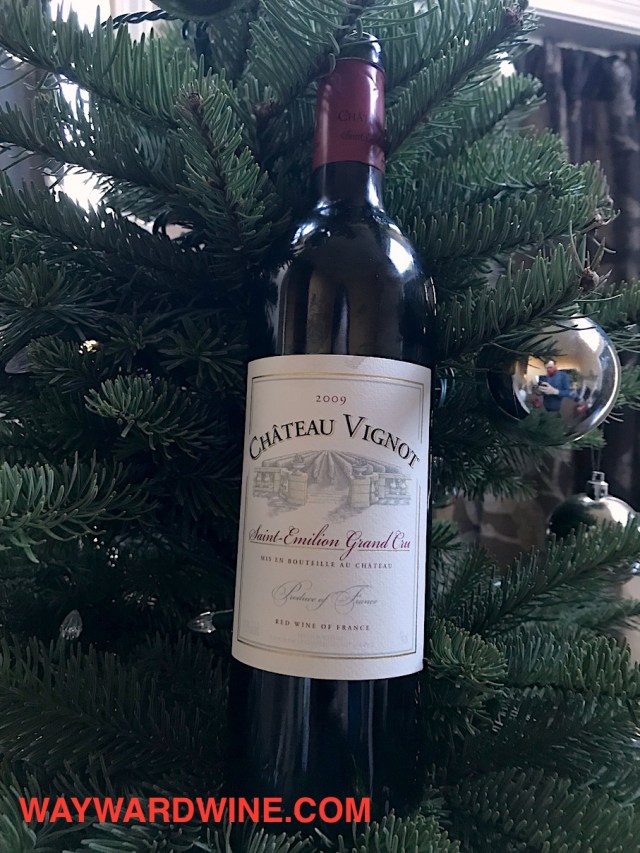
It is freezing outside and I am in the mood for a hearty Bordeaux. Some Bordeaux need years to work, while others taste brilliant young. So, when I find a Right Bank, Merlot blend, from the ripe 2009 vintage, I consider myself safe. Doubly so, this is young Château Vignot (est 2003) with modernist Pierre Seillan at the helm, Kendall Jackson money backing it, and a website pushing words like “approachable”, “elegant”, “feminine”, “silky”, and the phrase, “meant to be enjoyed upon release”. It all seems overeager to please.
Is it?
Château Vignot, Saint-Emilion Grand Cru, 2009 $60-$70
It smells tempting enough with plump aromas of dried blueberries, crushed raspberries, red cherry, toasted cedar, light caramel, and tobacco.
However, sipping it feels like licking a tree: a tart, dusty, angry tree. Green notes of olive, pine, stem, earth all frame some horrid prune juice…just no.
I give Vignot a couple hours to breath. But it still feels like reaching first base with tree bark.
Then I remember, the French eat to drink and drink to eat and eat and drink to live. Or something.
So, I whip out some aged cheddar from Scotland and Tillamook. The wine stands on its head.
That angry cedar tree remains, looming behind us, but we have walked out of its forest into a sunny grove with warm blueberries, black cherry trees, plum liquor, wafts of a nice cigarette: my kinda grove. Its acidity and tannin step back just enough to keep interest, the medium body holds, and the texture turns to distressed suede.
I know this is excruciatingly obvious. Food pairings make wine work. Yet, so often, we think ourselves wine gurus and dismiss them on first impressions. Crowds plow through wine tastings, judging them harshly, with nary a snack. As if speed dating ever worked.
This drives winemakers to manipulate their wares ever softer, sweeter, and dead on arrival.
So, to misquote John Lennon, give cheese a chance.
Have you been on the Sideways Pinot Noir bandwagon and maybe, possibly, kinda, finally gotten bored with all that silky, lush, Californian cherry cola? Want to try something new? Let us go to France.
I have long loved winery Vieux Télégraphe: named after an old tower built there in 1821 by the inventor of the telegraph. The name conjures up steampunk visions of world fairs, top hats, trains, and mythic wines. For six generations, the Brunier family has tended the vines around the tower since 1891. Their Châteauneuf-du-Pape will cost you $80. Luckily, we can dip a $45 toe with their cleverly titled and flip-labeled, baby CdP: Télégramme.
Everything about Télégramme centers on youth, freshness, and approachability. First, easy, thin-skinned Grenache leads the blend at 80 %, followed by a dash of 10% Syrah, 6% Mourvèdre, and 4% Cinsault. The grapes come from extremely young (for France) 30 year old on average vines. Methods are obsessively gentle. They pick by hand, sort in the vineyard and again at the winery, destem to avoid bitterness, pneumatic press to, well, you get the picture.
The Bruniers age Telegramme so you don’t have to: 10 months in vats, then 7 months in French oak foudres (30 hl).
Can it convert a Pinot Noir fanatic?
Well, the APPEARANCE looks clear, medium intense bright ruby, with medium legs.
AROMAS pounce with youthful, Pinot-like, pretty, vigor, reminiscent of bright red cherry, raspberry fruits, granite, and a whiff of turpentine.
The PALATE is succint, dry, with medium acidity, an extra crack of cedarwood tannins, medium plus, warm, pleasant alcohol, leading to a medium body: lean but complex.
Ample FLAVORS range from dried boysenberry, flint, dried tobacco, cinnamon, nutmeg that last a medium length.
Do not think of Vieux Télégraphe’s Télégramme as a Châteauneuf-du-Pape, even though it is. Our cliché of CdP being big, spiced, grippy, et cetera might disappoint here. But wine appellations are not McDonalds. Expect consistency and reveal your ignorance. Instead, think of warmish Pinot Noir: smooth, ripe, yet still lean, pale and pleasant.
Télégramme is a wine for now, although it will hold up five or more years. It is very good (4 of 5). Just use it like a Pinot: alone, with lean meats, salmon, delicate dishes, fresher cheeses.
Picking a Thanksgiving wine presents endless variables and pitfalls. Let’s make this simple. Choose one that will impress but not challenge or overwhelm both guests and the food. Imagine that polite, introverted guest who may not be the most memorable but charmed everyone. A wine so approachable, balanced, moderately complex but not showy does exist.
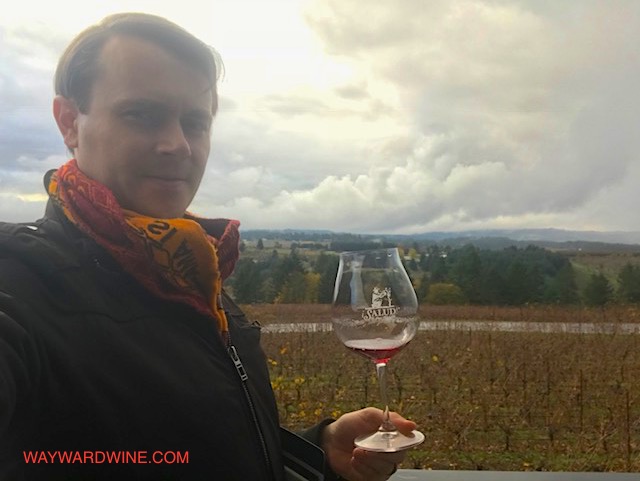
My charming/belligerent evening at Salud! wine auction (read here) inspired me. The Willamette Valley churns out many quality Pinot Noir. Today’s recommended bottle of Domaine Serene merits a place on your Thanksgiving table.
For a bit of background, Grace and Ken Evenstad came to Oregon from Minnesota and, by 1990, threw their finances into mimicking Burgundy. They own six vineyards. In 2001 DS built a winery dripping with francophilic pretensions including their Disneyland chalk caverns. They even bought Burgundian Château de la Crée in 2015 to complete the circle.
Me getting fancy drunk in D Serene’s chalk cellars.
Their winemaking is stellar. Sustainably, dry-farmed grape lots head to 250 separate, dry-iced soaks (they invented), then ferment, followed down gravity feeds into 70 different kinds of top quality barrels from 15 coopers, aging longer than most, blended, and then bottle aged (with their own corks) for one to two years (a luxury). Let us test their flagship: Evenstad Reserve 2014
Domaine Serene, Pinot Noir, Evenstad Reserve, Willamette Valley, OR 2014 $45.00 to $70.00/ Bottle
Evenstad lives 16 months in surprisingly high 60% new French oak barrels.
The APPEARANCE looks clear, with a moderate ruby color that fades to watery steal with limpid legs.
AROMAS lift with a bit of small drama from the glass with ripe red cranberry, raspberry, framed by light mint and dried vanilla bean.
The PALATE feels dry and imminently even-kieled, with present, uncombative medium acidity, tannin, alcohol, and body: it is round and silken.
Medium plus FLAVORS carry mashed red cherry, raspberry water, vanilla, dried tobacco, and light baking spices carry for a long yet gentle length.
DS’s flagship Pinot Noir is outstanding (5 of 5), faultless, pleasing wine. It may get lost at a professional tasting or competition. But it will hold its own against all that salt and butter and gravy, freshening palates yet not obtruding with acids or tannins. Even the names Serene and Evenstad sound stable, reliable, friendly.
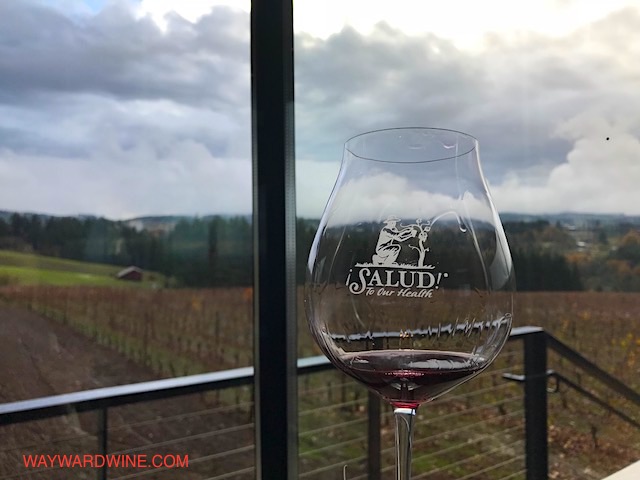
Working in the wine industry has its perks. We get paid to drink. And every once in a while, a ticket becomes available to Oregon’s premier wine auction Salud! 100% of its posh proceeds provide basic healthcare to the silent majority that make our ivory tower of fancy drinking possible: immigrant part-time field workers who can’t get it otherwise. Now, with a new baby, I am probably not a prime candidate to drop big coin on wine and travel lots (if that’s your thing, scroll to the video at the end). Instead, my goal is to get a better feel for Oregon’s wine industry.
Day one features nearly 50 Oregon wineries, who each create a 2016 Pinot Noir exclusively for Salud’s silent auction. Table after table pack bottles and winemakers shoulder to shoulder, pouring their release in hopes of garnering the highest bid. Ponzi Vineyard’s new facility gets crammed with suits and expensive jeans.
As the case bids rise on screens, I wiggle between perfume and cologne-laden well-to-dos, thrust my empty glass to a willing bottle, and then shuffle outside to take notes. Even though the basics are the same: Pinot Noir, 2016, Willamette Valley, a year plus in French barrels, et cetera, the range in style is immense. From Chapter 24’s ink black, tannic clutching, hot, big, black cherry-flavored Pinot to Résonance’s feathery and crisp cranberry-tinted high acid low alcohol Pinot, my palate works hard to keep up.
Bids favored the famed or new names. But my highlights dove blind into it, including wines with potential and power:
Adelsheim 2016 Salud Cuvée: What is it? A blend of Dijon clones from Calkins Lane Vineyard, Chehalem. How is it? Ruby red, intensely concentrated nose and palate of black raspberry, all spice, dried tobacco box: sexy, dense, viscous and well-balanced (4 of 5).
Archery Summit 2016 Salud Cuvée: What? Arcus and Red Hills vineyard lots, Dundee. How is it? Inky, dusky sandalwood, potpourri, black cherry, rosewater, dry, lush fat tannins, medium bodied, needs a decade (4 of 5).
Bergström: What? 100% Pommard clone Pinot. How? A tidy purple color, perfumed all spice, pomegranate juice, cedar finish, dry yet juicy, driven, well-synced acid and woody tannins, lengthy (4 of 5).
Dobbs: What? McMinnville Dupee and Momtazi vineyards. How good? A clear deep ruby. Toffee, red fruits, wood, forest floor. All edge and youthful aggression with dense tannic grip and reediness that will reward aging (4 of 5).
Domaine Serene: What? Côte Sud Vineyard, just Clone 667 on volcanic Jory soil. How goes it? Clear, ruby red. Flushed aromas of rhubarb pie, iron, tobacco. Showy, jangly flavors of candied red cherry, boysenberry, orange peel. Strutting stuff (4 of 5).
Hamacher Wines: What be you? Estate Paloma vineyard, Lauerlwood soil, 700 fasl, many Pinot clones. How do you roll? A dense, damask pattern on black velvet, feral fox, iron filings, boysenberry compote, black cherry, wild stuff (4 of 5).
Lange Estate: What ya working with? Freedom Hill Vineyard lots, sedimentary soils, Dijon 777 and 115. How go? Perfumed Indian spices. Dense, red cherry, black raspberry, grippy tannins, dried wood, give it a decade (4 of 5).
R. Stuart & Co.: Whatcha be? All Wädenswil clone Pinot from multiple vineyards. OK? Hazy, dusky spiced with cinnamon, raspberry, and light florals, lean with soft tannins and popping acidity. (4 of 5).
Raptor Ridge: Wassup? Meredith Mitchell Vineyard in McMinnville, own-rooted 100% Pommard, basalt, 76% new French oak. Howwit? Great, stoney, raspberry tobacco, well cut acidity and dry, (4 of 5).
Résonance: Another 100% Pommard, destemmed, French methods. As mentioned above, it is green, young, light, twangy, low alcohol with tart cranberry, and age-able (4 of 5).
Scott Paul: Maresh’s 1970 Vineyard is Oregon’s fifth oldest, 40% whole cluster. A high-toned, lean, action-packed, flicking licorice, blackberry, cardamom at you (4 of 5).
Trisaetum: barrels from three vineyards across the Willamette. Lean, taut, dusty woodworking shop, aggressive, tannic, tart cranberry, needs a decade (4 of 5).
All these 2016 Pinots need years to start strutting their stuff. The vintage shows power, tannic structure, color, good acid, and aging potential.
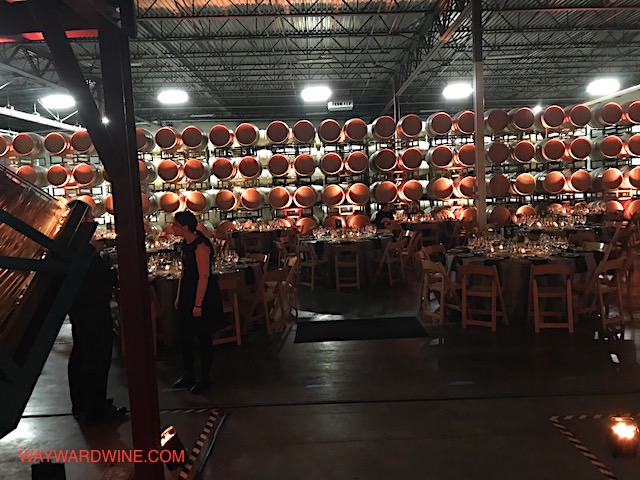
Next, because throwing money at fifty wines was not enough, we all stumble out of wine country to Argyle Winery’s new facility for dinner. Boom! Barrels:
Argyle’s bubbly making, bottle-rotating gyroscopes hang above us, waiting to turn.
Bottles ring the table and courses roll into us.
But honestly, if this felt excessive, sleep it off. The live auction comes tomorrow.
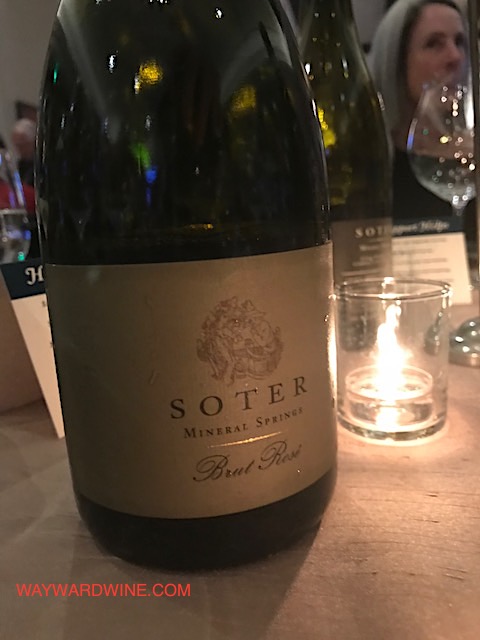
We shed our jeans and sweats for black ties and slick dresses. A dark, hilly drive finds the valet waiting for me at Domaine Serene. I check in, grab a glass of bubbly, and wander the halls and caves spotted by hightop wine tables with winemakers. Each brought cool wares. Favorites included Big Table’s Chardonnay, Lange’s Sparkling Brut Rosé, Domaine Serene’s 2010 Pinot, any Riesling, and Soter’s Mineral Spring’s Brut Rosé:
Texts and speakers send us to our chairs for the lux dinner and stewards pouring endless bottles.








 WAYWARD WINE