Happy Lunar New Year: Hot Pot and Old White Wine

Happy Chinese Lunar New Year my internet followers. We decided to celebrate the year of the cock with our fudge on a Japanese classic: hot pot.

I started by soaking dehydrated shiitake mushrooms.  Then I caramelized garlic in a pot. Once golden, I added 3 bowls of water to boil. While waiting, I furiously rinsed and chopped bok choy, carrots, enoki mushrooms, firm tofu, and broccoli. I then dolloped miso syrup, soy sauce, rice vinegar, the shiitakes, and a whiff of sriracha into the boil until I could just taste them. Fresh udon noodles and tofu plopped in. After five minutes, I killed the heat and then layered in the veg: crunchy’s first: carrots, then broccoli, bok choy, topped by enoki mushrooms. The lid capped in the steam.

While I dished it, topped with sprouts and roasted sesame seeds, I dwelled on what wine to choose. All these mushroomy, umami, and salty flavors being backed by various vegetables and light tofu presented a problem. Most reds would kill it. Medium bodied, mildly earthy Pinot Noir has worked in the past. Fresh whites come off clean but forgettable.

However, do you have decade old whites that you are scared to open? Hot pot will save them.

I have a $55 bottle of 2007 Viognier. But luckily it is from France, luckier from Condrieu, luckilier from biodynamic madman Chapoutier.
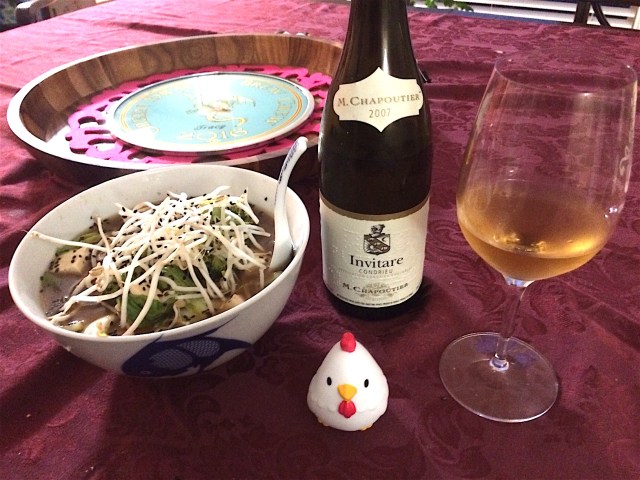
m-chapoutier-invitare-viognier-2007It looks a medium intense amber with straw-colored highlights.

AROMAS smell intensely of hot bee’s wax, honey, dried apricots, mint, salt, fresh linen, white vinegar.

The PALATE feels dry but fruity, with still alive medium acidity, medium alcohol (14%), and a plump medium body, and a waxen yet stoney texture.

FLAVORS contrast dried apricot, poached white pear, and honey with a salt, verbena, and white mushroom.

M Chapoutier’s 2007 “Invitare” Viognier from Condrieu managed to age gracefully. Cellar Tracker claims 2012 was its do or die end drink date. Yet, in 2017, shift your expectations from citric, fresh, and floral, and embrace the waxen, open, expressive complexity. View it like a trendy orange wine and it is very good (4 of 5).

Then pair it with a soy miso broth and vegetable hot pot and smile. Both flank similar umami notes and intensity. The wine sways toward dried fruits. The meal dives into earthy mushrooms. The roasted sesame seed pop. The wine’s honey brightens. The contrast works.

Why not add something old to something new. Happy Lunar New Year.  We could all use a fresh start.

Posted in Uncategorized | Tagged , , , , , , , , , , , | Leave a comment

A Gaja Barbaresco Vertical (of sorts) 2006 2010 2013

Last week, I braved an ice-capped Portland armed with Barbaresco. I just wanted to show two vintages.  But to be safe, I requested two samples in case one ended up corked. However, our warehouse accidentally picked 2006, 2010, and 2013.  Each run about $230 a bottle.  I decanted them that morning, put on my boots, and slid slowly to my first appointment.

Angelo Gaja changed the Piedmont forever. In the 1960s and 70s he became a control freak: switching to only his own grapes, small French oak barrels, Burgundy bottles, and long corks for ageing. His daughter Gaia Gaja (I know, he’s a touch proud) has pushed them to biodynamic farming, even breeding special worms to process their fertilizer.

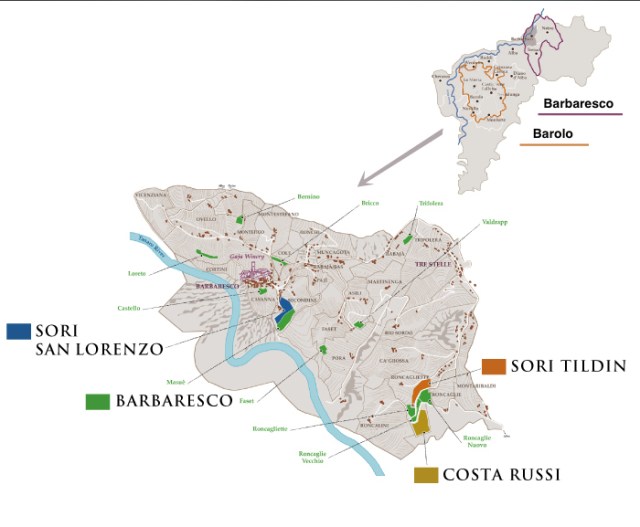
Today, 14 vineyards (in green below) comprise Gaja’s Barbaresco.

gaja-barbaresco-map

2006 Barbaresco

Gaja’s 2006 glowed warm, full, and ready. The APPEARANCE looked dusty, dark ruby at the core but bricked beautifully on its fringes. Bold AROMAS of crushed raspberries, potpourri, flint, coffee, and black beans carried the glass. The PALATE felt dry and impeccably balanced with plump tannins, medium acidity, toasty alcohol, a full body, and fine-grained leather texture. For FLAVORS ripe red berries ripple through it, caught by baking spices of nutmeg and burnt vanilla, coffee, and licorice that held a long length.

2006 grew across the day, only fading into earth, meat, and tannins towards the end of the third day. Even then, another account still bought a six pack. Gaja’s 2006 easily has another decade in it. It just graduated high school, knows itself, and is full of complex, critical thought. It is outstanding (5 of 5).

2010 Barbaresco

Now, Gaja’s 2010: a much-hyped vintage. At our first tasting, AROMAS smelled only moderately of blackberry fruit leather, balsamic, soil, and fresh violets. The PALATE felt dry with chunky tannins, ringing acidity, a compact, full body, and an unexpectedly smooth yet rich texture. FLAVORS tasted of black and red berries, tobacco, cedar, black tap coffee, mineral, and anise.

By day two, 2010’s aromas and flavors became opulent and seductive but still seemed shrouded compared to the open book 2006. It is outstanding (5 of 5) but drinks like a middle-schooler: awkward, gangly, energetic and clever but not ready. Wait until 2019 through 2030.

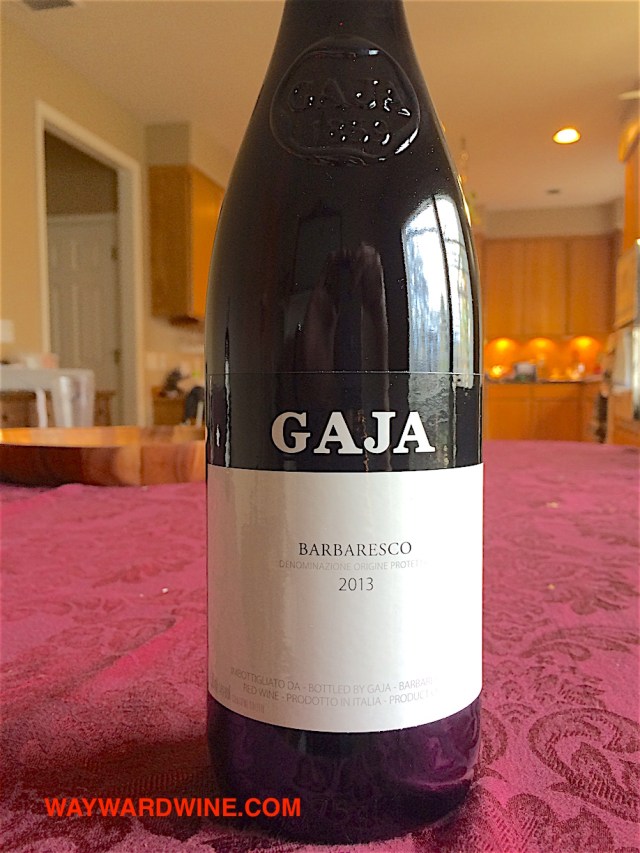
gaja-barbaresco-2013

2013 Barbaresco

Well hello there.  2013’s APPEARANCE looked a clear, bright ruby red with a maroon core. Unexpectedly, AROMAS pounced out of the glass. I have never smelled a Nebbiolo so young yet expressive. Imagine just-crunched anise, red maraschino cherries, orange peel, fresh peppermint, and white wood. The PALATE felt dry and taut, with lifting acidity, linear steel rod tannins, medium alcohol and a medium body.  FLAVORS did not disappoint either: bright red fruits, mineral, and spice that lasted a medium length.

2013 shows a shift for GAJA. One buyer wondered if daughter Gaia’s biodynamic efforts helped create this more expressive, brighter red. It is outstanding even now (5 of 5): a bouncing baby, curious, wild, and delightful. A vigorous decant or another decade will let it strut its stuff (just don’t vigorously decant your baby).

Nebbiolo’s tannins will cut you though. After one tasting, my palate was dust. So I invited my buyer to lunch at Olympia Provisions. We ordered the Italian charcuterie platter. Each Gaja came to life. The 2006 enveloped salty olives, Taleggio, and mortadella. The 2010 became bearable, punching the hard red sausage smartly. The 2013 became even brighter, tarter, and fruitier with the Taleggio.

That icy, 20 degree day became delightful. Yes, it took twice as long to drive from account to account. Yes, I panicked when slipping through a stop sign.  Yes, most accounts acted grumpy about slow business. But each stop meant I could watch these wines evolve.


Posted in Uncategorized | Tagged , , , , , , , , , | Leave a comment

My Love/Hate Relationship With Grower Champagne: Marc Hebrart 1er Cru Blanc de Blancs Brut NV

Grower Champagne has creeped into popularity for at least a decade. That little RM (récoltant manipulant) on the label provided wine geeks another means to stand out from the seething masses. It allowed shops and restaurants to charge more to customers unfamiliar with it.  We have all seen and bought the likes of Mumm, Veuve, Moët, Nicolas Feuillatte, et cetera, and known when we are getting hosed.  But today’s grower, Marc Hebrart, probably is not on your grocery store shelf.

Now, I love the endless variety that single source terroir can create.  Grower Champagne can vary from the terrible to the fantastic and reflect the best and worst of each vintage.  However, clear your head that a “grower” just tends to their adorable plot with a horse-pulled plow.  Equally, forget that the big houses are glamorous, bubbly, pleasure palaces: they are modern, often massive, multi-million case, industrial complexes (with some cool caves).

Growers own Champagne. The big houses pay them. There are 19,000 independent growers in Champagne. They own nearly 88% of all vineyard land. 5,000 make their own wine. The relationship is symbiotic, competitive, and complicated. But everyone’s goals are to make great wine and get rich.  For more detail, let us look at grower Marc Hebrart.

Son Jean-Paul Hebrart farms 15 hectares of vines, but they are spread out into 65 different sites in five other villages, including, Avenay, Val d’Or and Bisseuil and the grand crus villages of Aÿ, Chouilly, and Oiry in the Côte des Blancs.  Yes, each parcel is vinified separately, but most Champagne houses and growers do this. Like the big boys and girls, he also uses cool, glass-lined stainless steel and ceramic tanks. Yes, he might hand sort much of the fruit, but most do too.

The end difference, only 60 cases of Hebrart get imported stateside. He makes 6,000. That creates a sense of exclusivity.


Jean-Paul Hebrart’s Blanc de Blancs comes from his 1er cru vineyards of Mareuil-sur-Aÿ. Hebrart uses roughly a quarter of the last vintage to calm and balance the present. Big houses can blend back 20 years. Too compensate further for his lack of reserve wine, Hebrart allows malolactic fermentation and ages three years on lees in the bottle. This gives his Blanc de Blancs, like most growers, a distinctly nutty, orchard fruit quality. But let’s try it. Luckily, an account gifted me a bottle:

marc-hebrart-champagne-blanc-de-blancs

Marc Hebrart, Blanc de Blancs, Premier Cru Mareuil-sur-Aÿ, Champagne NV $45-$60 (Nov 2015 disgorgement).

Its APPEARANCE looks a clear, straw gold color, cut through with a rapid, medium-sized bubbles.  AROMAS waft with controlled intensity of golden delicious apple, lemon, poached pear, cut hazelnut, spices, and fresh-churned butter.  The PALATE feels dry yet silken, with pinging, zesty, citric acid, mild alcohol (12% abv), and a mid-weight body. FLAVORS follow aromas and the citric yet nutty profile with chamomile honey rounding it out for a medium plus length.

Hebrart’s Blanc de Blancs is very, very good (4 of 5). You can feel it comes from one place. You can taste Hebrart’s methods to make it drinkable.  He has to show all his cards. Meanwhile, negociant house Champagne can blend away these “defects”, providing reliable, consistent quality fizz.  Past reviews of Hebrart’s BdBs range widely from year to year, from salty to nutty, fruity to citric.  Either way, expect something interesting, complex, and honest: human, changing, warts and all.

Without big Champagne, little Champagne would not matter as much as it does today. We cannot define good without evil. Santa cannot exist if you don’t believe in him. Wait… Anywhichway, growers like Hebrart, just as big houses like Veuve, provide us, the thirsty masses, with an endless supply of variety. I say, drink it all and ignore when a hipster, wine geek gets all dogmatic about bubbly.  Our goal should not search out better or best, rare or ubiquitous, but instead we should live for the journey, respecting and learning about each in their own right.  If only we could treat people this way.

Posted in Uncategorized | Tagged , , , , , , , , , , , , , , , | 2 Comments

Primitivo for Frozen Days: Castello Monaci

Sick of winter already? Me too. Let us draw the shades, turn up the thermostat, play Hawaiian music, don shorts and a t-shirt and grab a pair of sunglasses. Our wine glass might as well play pretend. I say send it to the hot iron tip of the heal of the boot of Italy: Puglia, specifically Salice Valentino DOC:

italy-puglia-wine-map-salice-salento-regionThere, baking under an eternal sun, sits Castello Monaci. Lina Memmo owns the fairytale 16th century castle: a hub for weddings with its gardens and crenelations. TripAdvisor loves it (book your stay/wedding/escapism here).

castello-monaci-grounds

Maybe we can renew our vows here…

But we came for vineyards. Vitantonio Seracca Guerrieri supervises certified sustainable farming. Baked earth of dry clay, volcanic gravel, and limestone forces Primitivo roots in deep search for the water table. Vity has grapes picked at night. Immediately, Leonardo Sergio presses and ferments grapes entirely under cool temperatures thanks to small stainless steel tanks. It ages a mild 6 months in 75% stainless steel and 25% 2nd and 3rd use French oak. They produce 300,000 bottles of Pilùna Primitivo annually (the name Pilùna nods to clay pots that once dominated ancient winemaking).  With no further ado:

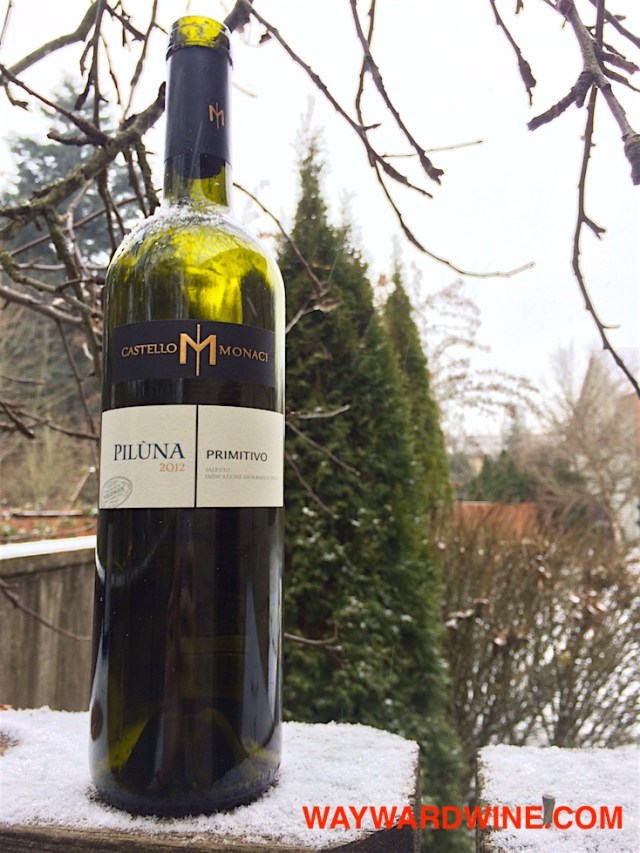
Castello Monaci, Pilùna Primitivo, Salice Salento Italy 2012: $10 – $15

castello-monaci-piluna-primitivo

APPEARANCE: the Primitivo has a rich purple core with a moderate clear rim of cranberry and tree trunk legs. AROMAS and FLAVORS: smell plump and warm with plum and prune, boysenberry syrup, scrub bush, dried sage, and licorice lingering a medium plus length. The PALATE: feels dry, with mild acidity, ripe tannins, warm alcohol, and a full body.

Castello Monaci’s Pilùna Primitivo is modern but not so squeaky clean that one forgets its origin. It serves up sunshine with ripe fruit and hot earth.  It is supple enough to enjoy alone but carries enough structure for grilled meats (even if they have to be grilled indoors), hard cheeses, sausage pizza, even a savory dark chocolate.

It is very good (4 of 5) and a lovely way to warm oneself through winter. So make your own realty. But do not forgot to take Vitamin D supplements.


Posted in Uncategorized | Tagged , , , , , , , , , , , , , | 3 Comments

Prohibition Leading Me to Drink

We are watching Ken Burns’ documentary on Prohibition. But in emotional rebellion, it drives us to drink. While Capone bootlegs beer, Le Chiuse’s organic Rosso di Montalcino 2012 stands up, richly textured, smoothen, cherry skinned, licoriced, and earthen. Magnificent (5 of 5) anti-establishment drink.

le-chiuse-rosso-di-montalcino-2012

Posted in Uncategorized | Leave a comment