New Year Sparkling Wine: Champagne vs Cremant de Limoux and Loire

And so it ends not with a whimper but a bang. We cannot leave Paris without cracking bottles of bubbly.  No 191 day EU Austerity Drinking Tour could finish France without value Cremant or Champagne.
For a mere €15.00 we find true, actual, not Prosecco, Champagne from Champagne, France (specifically the village of Buxeuil in the region’s southern extreme).  Grower André Diligent et Fils created this Brut:
Andre Diligent et Fils Brut Champagne France
APPEARANCE: looks clear, medium gold, with medium sized, rapid fizz.
AROMAS: smell complete, with fairly intense caramelized pear, pastry dough, almonds, and musk.
PALATE: feels dry, with oodles of acidity, average 12% abv, and a medium minus body.
FLAVORS: taste moderately of tart lime, pear, honey, chalk and slate. However, they only persist a medium minus length.
CONCLUSIONS: Diligent Brut is just that, a diligent effort: good, cheap, tart, toasty, rustic, musky, and quick. There’s not much here but it is correct to type (3 of 5). Pairing sweets does improve our impression of it.
€10 gets us a bottle of an old, favorite producer: Gérard Bertrand. However, we have never seen his organic Autrement, Brut, Chardonnay, pinot noir, chenin blanc, Crémant de Limoux, France. 2009.
Gerard Bertrand Autrement Cremant de Limoux Brut 2009
So can a hill called Limoux in Southern France compare to Champagne?
APPEARANCE: looks a clear, mild lemon color, with rapid, small fizz.
AROMAS: smell young and of medium intense lemon, apple tart, peach, and red fruit.
PALATE: feels dry, with a high but gentle acidity (hard to describe), medium alcohol 12.5%, and a medium body.
FLAVORS: taste moderately of lemon and lime, peach, and take a turn for the odd with lettuce, saline solution and light roasted nuts that last a medium plus length.
CONCLUSIONS: Bertrand’s Autrement Limoux Brut manages to be very good (4 of 5). Although strange at times, it challenges us and shows more complex character than the Diligent Champagne. Both are good. The Limoux is just more interesting. We will save the Vouvray Brut for last…
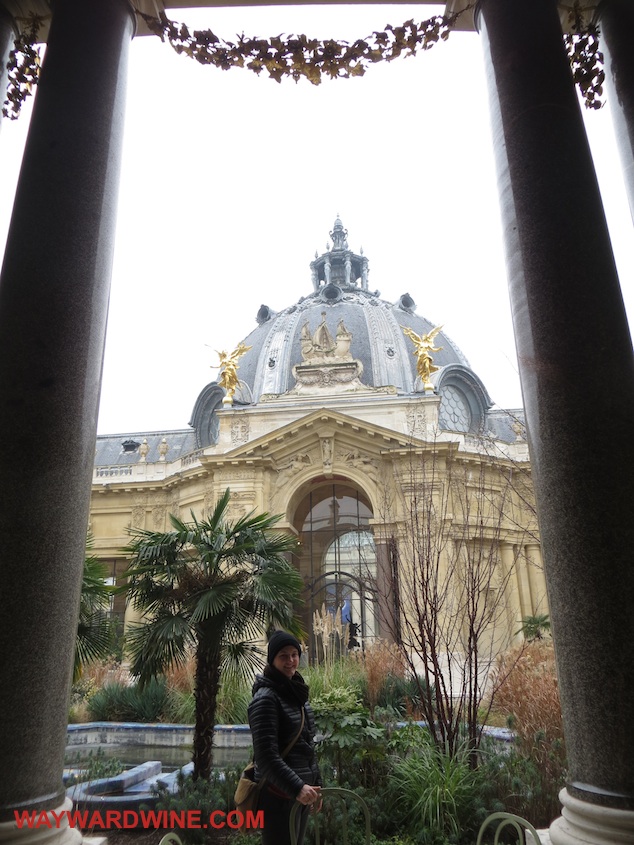
Aside from drinking, our last days hunt for free museums in Paris. Yes, there is more to life than the Louvre. The Petit Palais, built during a flurry of 19th century World Exhibitions, exhibits that century’s works for free.
Petit Palais Courtyard Tracy.jpg

Drama is high with writhing muses and stoic statues everywhere. Wine provides a veiling theme for this erotic, drunk, chalice tipping Bacchanal twisting among vines.
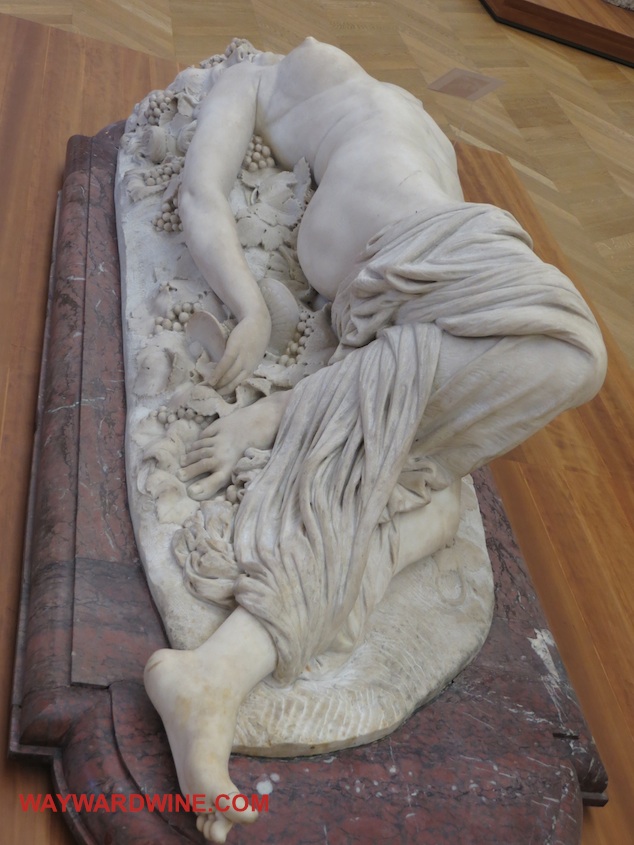
Wine Nude Paris*ahem…”Bar tender. I’ll have what she’s having.”

Art Nouveau’s chameleon colors and materialism also enrich the space.
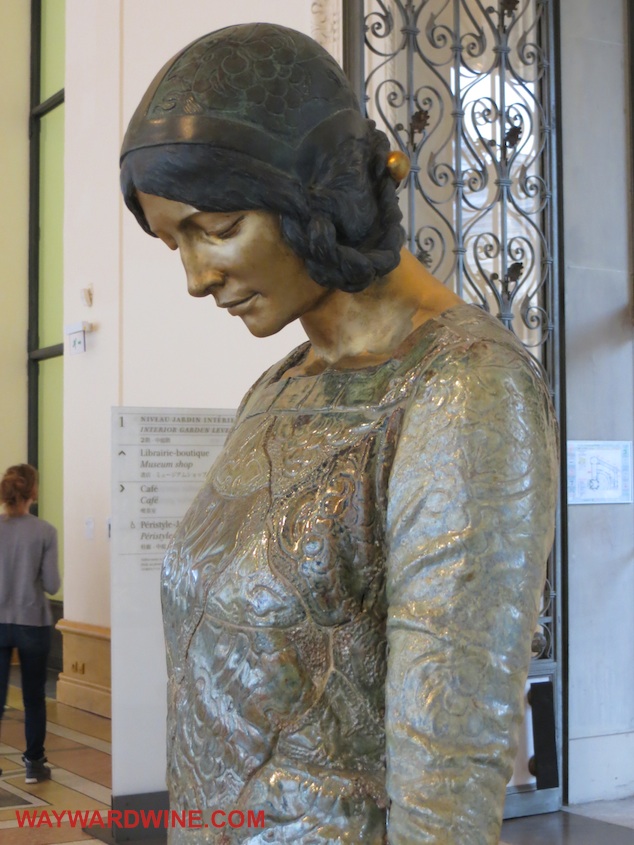
Art Nouveau Lady Petit PalaisI get a bit desirous of an impressionist’s portable easel:
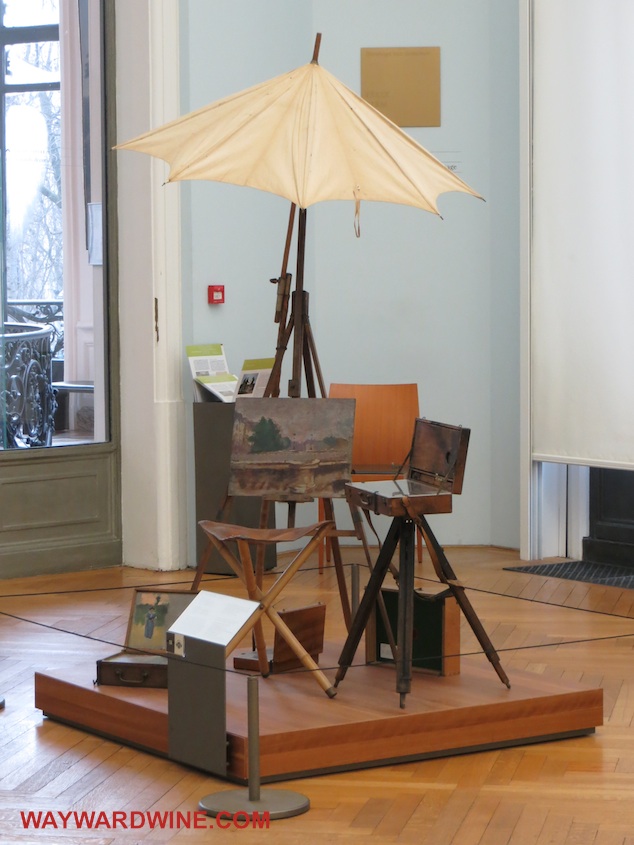
Petit Palais Easel.jpg

But down the swooping staircase we find another world. Collections of odd antiquities fill one hall. A crocodile wrestling drinking horn from ancient Greece must have amused a few Atheneans:

Crocodile Wrestling Drinking CupThe Art Nouveau dining room, however, beckons us to luxuriate in its winding wood curves:

Art Nouveau Dining RoomBut free art is not relegated to museum walls. Paris clutters every urban inch with fantastic crafts, such as this oak tree framed door, whose branches extend like icicles into 3D glass panels.

Paris Oak Doorway 2

Colorful shops abound, including La Pistacheri: yes, a shop devoted to pistachios.

La Pistacherie ParisHell bent on finding more free museums, we stumble into the Museum of Modern Art. Intimate paintings and indescribably vast monuments to modernism color the blank white rooms.
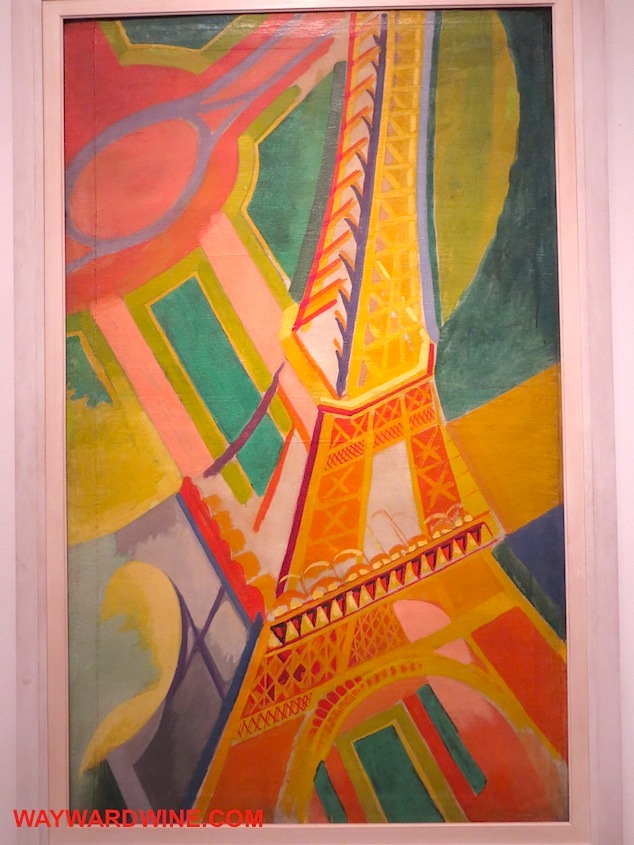
Robert Delaunay Eiffel Tower

From Delaunay to Art Deco, Chagal to Picasso, the museum shows a verve, futurism, and vibrancy that seems dead to the irony of post modern artists.

A walk down the Champs Elysees opens free museums to materialism with Mazaratti, Ferrari, and Mercedes flaunting their car craft (and me impersonating gull wing doors):
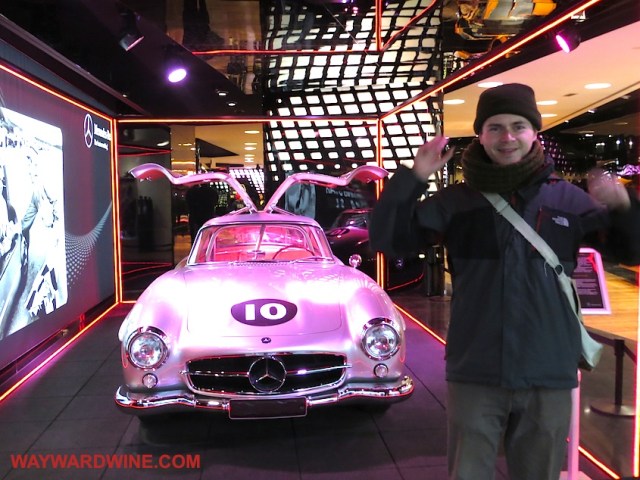
Mercedes 300SLBut we find the true gem of Paris on our last day. Musée Carnavalet: The Museum of the City History of Paris. Imagine, if London, Istanbul, or Rome, held a garage sale of its entire history in one day.

Musée CarnavaletRebuilt apartments, bedrooms, and dance halls jump decades and centuries as we walk through its galleries.

Items from the French Revolution strike us most, such as Voltaire’s desk, Robespierre’s hair, keys and pieces of the Bastille, Marie Antoinette’s slippers, Louis XVI’s last razor, or this militant room:

Musee Carnavalet Military Room

It all overwhelms us. But we power on. Even the Neo-Classical paintings are worthy of the Louvre. This detail was by Gérard.

French Imperial Painting

Just past Marcel Proust’s bedroom is the most amazing hall from the 1940s. Silver leaf covers it floor to ceiling, which was then painted with something out of Tolkien:

Carnavalet Silver Leaf Room

But then we find a shopfront saved from the Art Nouveau period: G. Fouquet’s Jewelry Shop.

Fouquet Jewelry Shop

Imagine sticking your head in a Tiffany lamp. Every edge, every light, every screw, every backlit lifesize bronze peacock was hand crafted:
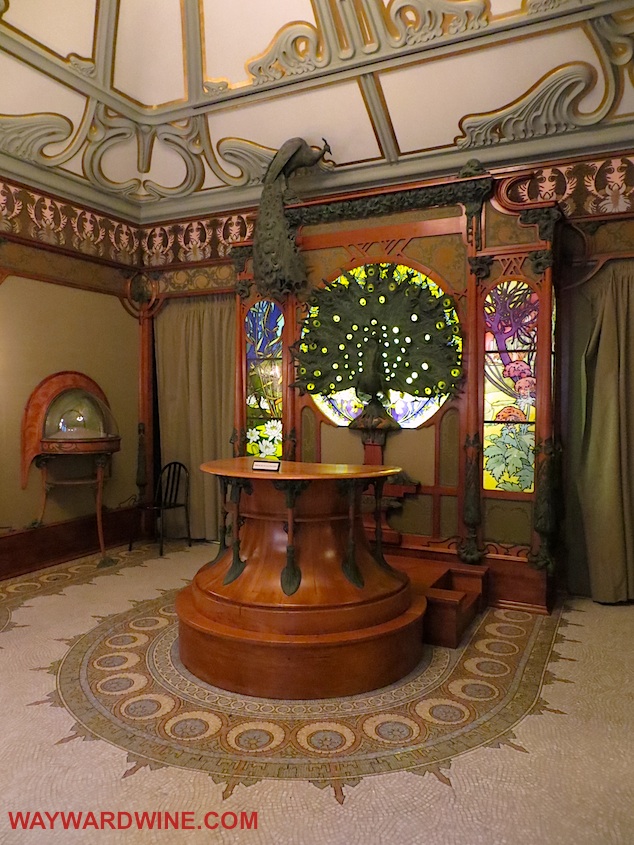
Fouguet Jewelry Shop InteriorCompletely undone by Musée Carnavalet we head back to Montmartre to pack for the last time.

But enough of the past. The New Year calls upon the present. Time for one last drink to the future.

For €8.90 we pop fizz from the Loire. This Brut comes from La Cave des Producers de Vouvray De Chanceny. It is their Brut Excellence Tête de Cuvée Vouvray, 2009 made from Chenin Blanc.
La Cave des Producers de Vouvray Brut Excellence de Chancy 2009
APPEARANCE: looks a clear, pale lemon color, with rapid, angry fizz.
AROMAS: smell moderately of honeydew melon, lemon, almond, and slate.
PALATE: feels dry, with unforgiving high acidity, medium 12.5% alcohol, a medium body.
FLAVORS: taste of medium intense melon, lemon juice, finished by medium plus length salted caramel.
CONCLUSIONS: In 2013, De Chanceny’s 2009 sounds too brusque, cheap, and uncompromising to be more than good quality.
Yet looking back on my notes, I mentioned “Has potential for aging. Too taut, too effervescent now, mellows in glass after an hour. Very good (4 of 5) in 5 years.”
Like this wine, we rushed Europe. We attempted to cram every major sight, sound, food, and drink from every city we could squeeze into a public-transport and budget-minded trip. 191 days of endless museums and churches blurred into anathema. We fought, got sick, and ended up hating Europe at times.
But that is why we love Europe. It never let us stop. A cornucopia of excitements still remains for us to find at some future date (hopefully with better shoes).
Thanks for following us on this journey. Happy New Year.


Posted in Uncategorized | Tagged , , , , , , , , , , , , , , , , , | 4 Comments

Last Tango in Paris: Saint-Chinian red blend, Saint Joseph Syrah, and the Paris Opera

This is the end. Our seven month, thirteen country EU Austerity Drinking Tour finally, achingly, grinds to a halt. 188 days of tasting Europe’s best value wine, whiskey, and beer has trialed our sanity, budget, and marriage.

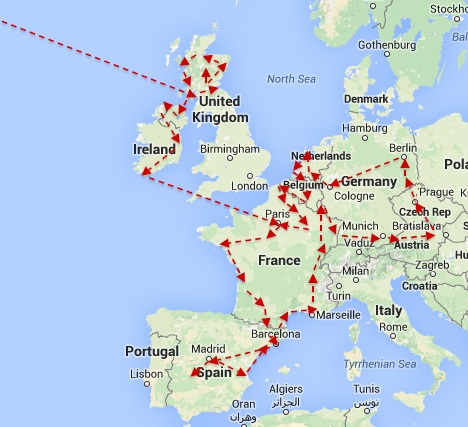
But today the SNCF takes us from Reims, Champagne to Paris:

EU Map New York To Paris Day 191

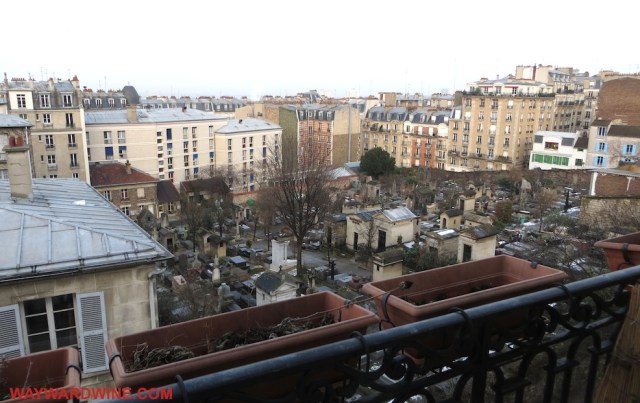
We stay in Montmartre with a friendly, middle-aged singleton. His apartment overlooks a snow-draped graveyard, he likes his “quiet neighbors”:
Quiet Neighbors Paris France
Having been raised by Andrew Lloyd Webber, we book a tour of the Paris Opera House aka Palais Garnier. At dawn, we cross Paris via underground. A short ticket line sends us to a central couch deep beneath the theater. Here, we soak in endless decorative motifs that depict seasons and astrological signs.
Paris Opera Basement
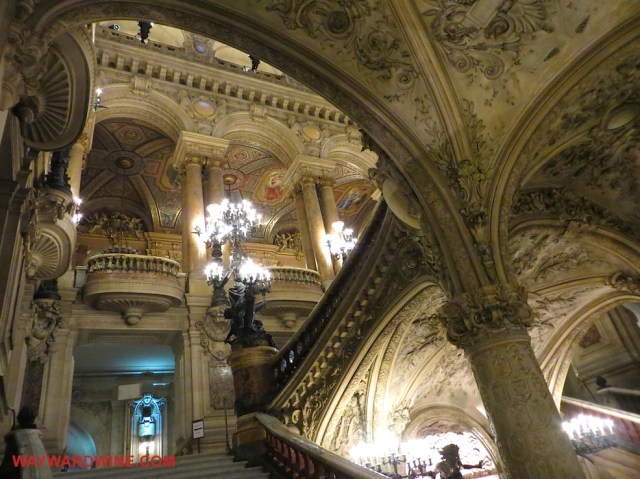
At last, a black-sweatered column with glasses takes us to the grand staircase.
Paris Opera Staircase
The terms “extravagant” and “fear of the void” come to mind. Parisian elite came here to see and be seen. This staircase provided their stage.
Paris Opera Stair Case 2
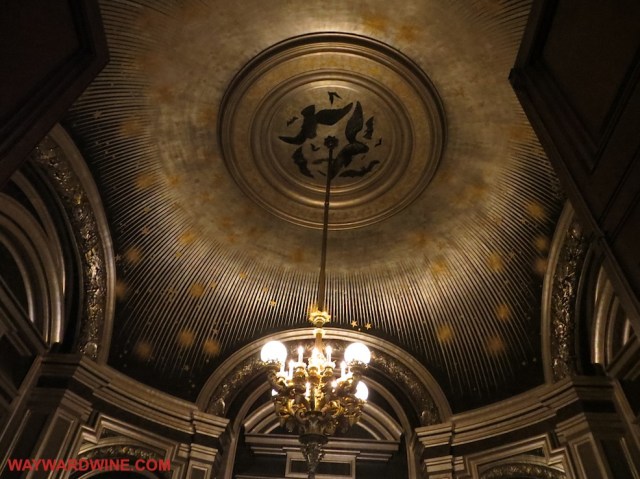
But truly amazing is the second story, where royalty like Napoleon III would banquet and dance beneath gold, chandeliered ceilings, while watching the staircase procession. One alcove in particular struck us with its bat-spangled night theme:
Paris Opera Bat Room
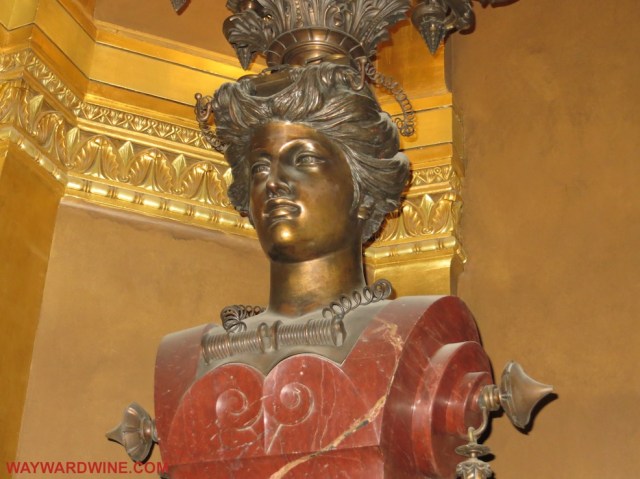
Eclecticism carried over to another niche with a wired bust of the muse of electricity:
Wired Paris Opera House
We transition from the staircase to the theater itself, where we whisper while the staff set stage:
With that ceiling, Chagal follows us from Reims Cathedral to the Paris Opera.
Enthused but exhausted, we stock up on groceries and wine from a local shop.  Our host likes red. So to prove that our half year of value-based EU drinking was not a waste, we needed to impress him with something, anything.
So we turn to gloriously sunny but inexpensive Languedoc, specifically Saint-Chinian AOC.
For a mere €6.70 we pick up Château de Veyran, from their single vineyard, Clos de l’Olivette, Saint-Chinian, France 2009.
Chateau de Veyron Clos de l Olivette 2009
So how does it fair?
APPEARANCE: it looks clear but a deep ruby, with an opaque rim: basically Mourvedre ink.
AROMAS: smell of dried black cherry, fig, and incense burner in a Catholic church, with snaps of flint.
PALATE: feels dry, with medium acids and tannins. Alcohol warms up winter with 13.5% abv making for a medium plus body.
FLAVORS: pounce with medium plus intense flavors of red and black cherry jam, dried tobacco, vanilla, chocolate coffee bean, followed by a medium plus length flinty stony finish.
CONCLUSIONS: We taste our host blind on it. He loves the Veyran and guesses it is Spanish (not shabby since Spain sits next door to Saint Chinian). We find it a bit lush though: not greatly structured. Yet it is complex. Very good regardless (4 of 5). Better, he guesses it is 20 EU.
But the night is young (and dinner half done). We up our game and risk a €12.50 wine. Smartly, we stay southern but shift to Eastern France in Saint-Joseph: home of Syrah:
Saine Desirat Saint Joseph 2009
Another 2009 from Cave de Saint-Désirat: a grower in hilly, cooler Saint-Joseph.
APPEARANCE: looks a leaner yet medium plus ruby, with a thin clear rim. AROMAS: smell tidy, developing, and richly of macerated black cherry, mint, blueberry, coconut macaroon…now cocoa…now pepper.
PALATE: feels dry, and notably acidic and tannic, with milder medium 12.5% abv, making for a medium body.
FLAVORS: taste of whipping tart red apple, black cherry, salt, baking cocoa, fall leaves (French oak), with a Syrah typical, medium plus white pepper finish.
CONCLUSIONS: Albeit more serious our host respected this even more. Saint-Désirat is balanced, complex, and precise.  It is very, very good quality (4 of 5). I imagine that now, nearly three years after this note, it tastes amazingly.
We may not be French. But months in the country thinking nothing of wine and art has inculcated us with a respect and knowledge of the country’s great value wine niches.
Expect a special, New Years Eve Champagne and French bubbly review written during our last days in Paris.
Posted in Uncategorized | Tagged , , , , , , , , , , | 3 Comments

Christmas Dinner with Penfolds 389 2012 South Australia

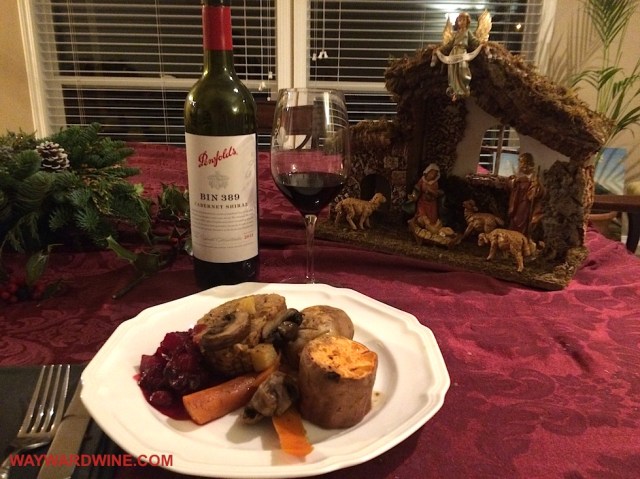
So this is Christmas, and my wife has baked a feast of field roast, potatoes, yams, carrots, mushrooms and cranberry sauce. We just happened to have a bottle of Penfolds 389: a nearly equal parts cabernet sauvignon and shiraz blend amalgamated from their plots throughout South Australia.

Penfolds Bin 389Rain and cold grip the outdoors. So our glasses tend toward the sunny Southern hemisphere. But I worry this will be a monster of alcohol and fruit. Will it overwhelm this hardy but still vegetarian dish?

But Penfolds manages a delicate touch here. The color may look an dark ruby. Yet the aromas smell filigreed, complex, and nuanced. It reminds us of orange rind, spearmint, toast, and dried vanilla bean. Red raspberry and blackberry compote support the wild array of spices.  The palate feels similarly balanced, medium bodied, well poised and controlled, with enough acidity matching hands with the twang of the cranberry sauce.  Our meal’s earthiness blends well the wine’s oak toast.

Rarely does a red with 100% American oak (40% new) work for me (they come off cloying, bourbon-like in their coconut and vanilla softness). But here, oak provides a bit of dust, ash, and drying tannin.

Penfolds’ 2012 389 is man over matter. They have created a multifaceted, interesting drink that is greater a sum than its parts. Very good (4 of 5).

Posted in Uncategorized | Tagged , , , , , , | Leave a comment

2002 Brut Lanson Champagne Vineyard Winery Review

Last Monday’s EU Austerity Drinking Tour post found Wayward Wine spelunking Taittinger’s Champagne caves (read here). Today, we visit Lanson, another of Reims’ iconic houses and an old favorite of ours and Queen Elizabeth II.

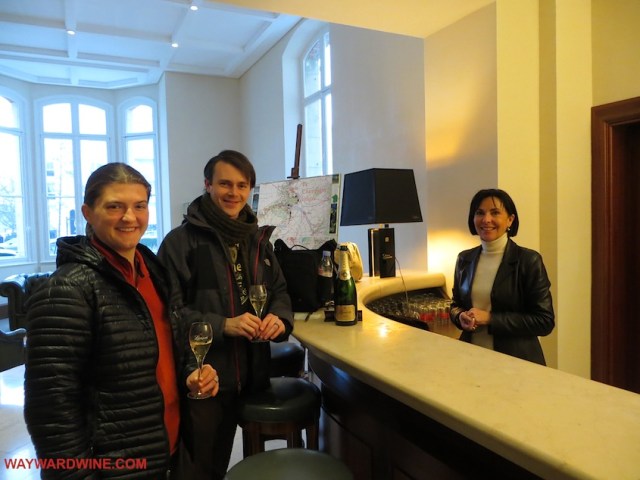
Our hosts make us a fabulous quiche for breakfast.  Then we bundle up, and let their freezing cat scurry in as we head outside.

Reims cat

A bit lost, we accidentally walk through the shipping gate into a walled courtyard. We find the front, our tour guide and tack on another guest to spend over two hours touring the vast facility.  Enjoy the following video montage from vine to box:

In case your YouTube is struggling, here are photos for context. Sure, Lanson’s caves lack Taittinger’s antique charm. They loom high and vast thanks to modern cement.

Champagne Cage Wine

But I’m sure Taittinger’s non-vintage caves are similarly massive and modern (we saw only their ancient Comtes de Champagne caves last Monday).

Instead of hand-riddling, Lanson employs automated gyropalates to agitate lees into the bottle neck.

Lanson Champagne Riddling Gyropalette Machine

We feel torn between the romance of employing thick-wristed individuals versus economic machines. With Champagne’s ever inflating price, this modernity keeps it an affordable splurge. Hopefully, riddlers will continue to turn the high tier cuvees that can demand that cost.

If you ever wondered what that sludge looks like near the end of it life in bottle:

Champagne Lees Post Riddling

Getting to see the labs was a treat as well:
Lanson Lab Champagne

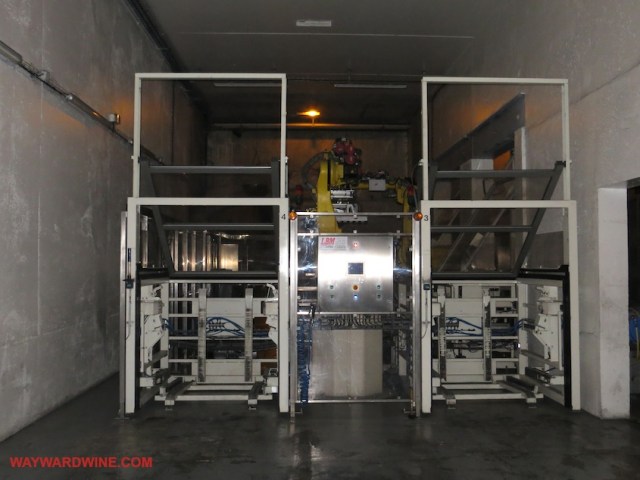
The fully automated bottling line was a compact, exacting, turnstile of bubbly-making magic:

Lanson Floor Capping Caging Champagne

But what really capped our day off was the tasting. Chance had it that some celebrity swung through that morning. So we got to forgo Lanson’s entry, black label non-vintage Brut, and instead try their 2002 Gold Label.

Lanson 2002 Gold Label Champagne France

Lanson, Gold Lable, Champagne, France 2002. This comes from 100% Grand Cru vineyards.  Lanson only makes it in exceptional vintages like 2002.  47% chardonnay and 53% pinot noir make up its blend.

APPEARANCE: Gorgeous is a start. A clear, moderate gold color with gold leaf highlights, matched by a rapid, mixed size fizz.

Lanson Glass

AROMAS: smell clean, developing, with pronounced aromas of honey, lychee, golden pear, apple, vanilla, biscuits. There is quite a bit of ripeness.

PALATE: (11g/L) teeter it towards off dry, but medium plus acidity makes us forget any sweetness immediately. A medium alcohol of 12.5% by volume adds an unexpectedly rich medium body, with a sprightly but silken texture.

What makes Lanson a rarity in Champagne is that they halt malolactic fermentation. This renders a taut, dry, tart Champagne.

FLAVORS: Medium plus flavors of wild strawberry, slight smoke, toasted bread, and black tea leaf last a long, complicated while, dancing about our palates.

Lanson’s Gold Label 2002 Brut is outstanding Champagne (5 of 5).

Tracy and Aaron Lanson Tasting Champagne

Check in next Monday as our EU Austerity Drinking Tour continues!

Posted in Uncategorized | 1 Comment

Taittinger Champagne Caves

Wayward Wine’s tour of Champagne continues after last Monday’s post (read here).

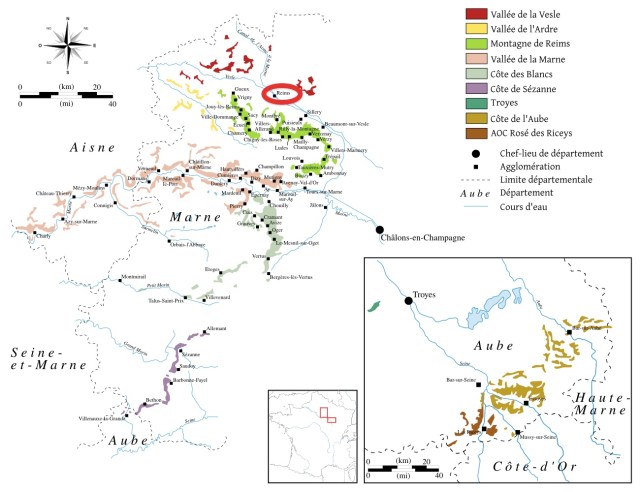
Champagne Map Reims

Today we leave the frozen tundra of Reims above for the subterranean caves that turn wine into fizzy, magical Champagne.

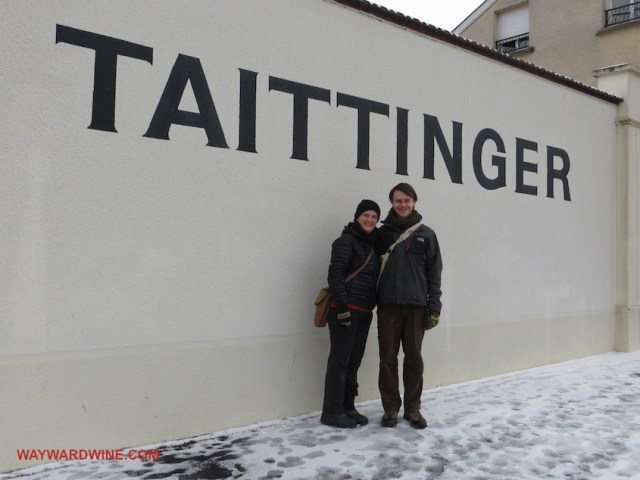
Our hosts recommended we reserve a tour of the caves of Taittinger: a producer we love. So we cross town, trudge uphill, and find the unassuming complex:

Taittinger Sign Tracy AaronThe waiting room looks chic, clean but lonely, baring an Australian couple and a fab model of Saint-Nicaise basilica that preceded the Champagne house (which the French Revolution flattened).
Taittinger previous cathedral

In no time, a finely dressed young lady collects us and sweeps down a creaky flight of stairs:

Taittinger StairwellTaittinger is one of the last major Champagne houses still owned and run by its namesake family (let us ignore that brief stint of American ownership in 2005). But they are infants in Champagne.  These wine merchants took over 1734 bubbly house Fourneaux and moved into Champagne only between the world wars. They now own a huge 288 hectars of vines that comprise half of their production. Ever opportunists, after WWII they snapped up today’s abbey buildings and adjoining caves.  These caves make them special.
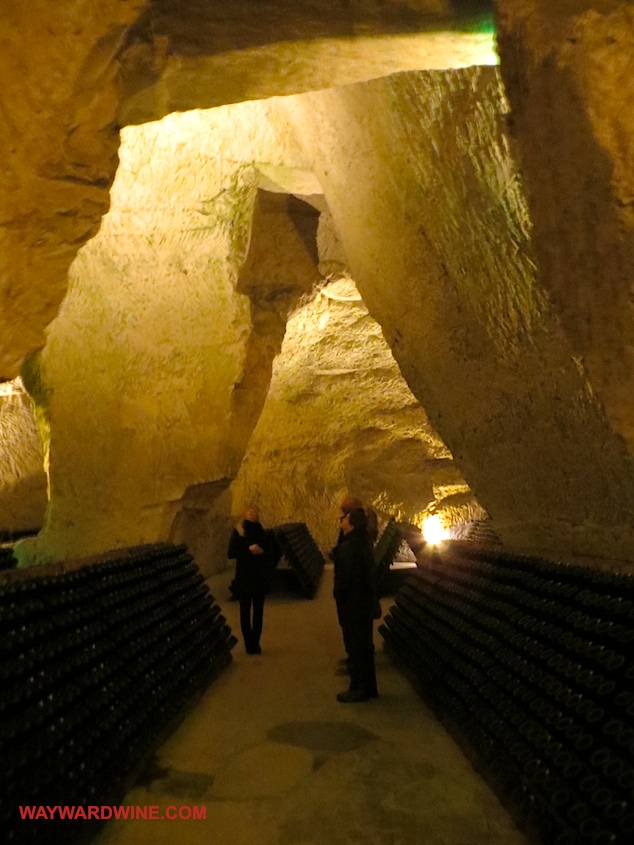
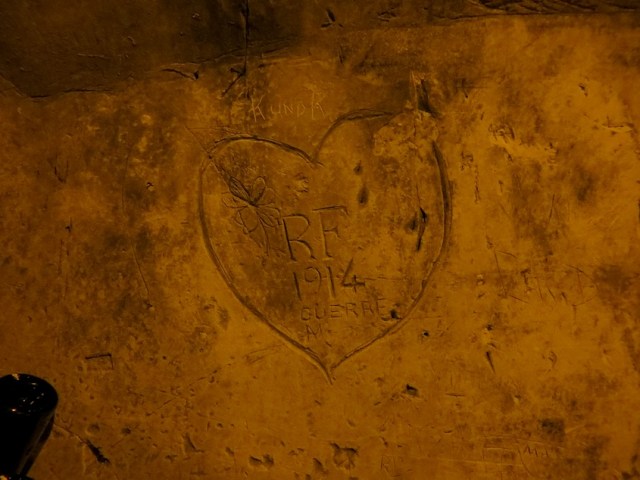
Only four other houses cellar their wine in Reims’ famed “Crayères”. The Romans cut the core of them as quarries to build urban monuments (see last post). But they created a labyrinthine cathedral in the process.

Taittinger Champagne Gallo Roman Era Caves

In later centuries, the caves wintered goods for St Nicaise Abbey and provided safety from shellings for locals and soldiers during WWI and II. Roman arches cross with medieval pointed gates, centuries old doors, and brickwork. Graffiti documents the span from Romans to the the modern age.

WWI Graffito Champagne Taittinger

By the Eighteenth Century, monks realized the constant cool, dark, humid conditions provided the perfect home for turning still wine sparkling. Unlike Prosecco that referments a still wine in a tank to give it CO2, Champagne must secondary ferment and age in each bottle (usually magnums) for at least 1.5 years for non-vintage Brut and 3 for vintage Brut.

Taittinger Bottles Cave

Arch after arch is filled with thousands of these bottles each. That time aging on the yeast lees gives Champagne its signature toasty, bready, autolytic notes. You can see that lees’ sludge streak below:

Taittinger Lees Aging

To separate now fizzy wine from that sludge, bottles tilt upwards on racks (below).

Riddling Racks Reims Taittinger Champagne

Riddlers (Remuers) deftly twist each bottle with agile wrists, slowly slipping the sludge into the neck. Then, bottle necks get frozen, the sludge-cicle pops out, a dosage of sugar, wine, etc tops off the bubbly’s balance, and a cork goes in.

Taittinger owns four kilometers of this subterranean sprawl.  We feel completely lost. Here they primarily make their 100% Chardonnay prestige cuvée, Comtes de Champagne, named for Count Theobald IV (who mythically brought Chardonnay back from the crusades).

Back up in the chic reception room, I spot something once ubiquitous but today rare in Champagne: a barrel room:

Taittinger Barrel Program

Our guide informs us that it is merely experimental. I wonder…

Anyway, this being an EU Austerity Drinking Tour, we opt for the complimentary tasting of Taittinger Brut Champagne NV

Taittinger Tasting RoomServed like wine in the latest of flutes, Taittinger’s house has sublime balance. Golden delicious apple, lemon peel, an chalk tango with slivers of almond on a warm croissant. Their NV is very good (4 of 5) as always. Paying around $50 for a bottle (which costs $14-$20 to produce) is a total treat.

We walk out to the cold courtyard and then wander south to find that other famed producer, Veuve Clicquot. Let us just say, the high fences and newer buildings lacked Taittinger’s romance:

Posted in Uncategorized | Tagged , , , , , , | 3 Comments