Wine Review: E Carrel Brut Sparkling Wine from Savoie France

Just before you get to Swiss and Italian Alps. Just before you bathe yourself in fondue. Make a wine stop in France’s Savoie:

Savoie Wine Map

Savoie is a collection of seven gerrymandered valleys just warm enough to ripen grapes.  Romans called it Sapaudia or Sabaudia: land covered in fir trees. Clearly, they had little confidence in its wine potential.  But the French needed somewhere to ski.  So they annexed Savoie in 1860.

Understandably, crisp white wines make up three fourths of Savoie’s product.  Native grape Jacquere dominates at around 20% of plantings, followed by cool climate red Mondeuse, white Altesse (aka Roussette), and familiars, Roussanne (aka Bergeron), Chardonnay, Pinot Noir, and Gamay.

Eugene Carrel, Paulette and son Olivier run their family estate in Jongieux, forty miles southwest of Geneva.  Their 23 acres of vineyards hang high and steep at 1,476 feet above sea level, on chalky clay soils, desperately facing the sunset southwest.  Luckily, Jongieux enjoys nearly three more hours of sun than the rest of Savoie.

E. Carrel’s Brut comprises of 80% Chardonnay and 20% Jacquere made fizzy thanks to secondary bottle fermentation akin to Champagne. Promising….

But how does this mountain goat bubbly taste?

Carrel Brut Savoie

The APPEARANCE looks clear, but like pale golden hay, with a rapid froth that mellows into a fine rapid string of pearl bubbles. Lovely.

Mild, fresh, but quiet AROMAS smell of grass, hay, light honey, lemongrass, and star gazer lily.

The PALATE feels off-dry, braced by racing, well cut acidity. Yet a plump little medium body and waxed texture compensate for the acid and fizz.

Flying intense FLAVORS contradict the demure nose with fresh white honey, crisp lemon grass, a touch of chalk, and singing lemon juice that last a medium plus length.

E. Carrel, Brut, Savoie France NV will start any party off right. This is very good (4 of 5) and under $16, a lovely alternative to any Cremant de… or Cava out there.  Involve appetizers, salads, mild or young cheeses (goat boucheron), flaky white fish, scalloped potatoes…heck, take off your ski jacket, put on a cardigan sweater, kill the lights, fire up some candles, and warm a pot of fondue.

Posted in Uncategorized | Tagged , , , , , , , , , , , , , , | Leave a comment

Cava Solves Power Outage

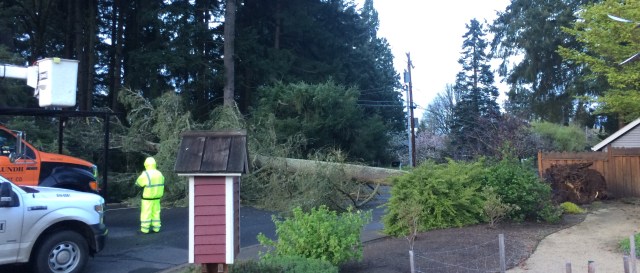
imageWith 90 + mph winds knocking trees into power lines, it looks like we will not have power through the night. Desperate times call for desperate measures: time for the emergency Cava rosado. Nothing will fool us into thinking we’re in sunny Barcelona better.

Vilarnau, Brut Reserva Rosé, Cava, Spain NV $15

It looks bright clear and cranberry pink. Smells of fresh, underripe strawberries, orange, and vanilla. Nears brut dryness with zipped acidity and a twangy fresh personality. Made from native Trepat and Pinot Noir. Very good stuff 4 of 5. $15 Thanks Vilarnau!

Posted in Uncategorized | Leave a comment

Revel in the World’s Biggest Wine Bottle Punt

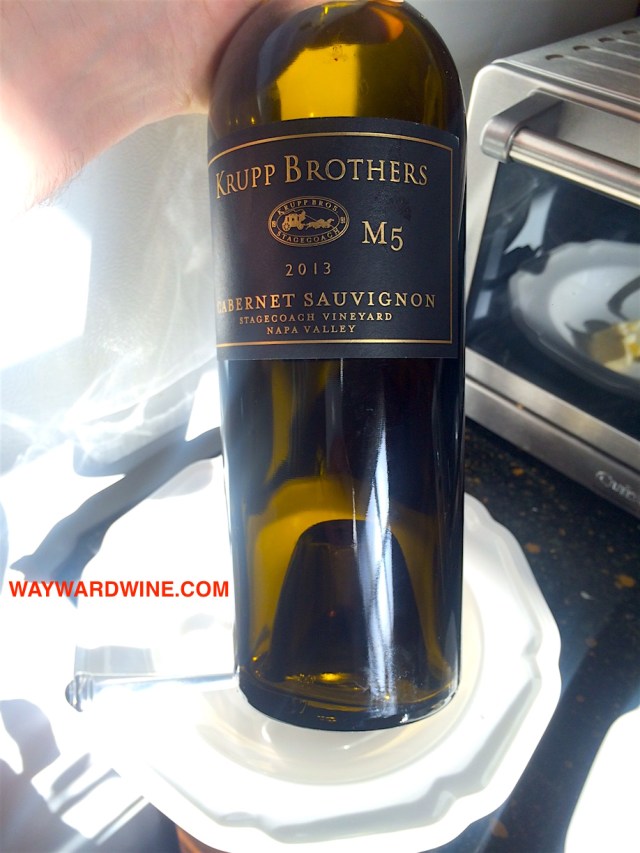
Now, I am not implying that Krupp Brothers Winery suffers from an inferiority complex, size issue, or that they are over-compensating for anything in particular. But *cough *cough

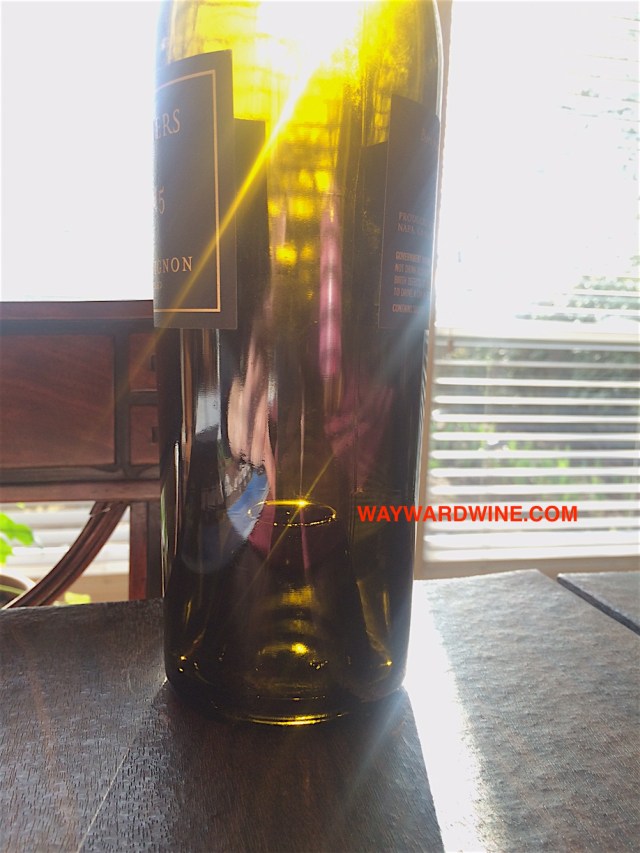
Krupp Brothers Punt

Look at that punt. You could fit a foot in that punt. That punt defies the laws of glass physics. I mean, just revel in its glory:

Wine Bottle Punt I thought this M5 Stagecoach Cabernet was a magnum. Nope, 750ml. Empty, it weights nearly two pounds and eleven ounces. Empty!

Krupp Bottle Weight

2 lbs 11 oz! Our rabbit weighed 2 lbs 11oz. A whole dang rabbit! Normal wine bottles weigh fourteen ounces. 14 oz! Not nearly three times that amount.

The next time you spend $200 on a bottle, feel solace in knowing that you are getting a lot glass. Buy two and you will get two new barbells: very expensive, breakable barbells.

The wine is pretty good as well.

Posted in Uncategorized | Tagged , , , , , | Leave a comment

Found in Translation: A Grape By Any Other Name (Monthly Wine Writing Challenge 32 #MWWC32)

The theme is “translation” for this, the thirty second Monthly Wine Writing Challenge.

Luckily, my Aunt surprised me recently.

She hosts near-monthly dinners, cooks great food, and pours copious amounts of sparkling wine.  I bring good bottles that survived my workweek.  Well, at our last powwow she had something new from Oregon.

Now, most American wine is an act of translation.  Why?  Because we try to conjugate European grapes with American soil, climate, and palates.  Results taste familiar but different: like speaking French with a Texan accent.  But with today’s wine, America forgot the encyclopedia.

My Aunt’s wine comes from Dundee, Oregon.  There, by 1975, 15 acres of red clay-loam and volcanic soil got planted with what they thought was Pinot Blanc.  Erm…nope!

The mistranslation dates back to 1939, when Georges de Latour first planted a white grape at Beaulieu Vineyards (BV) in California.  BV called it “Pinot Blanc”, “Melon”, and even “Chablis”.  Even David Lett, founding father of Oregon’s Eyrie Vineyards, fell into the Pinot Blanc trap.  It took until 1980 for French ampelographer Dr. Pierre Galet to discover that America’s “Pinot Blanc” was actually Melon de Bourgogne: a grape synonymous with Muscadet in the western Loire.

Whether marketing or mess up, we should not cast too much blame.  Melon de Bourgogne, as its name implies, originated in Burgundy anyway.  It even comes from a Pinot blanc and Gouais blanc crossing.  Also, Melon from our warmer climates is soft, pear-like akin to Pinot blanc than its briney lemony Loire counterpart Muscadet.

By the 1980s, Ken Wright’s Panther Creek set Dundee’s vineyard straight.  He made the first, aptly-labelled, “Melon de Bourgogne” from those vines.  After 1999, the Baldwins bought the vineyard and founded De Ponte Cellars (named after their Portuguese matriarch). Their winemaker Isabelle Dutartre hails from Burgundy, which promises well.  Oregon’s 2014 vintage provided record amounts of exceptional fruit.

So how does their Melon de Bourgogne fair?

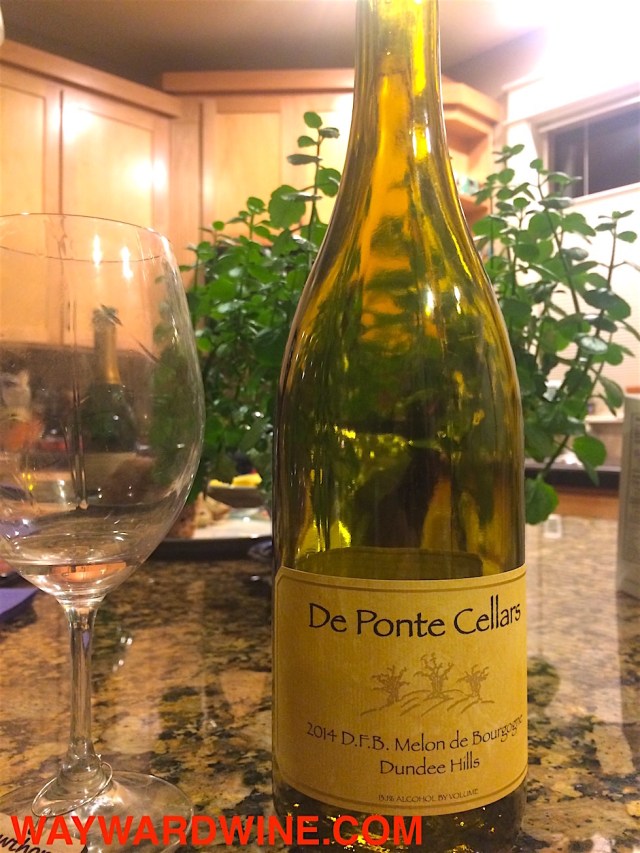
De Ponte Cellars, D.F.B., Melon de Bourgogne, Willamette Valley, Oregon 2014 $20-$25

De Ponte Cellars Melon de Bourgogne 2014


The APPEARANCE borders on pale straw, with glints of gold.

AROMAS waft about, easy-as-you-please, showing white pear, apple blossom, light honey, and a little pip of lemon juice softened by marzipan.

The PALATE’s acidity feels bright but tame, the body medium, round and texture mildly viscous.

Mellow FLAVORS echo aromas with ripe white pear, honeyed lemon, chamomile tea, and a pinch of salinity. Flavors carry an unobtrusive medium plus length.

De Ponte’s 2014 Melon de Bourgogne is tidy, fruity, and easy, yet dry, fresh, and linear enough to take seriously.  But do not expect zippy French Muscadet.  This is American Melon and it is very good (4 of 5) especially drunk now.  It begs for Spring, mild seafood, oysters, salads with pear, nuts, and feta, vegetable Paella, or mild cheese like my Aunt’s Gouda.

As the wine maker turns grapes into magic, wine writing requires us to translate liquid into words.  We parse a drink’s chemical signatures to tell its story: by proxy, adjective, association, and metaphor.  However, neither are perfect.  Pinot Blanc is not Melon de Bourgogne.  Yet it seems like it.  Just as my “white pear” is someone’s golden apple.  Our stumbling makes the journey more interesting.  In wine making, as in wine writing, it is fine if some things get lost in translation.

Monthly Wine Writing Challenge #32 (#MWWC32)

Source: http://www.melondebourgogne.com/history/

Posted in Uncategorized | Tagged , , , , , , , , , , , , , | 10 Comments

Singing Syrah: Jaboulet Crozes-Hermitage and Cornas

If you venture to the French aisle of any wine store you will likely see a wine by Paul Jaboulet. Their entry level rouge, Parallèl 45, is nearly ubiquitous.

paul jaboulet parallel 45And a nice little Côtes du Rhône it was. I say “was”, because after 200 years, in 2006, the family broke apart, and Paul Jaboulet sold the winery to finance company Frey (based in Bordeaux’s Chateau La Lagune who also own half of lovely Champagne Billecart-Salmon). No Jaboulets work there anymore.

However, Philippe Jaboulet had directed PJ for thirty years and was not ready to quit. He and his son Vincent kept about 32 acres of the family’s vineyards and bought 37 more. They farm organically and are HEV certified (fancy sustainable).  P&V Jaboulet is located in the northern Rhône Valley, just south of Tain l’Hermitage.

Rhone WineThis is Syrah and Marsanne country. So let us dive in:

P&V Jaboulet, Crozes-Hermitage Blanc 2013: 100% Marsanne 30 year old vines on alluvial, pebbly soil covering 1.2 hectares.

The APPEARANCE looks a bright, clear, medium gold and quite leggy. AROMAS seduce with jasmine, turkish delight, and oodles of golden pear and honey.  The PALATE feels just bright enough, but round, plump, and viscous.  FLAVORS keep to pleasant gold pear, honey, with a little lemon and saline lift that last a medium plus length.

P&V’s 2013 Blanc is very good (4 of 5) but should be drunk soon. Imagine a salad Nicoise or grilled chicken.

Jaboulet Crozes Hermitage Wine

P&V Jaboulet, Crozes-Hermitage Rouge 2013 Syrah, 32 acres of new and long-standing family property. It lives a year 20% in old barrels, stainless and concrete.

The APPEARANCE looks a bright, clear medium ruby red color. AROMAS smell moderately of ripe red cherry, fennel, and herbs de provence. The PALATE feels even, balanced with good acid, some tannin, a medium body, and soft texture. FLAVORS taste of mellow but ripe cherry, with dried herbs, and mocha powder that last a medium length.

The PV CH Rouge is well made, clean, synced, but somehow simple, so good (3 of 5).

P&V Nouvelère, Crozes-Hermitage Rouge 2010 comes from the family’s famed Thalabert vineyard. P&V renamed it Nouvelère to honor this ‘new era’. These Syrah vines go back 80 years: Jaboulet’s oldest. It lives two years in a mix of small and medium barrels.

The APPEARANCE has a deeper ruby core with brick tinting its clear rim. Prouder AROMAS claw out of the glass with darker berries, black raspberry, framed by tobacco and herb. The PALATE is dry, with medium acidity, round but woody tannins, warmer alcohol, and a medium body. FLAVORS taste of mixed berries, fruit leather, dusky minerals, and tobacco that linger quite a while.

P&V Nouvelère is complex, holding, but not overdone or overwhelming: very good (4 of 5). Drink now through 2020.

Lastly but hardly least…ly: 2010 Cornas: a small 1.7 acres bowl-shaped arena of granite, sun-bleached and first-picked, facing south east. It ferments in vats and ages two years in 228-liter oak barrel (50% new oak).

The APPEARANCE has a deep iron garnet core ringed by a clear copper with wide legs. AROMAS and FLAVORS stick to your palate like glue: blackberry jam, fresh blueberry, and black cherry, red cedar smoke, dried mint, and anise. The PALATE feels supple and fruity but bright enough yet wooded with a textured, with dry, long finish.

P&V’s Cornas has all the stuffing to go the distance another decade. It is outstanding now (5 of 5) and a decanting alongside wild game will set up any evening.

It makes me glad to see Philippe and Vincent Jaboulet have carried their family name and properties to new heights. The style is clean, modern, fruit-driven, but not cheapened by over-extraction or oaking.  Definitely, search them out!


Posted in Uncategorized | Tagged , , , , , , , , | Leave a comment