Luxembourg Wine: Elbling, Auxerrois, Rivaner, and Pinot Noir

133 days of travel just careened us through the frigid vineyards of Burgundy.  With winter gripping, we decide to dip a toe in Luxembourg.

EU map New York to Luxembourg Day 133Sandwiched between France, Belgium, and Germany, Luxembourg spans nary 1,000 square miles, filled by 525,000 residents.  But can such a small, cold country grow grapes of wine worthy merit?

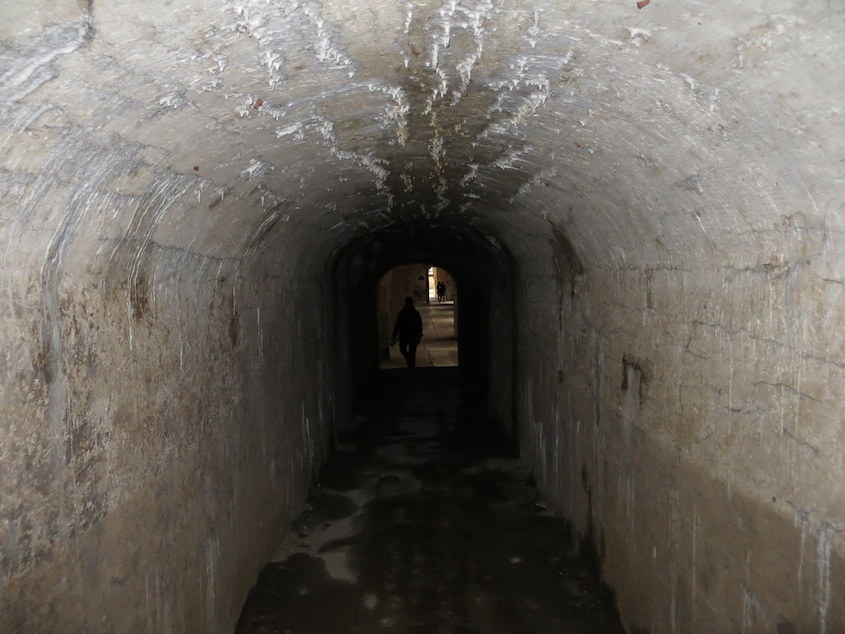
After dragging our gear across town, we unload into a hostel deep beneath the capital’s cliffs and fortifications.  But hunger and knowledge of a Christmas market drive us to climb back up.
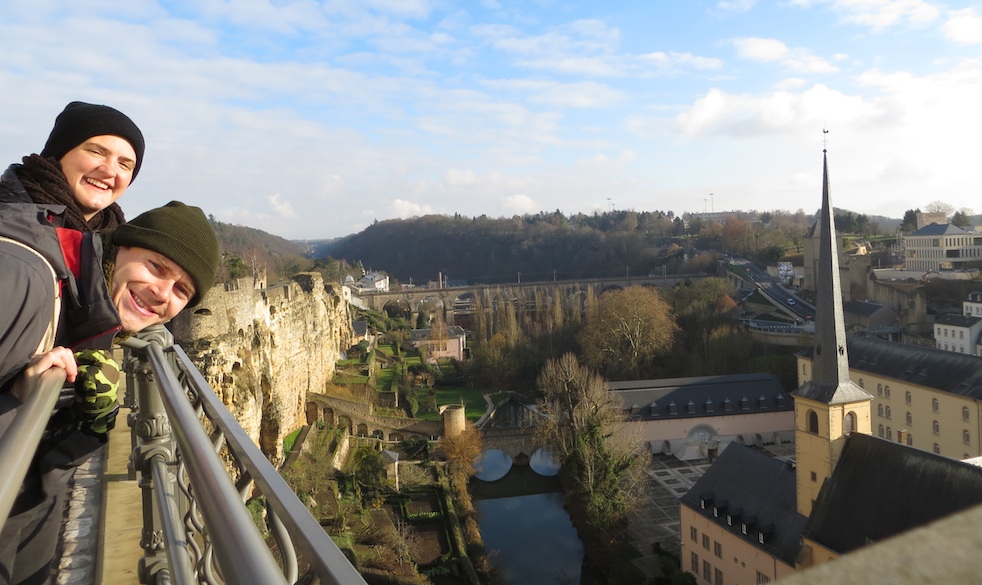
Tracy Aaron Luxembourg After a pleasant wander up and down parapets, down clean, narrow medieval roads. We discover the town square and potato pancakes:

Tracy Christmas Market Luxembourg Although early, the market bustles with wood-carved nativities, a man in polar bear costume, swarming children, a wool sock maker, tables full of free stollen, and most especially, the fondu chalet.  Filled with gluhwein and hot cheese, we glow with warmth and hit up the art museum.

Behind a 19th century facade is a sleek, modern museum. Each floor showcases a different era.  And yes, we find wine all the way back in the Roman era:

Roman Vine SarcophagusThis sarcophagus centers on a strange vine-legged woman (Spirit? Goddess? Monster?) She clearly represents fecundity and the vine, flanked by putti eating grapes and collecting/crushing? them for future wine.  We also discover a wooden barrel with grape pits (ceramic pithoi did not happen this far North):
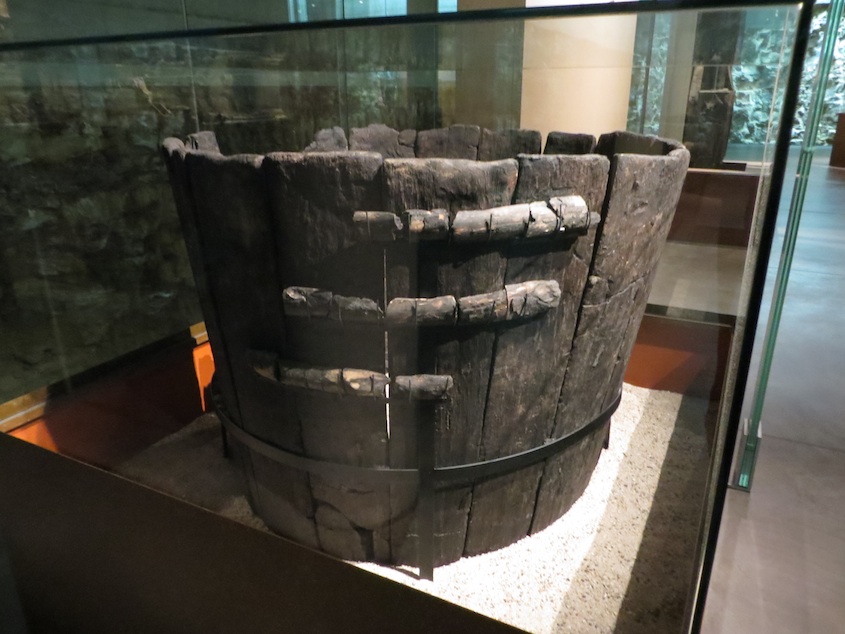
Cuve 280 AD LuxembourgInspired and plotting dinner, we head to downtown’s cooperative grocery store.  Evidently, we are not in France any more:

Heinze Mexican KetchupWith some trepidation, I collect four bottles for a grand total of 21 Euros of local Luxembourgian wine.

Now the Moselle (aka Mosel) that runs through Germany’s famed Riesling region also creates a warm-enough microclimate along Luxembourg’s Eastern border. Here dry whites are king.

We start with A. Gloden & Fils, Vin de Barrique, Moselle, Luxembourg, 2009. €7.40.

Gloden et Fils Auxerrois Barique LuxembourgMade from the Auxerrois grape (a child of Chardonnay), this white has barrel-aged aspirations.

Appearance: a pale lemon color, with a worrisome slight fizz.

Aromas: Although not overwhelming, this smells of pleasant white melon, creme brûlée, and anise.

Palate: Thankfully a slight sweetness tames the extra acidity, barely supported by a moderate 12.5% alcohol and average body.

Flavors: Unlike the aromas, we taste lemon and golden pear, but again followed by that nice creme brûlée (thanks barrels) that lasts a medium length. Gloden’s Auxerrois is good (3 of 5), pleasant, pillowy, with well balanced tartness.

Feeling on secure cold-climate ground, we try Gloden’s 2011 Elbling grape wine from the Côteaux de Wellenstein, 2011. €2.90.

Golden Et Fils Elbling LuxembourgYes, Elbling: not the handle for a hispanic rapper, but a grape of ancient origin (possibly mentioned by Pliny and Columella) and the same parents as Riesling.  But how does Elbling at 2.90?

Appearance: Another pale lemon color fills our glasses.

Aromas: Youthful, moderate aromas of spicy honey, licorice, lemon, and ginger make it sound interesting.

Palate: Even more sweetness here still has no chance at balancing the high acidity, paltry 10.5% alcohol, and light body.

Flavors: Jagged, lean lime, lemongrass, and slate that dissappear as soon as they offend our palates. Acceptable (2 out of 5). Gloden’s Elbling is consistently bright, acidic and simple.

We turn to a more showy label: Caves Gales, Rivaner (aka Müller-Thurgau), Côtes de Remich, Luxembourg, 2011. €3.50

Caves Giles Rivaner Cotes remich luxembourg 2011Known in Germany as Müller-Thurgau, Rivaner sounds like the title of some Tom Cruise movie.  Likewise, Rivaner the grape was a recent (1882) crossing of Riesling and Madeleine Royale, and is the most widely planted newbie thanks to its cold-hardiness. So…

Appearance: Pale, greenish, and a bit fizzy.

Aromas: Young but notably stronger aromas of lime, pineapple juice, and honey reflect the Riesling bloodline.

Palate: Light sweetness controls the bright acidity, with alcohol touching 11.5% creating a light body.

Flavors: Nothing shocking but medium intense flavors of pear, pineapple juice, lime juice wrap with a shortish, slate finish. Still, Gales’ Rivaner tastes clear cut, and good (3 of 5).

Emboldened, we turn to the Pinot Noir: Caves St Remi-Desom, Côtes de Remich, Moselle, Luxembourg, 2010 €7.39

Desom Cotes de Remich Pinot Noir LuxembourgOur palates still remember eating and drinking in Burgundy yesterday, so we how does Luxembourg stack up?

Appearance: a medium minus intense ruby color barely reaches the glass’s edge.

Aromas: Young yet well pronounced notes of cranberry and orange juice lead to clove, honey.

Palate: Sadly, here things fall apart. Without any sweetness, all we can feel is seering acid and overt 13% alcohol. Tannins are limp. The body is light.

Flavors: Like the nose, medium flavors of mulling spices, honey, tart orange, and cranberry juice lead to somewhat slate-like, sandy finish of medium length.

Desom’s Pinot is only acceptable (2 of 5).  Its flavors are straightforward, with clear acidity, and quick. Tough follow up act after a day in Beaune, but there just no structure or complexity.

Now we love cold climate wines.  Years of Finger Lake, Lake Ontario, and Long Island drinking tempered our palates to appreciate mouthwatering acids, light bodies and wild, edgy, funky flavors.  But by morning we both hurt.  This honestly minute survey does no justice to Luxembourg and its wine.  And granted, we are on EU Austerity Drinking Tour, so of course the 7.40 Auxerrois tasted most decent.

We return to the Christmas Market to tame our seered palates. Potato pancakes help. But really, only the fondu chalet can save us. If it ever opened. So we take in some horn playing, enjoy some yoldeling, get crushed by the increasingly-gluwein infused crowd, then finally fill up of magic cups of cheese.

We then catch a bus to the WWII American cemetery.  A long, cold walk finds us between battlefields.
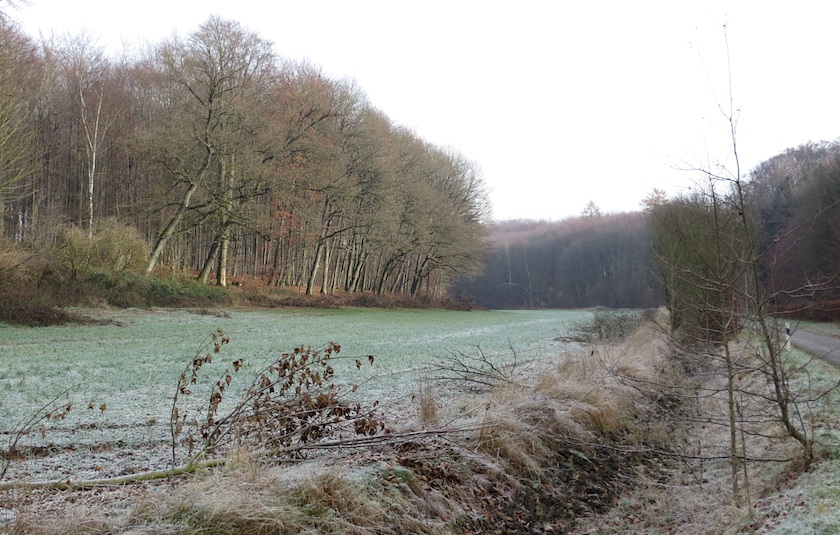
Icy LuxembourgNearby the Battle of the Bulge turned the Nazi’s last stab at Europe into a full on retreat.  Here, George S. Patton Jr. was buried amongst 5,076 other Americans:

Patton GraveWe walk between the crosses. I find an Oregonian. Tracy finds a servicewoman. Then the sleet picks up.  For balance, we trek another 20 minutes without sidewalks or signs to the German cemetery:

Nazi CemeteryMultiple names fill each marker, many unknown. The triumphal white of the American cemetery is replaced by grey granite. Even time is dead here.

The frozen sun starts to set. Chilled, we head back and decide to have a sober night. Luckily, we buy chocolate yule logs for dinner.

Next Monday’s post, we return to France and Alsace!

Posted in Uncategorized | Tagged , , , , , , , , , , , , , , | 2 Comments

Fontenay Abbey: Au Revoir Bourgogne

Having hit 130 days of nonstop travel, our EU Austerity Drinking Tour needs a moment of sober solace. The last three days in Burgundy have climbed Beaune’s premier cru vineyards, visited the Hospice de Beaune, and Dijon’s medieval gems.

Today we wake at 9am, feast on chocolate croissants, then hop train to Montbard.  Our small map puts famed Fontenay Abbey nearby.  Since UNESCO declared Fontenay a World Heritage Site on our birth-year, it must be worth a day trip.  But the 6 kilometer march, without sidewalk, near freezing, turn this into surprise penance.

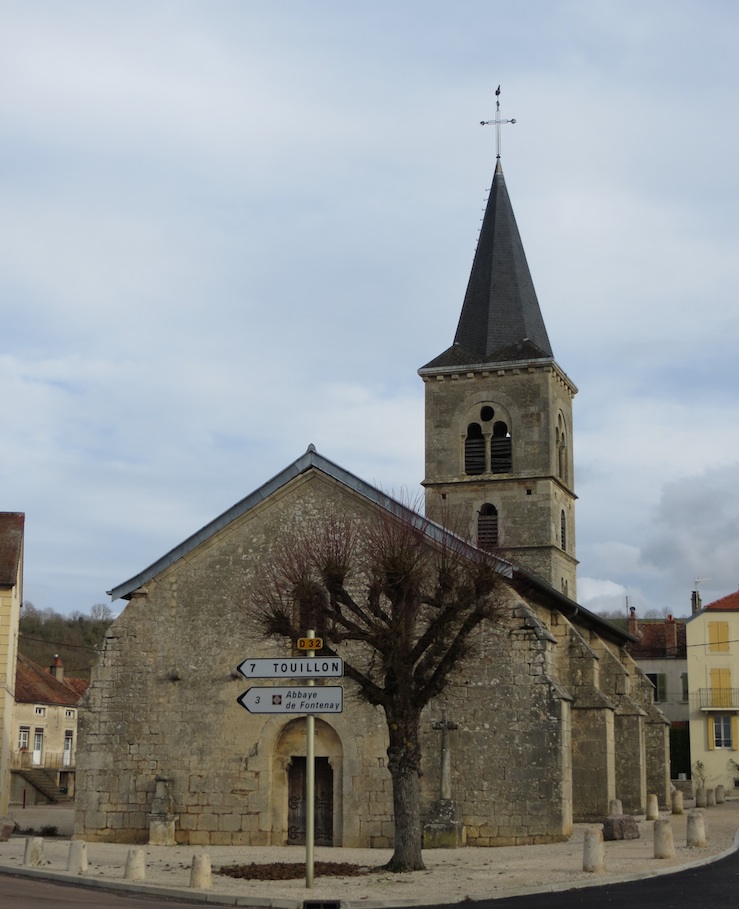
Halfway, our tired feet discover a lovely ancient chapel:

MontbardChapelBut that’s not it.  The one lane road takes a turn, and we discover…cows!
Burgundy CowsWe keep going but feel lost. Cars and people have evaporated. Finally, the gate to Fontenay emerges, shrouded by trees.

Fontenay GateReally? Seriously? That’s it? We just walked 6km for this?

But then we enter a time capsule, a world trapped between the Romanesque and Medieval. Here poor, pious Cistercians worked a self-sufficient life. They founded it in 1118 because their founding Abbey wasn’t austere (aka miserable) enough.

First stop, church:

Fontenay ChurchA Bishop on the run funded and founded the massive chapel in 1147.

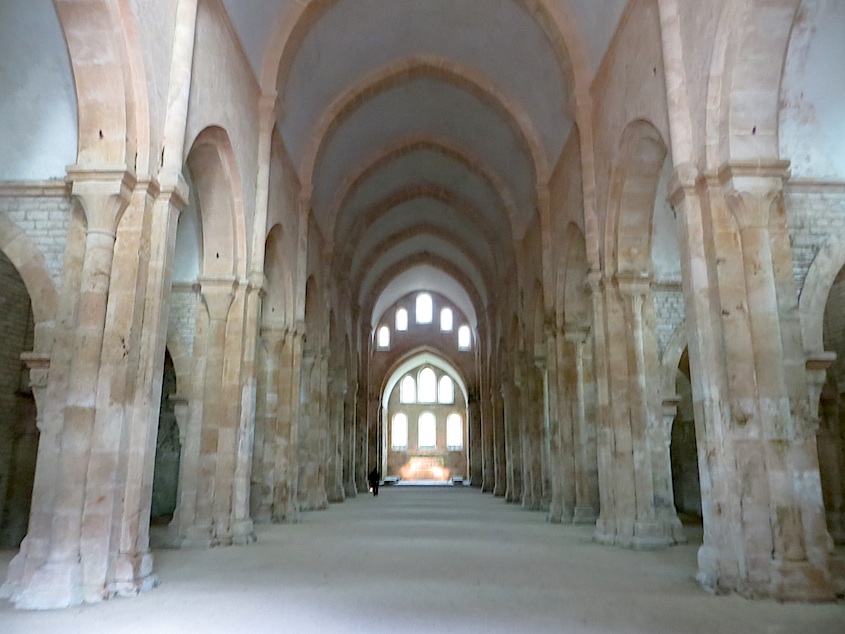
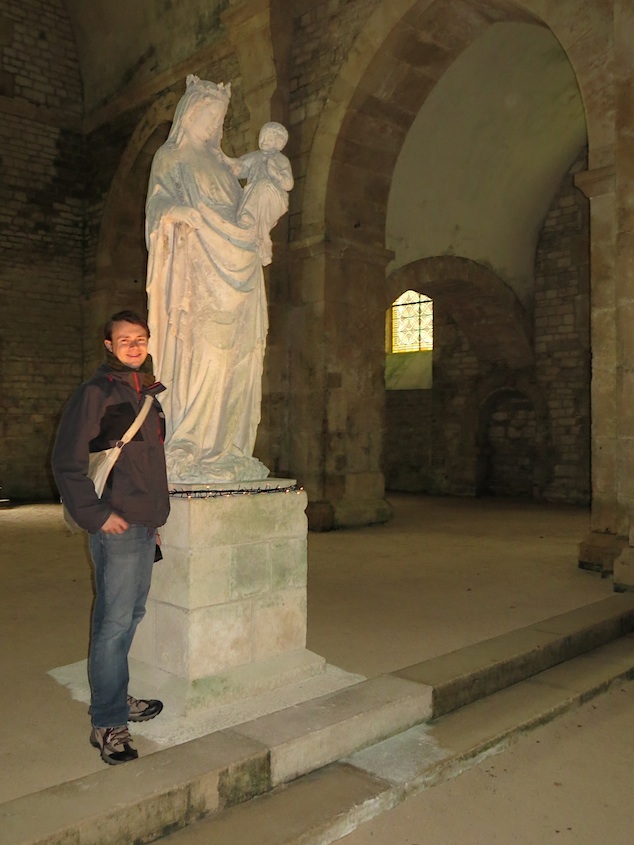
Fontenay Church InteriorWe feel small beneath its simple, weighty, arches. Divine light was the only coloration. Little decorates it beyond a few patterned tiles and a columnar Mary and child:

Fontany MaryWith a thin wrap of Christmas LEDs…it is Novemeber after all. However, such minimal decor opens our eyes to smaller details, like the almost Alhambra-esque pointed arches:

Fontenay Church ArchesAfter church, we head to the massive, vaulted dormitories.

Fontenay DormitoriesBunk beds once lined this massive, cold, shared space. Just imagine college but with 300 roomies in an echo chamber.  We head below to the stump forest courtyard:

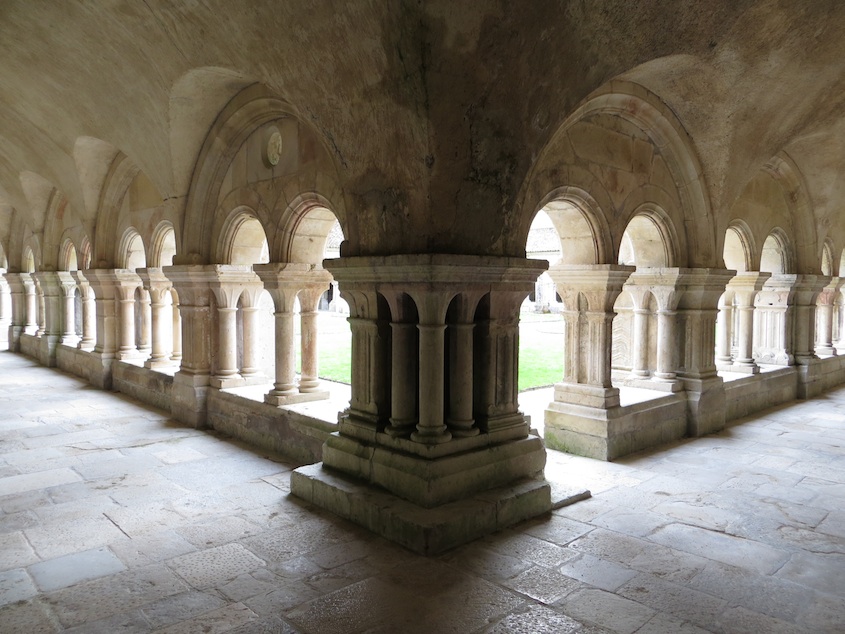
Fontenay CoutyardAdjacent to the courtyard, the most impressive tropical forest supports the massive dorm room above.

Fontenay Understory ArchesThese vaults connect to the Kitchen:

Fontenay KitchenAlbeit amazing, we soon realize we have yet to see any of the typical anthropomorphic carvings or delights of other chapels, churches, or monasteries. Fontenay was a deprivation chamber. Only thought of the divine had a place here.

But there was always work.  Like a bookend to the Basilica, on the other end of the campus, was the forge:

Fontenay Iron Forge The backdoor of this basilica opened to a real iron mine: convenient!

Fontenay Iron MineThen excavated iron ore was then brought into the main hall, where the massive furnace heated it for smelting and production of tools.

Fontenay Iron FurnaceHowever, these monks were as smart as they were hardworking. That hammer is attached to a massive, churning, hydraulic wheel: making it Europe’s first metallurgical factory, possibly its first industrial plant.

Fontenay Water WheelAt least that’s what the overly proud French plaque claims.

Later years saw English kings and Popes visit Fontenay. The French revolution turned it into a paper mill.  Turn of the last century restorations returned Fontenay’s austere charm.

Fontenay Tracy AaronThe campus feels calm, committed, and pure.

I freeze outside trying to draw it, while my smarter wife enjoys the museum. Then we face our hike back to Montbard. The world turns from Burgundian pale grey to something more brooding, deep, blue, and fired with pink flame.

Fontenay Days EndThen it rains.

We soak for our three hour our walk back to Montbard’s station (with a grocery store dinner between). But the day and abbey cleared our minds, preparing fresh ground for a trip out of France, to stick our toes in Luxemburg. Although only in Burgundy four days, we must leave before we get too attached, and before the fish starts to stinks as my grandmother once said.

Posted in Uncategorized | Tagged , , , , , , , , , , | 2 Comments

Looking Beyond Local #MWWC12 Troon, Cabernet Sauvignon Reserve, Applegate Valley, Oregon 2008

wine-stain1-3We in the West with more money than sense have made religion out of things local.  Like buying indulgences, that carrot at your farmer’s market or grandma’s un-labeled jam make us feel like we have done our part.

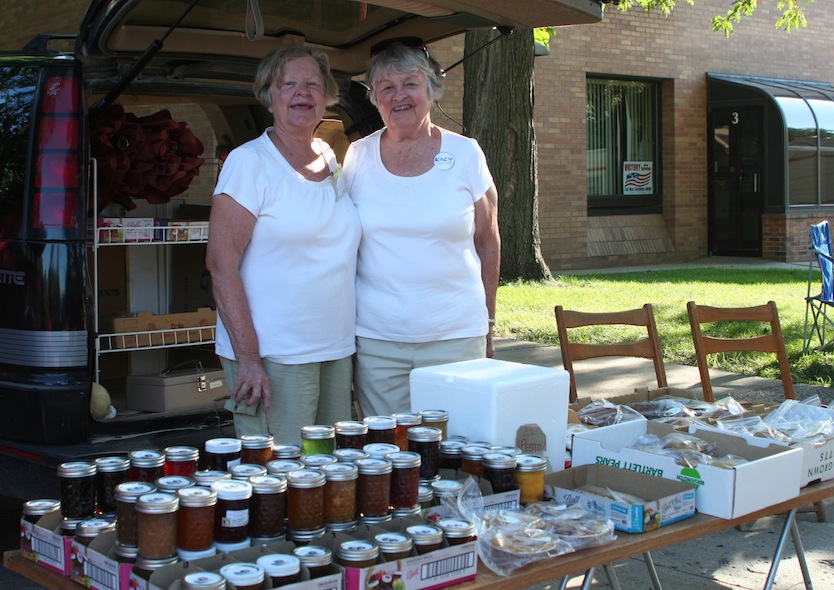
Farmer Market JamDelicious or dangerous, buying local frees us of our carbon-footprint guilt.

Yes, directing money back into the native economy slices out the middle-person. Yes, things grown from the same soil, sun, waters, and hands tend to synchronize well with similar products (see terroir).

But let us not fool ourselves.  At some point we get tired of underripe tomatoes, botulism, and local IPAs.  At some point we crave adventure.  This is why Oregon Pinot Noir bores me. I live a few minutes’ drive from some of the Willamette Valley’s best vineyards. I obsess daily over the finer permutations of Yamhill-Carlton or Dundee soil types.  But Pinot is (pretty much) all we grow here.

Local need not be so narrow.  Wine can transport one’s palate from the fringes of Morocco to Burgundy, to Napa, to Chile.  So, to slightly broaden my horizon, a day trip South finds us in the Applegate Valley AVA:

applegate valley mapHere the great, wet, state of Oregon sees more sun than any other part.  It’s dry, hot, and thus capable of warmer-climate grapes such as Syrah (see Quady North review), Viognier, Malbec, and occasionally Cabernet Sauvignon.

The Siskiyou Range draws the cool Pacific onto the Applegate’s hot, granitic soil.  Only in perfect years, like 2008, does Troon Vineyards, the Applegate’s eldest, decide to bottle their Cabernet Sauvignon.  As luck has it, Herb Quady was at the helm and made 278 cases.

Troon Cabernet Reserve 2008Appearance: The narrow rim looks clear and ruby, but the core opaque, inked, purple.

Aromas: Fresh, glinting blackberry jam spreads across crispy, buttered toast.  Or maybe I’m in a cherry orchard, blueberries at a distance, a waxy black vanilla bean.

Palate: Dry, notable acids ring fast and high up front.  They fade into soft, dusty tannins.  These turn to a warm glow of 13.8% alcohol.  The body feels full yet muscular.

Flavors: Ripe, bundled black berries and cherry fruit dive into taught, food-starved, tannic dryness thanks to 24 months of French barrel time.  The oak adds an adult dollop of volcanic ashy edge and tobacco near the finish. But somehow at the end that laser line of bright red fruit returns.

Troon’s Reserve 2008 Cab is outstanding, complex, lengthy stuff (5 of 5). It has an easy decade of evolution ahead of it but right now would simply eat any pepper steak, aged stinky cheese, or mushroom tart.

Conclusions: Don’t allow fervent adherence to things local to make you myopic.  We become broader and better people by learning beyond our bubble.  Few knew Oregon could make Cabernet, let alone one of such greatness.  But we need to look beyond our borders to find it.

Thus concludes my submission to the 12th Monthly Wine Writing Challenge.

Posted in Uncategorized | Tagged , , , , , , , , , , , , , , | 9 Comments

Beaune Part 2: Hospice de Beaune Hotel Dieu

Last Monday’s post, we hiked the frozen tundra of Beaune’s vineyards, tasted pinot noir from skeleton vines, got lost, and ate its chalky soil.  Today, we tumble back into Beaune to visit the Hospice de Beaune Hôtel Dieu: home of the world’s most famous wine auction.

A few plagues and marauding bands brought Beaune to a humanitarian crisis in the 1440s. Desperate to stop disease and buy a one-way-ticket to indulgence-paved heaven, Nicolas Rolin, Chancellor, and wife Guigone had a hospital and hostel built for the poor.  We arrive outside, a bit underwhelmed:

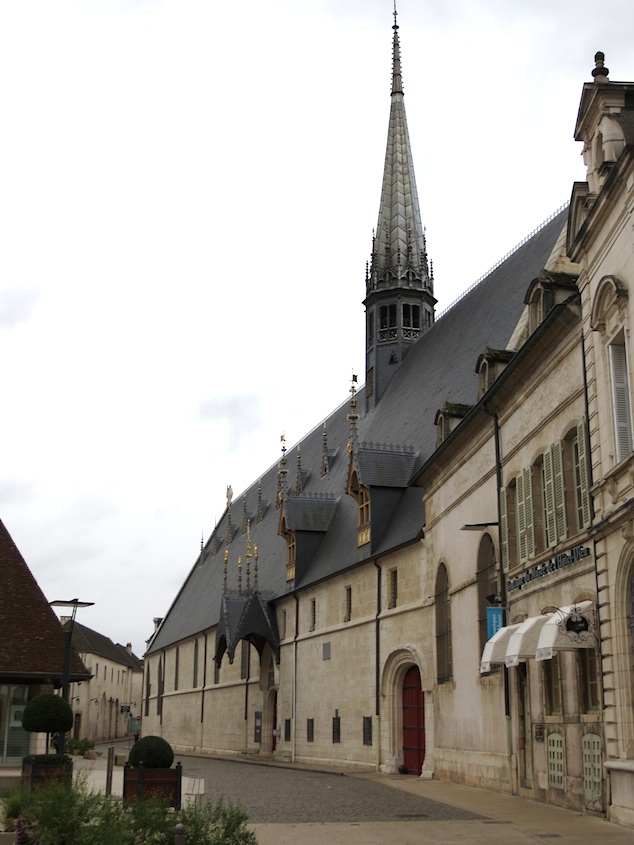
Exterior Hospices de BeauneIt’s cool looking but Beaune’s limestone forms a cold facade. Yet the red door hints at the extravagance within:

Hotel Dieu Hospice Red DoorWe pick up audio guides and enter into not just any courtyard:

Courtyard Hospice de Beaune

iframe width=”420″ height=”315″ src=”//www.youtube.com/embed/uAknEGjUWrk” frameborder=”0″ allowfullscreen></iframe>

More about that auction later. First: context:

Christopher Columbus wasn’t even born when this was built.  The hospital still runs today, but off site in a modern facility. But here, up until the 1970s, nuns and doctors toiled over the poor and infirm, keeping the riff raff from infecting higher society.

This is the great hall where the poor rested, ate tables along the center, while enjoying mass from the convenience of their beds.

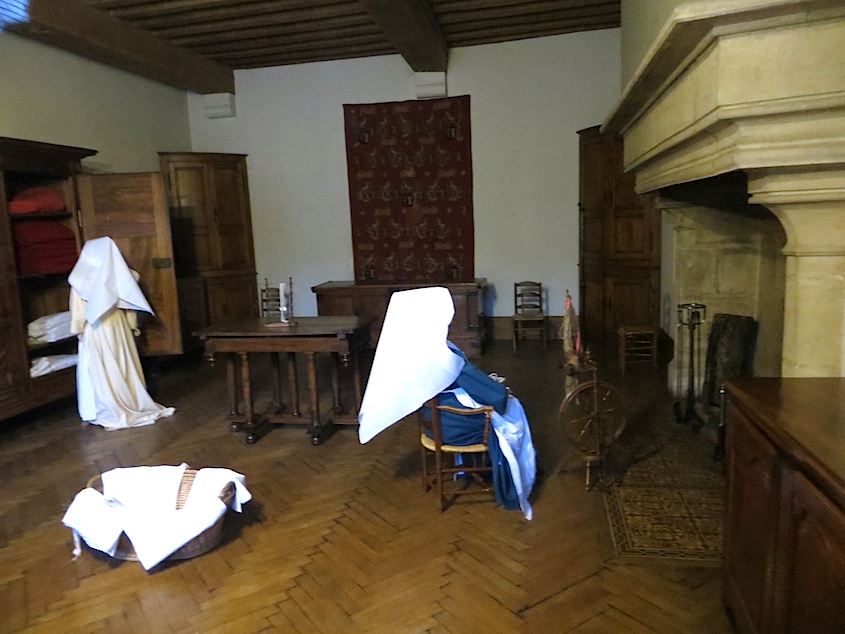
Hospice de Beaune InfirmeryBeyond the great hall follow modest rooms where nuns slept, ate, and probably complained about either exhaustion or boredom:Nun room Hotel de dieuIn excessive contrast was a later Baroque chapel added, not for the poor, but for those who ran the Hospice:

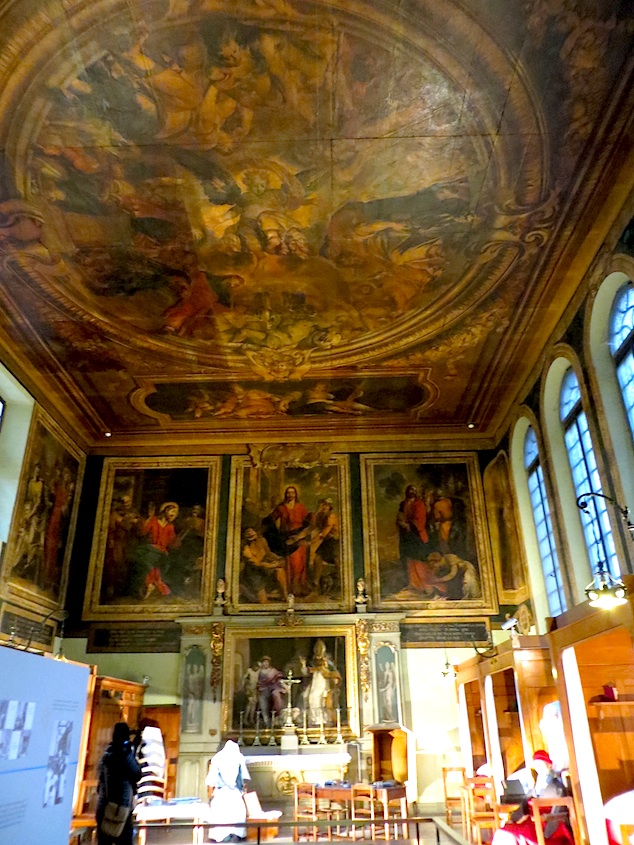
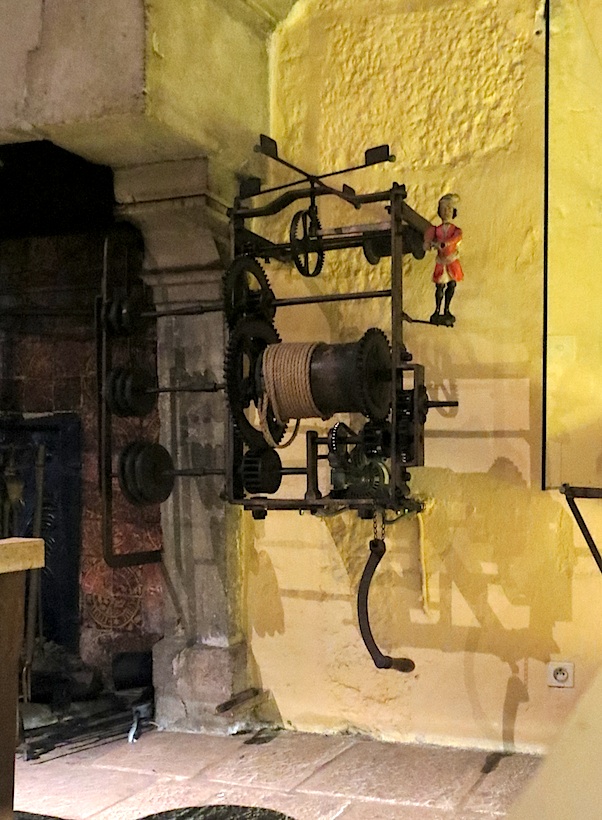
Hotel Dieu Painted Room The whole place tended toward eclecticism and extravagance. We’re not going to show photos of the rectal medicine funnel.  The kitchen had the most fantabulous contraption for meat turning:

Fantabulous Meat TurnerAnd they ensured the stove had not one, but two goose-necked water spouts…practical:

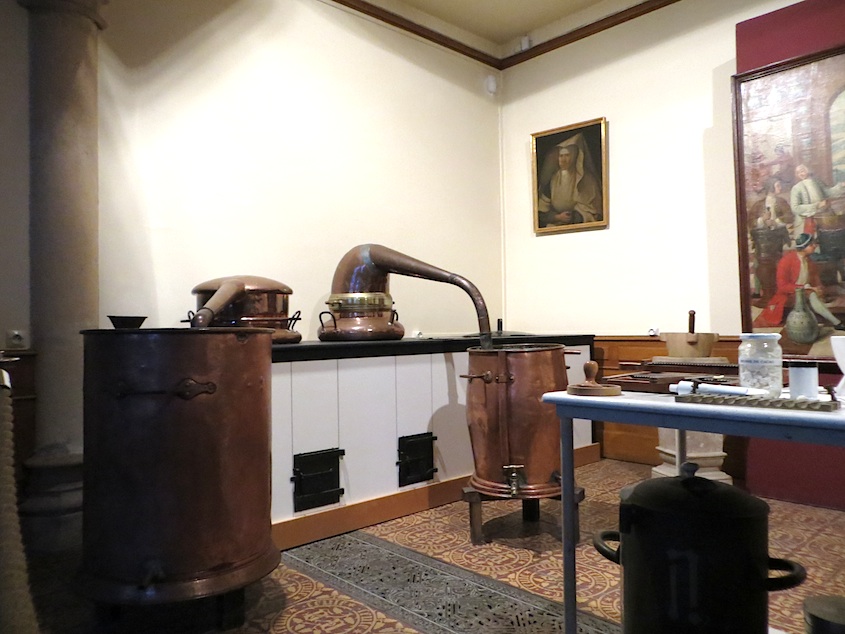
Kitchen Beaune HospiceMeanwhile, the onsite apothecary had wall-to-wall jars of herbs, as well as a state-of-the art distillery.

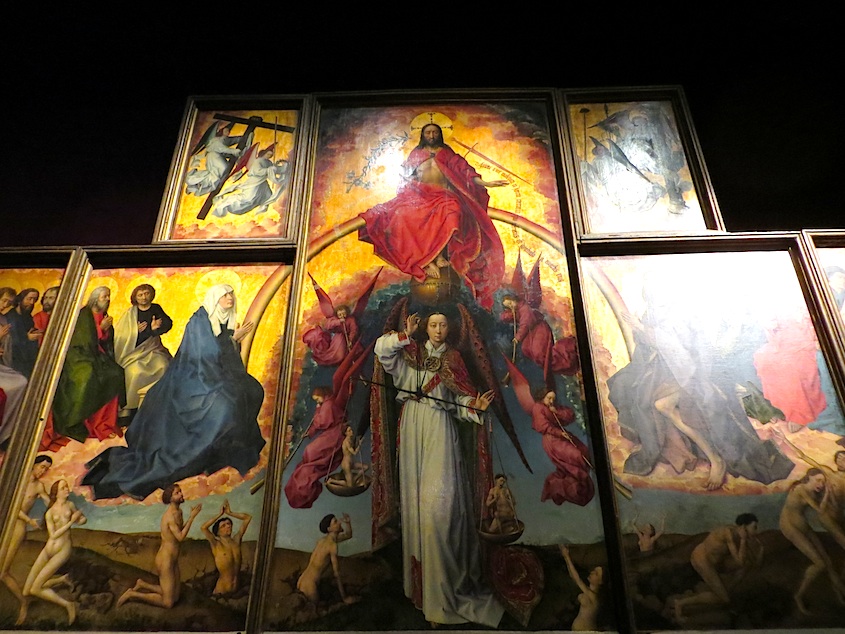
Beaun Apothecary Hospice Oh, and let us not forget one of Art History’s favorite Weyden polyptych panels with Jesus riding a rainbow:

Weyden Jesus Rainbow RidingThis Weyden reminded us that Burgundy certainly once looked North, especially with their kingdom including the Netherlands.

Works like this were one of many ways higher society kept donating their way to heaven. Another Christmas gift to Hotel de Deiu came in the form of vineyards.  Today, the Hospice owns 150 acres of Grand and Premiere Cru vines throughout Burgundy.

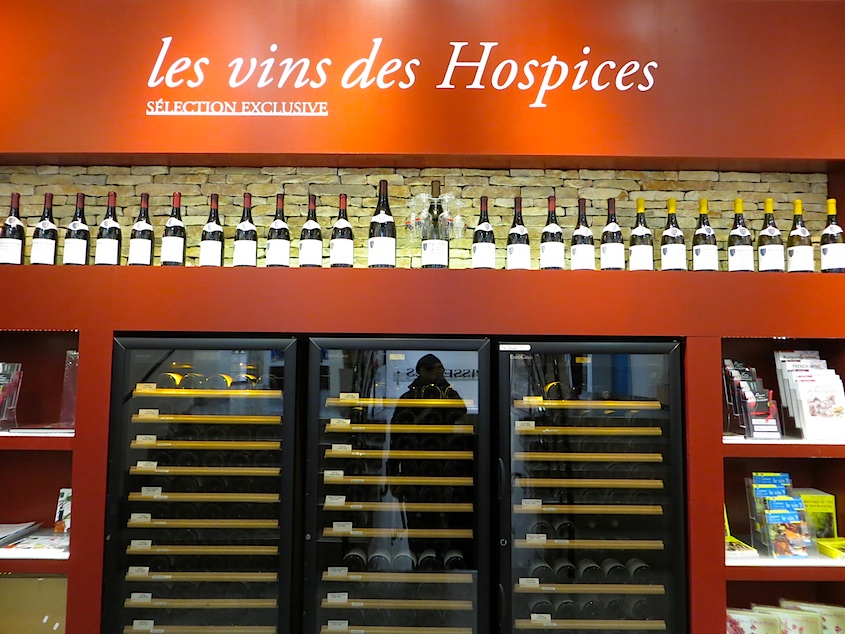
Vins des HospicesAfter each harvest and fermentation, their wines-to-be are auction the third week of November.

The charity auction has run since 1851.  Come auction day, 31 cuvées of red and 13 of white totaling 800 barrels are up for grabs.  How high (or low) sales go often sets the standard expected value for the rest of Burgundy that vintage.

Sadly, we couldn’t try any.  The nuns don’t have a tasting room.  This is an EU Austerity Drinking Tour after all.

Next Monday’s post and 131 days of constant travel take us to a magnificent monastery outside Dijon.


Posted in Uncategorized | Tagged , , , , , , | 3 Comments

Thirsty Thursday: Birthday Champagne Challenge at Paley’s Place LeMaire

It’s my wife’s birthday and I’m in trouble. I sell wine to restaurants throughout Portland. But who to choose.  We rarely eat out.  We mostly cook, and it’s usually vegetarian.  So the whole restaurant scene seems like overpriced, meat-fest, fluff (especially when we buy wine at cost).  Yet, deep down, she wants to be overwhelmed.  Nothing too formal, just outstanding.

Argghhh…

After a mild heart attack, I forget my job.  I forget accounts that sell my wine. I think about who I respect.  Where do my wine-geeks eat at?

Paley’s Place

Although October and Fall have started, it remains sunny, 80F, and the Fates have a table for two on the patio.  After a nervous parley with their buyer, we settle in.  The world turns amber.

Then out come two glasses of Crèmant de Bourgogne: Burgundy’s affordable answer to Champagne.  From Clotilde Davenne, it tastes snappy, citric, a touch saline, and utterly refreshing. This leads us to a challenge: she wants the five course, totally unknown chef’s menu, and I want the Red Wine-Braised Freekeh & Delicata Squash salad, as well as the Merguez-Stuffed Lamb Shoulder.

What could possibly pair?

We sip the flute and pour over the wine list.  I have some top Champagne, reds, whites, Brunello, and Burgundy there.  Yet nothing makes sense.  Then fantastic, adorable rondels of fried potato distract us.  We sip the bubbly.  At least four waiters try to help us. We sip the bubbly.  Bread arrives.  We sip the bubbly.

Then the dim bulb lights: bubbly.  Not this bubbly.  But not my bubbly.  But a bottle of Champagne.  It is her birthday after all.  Not any Champagne, but grower Champagne, Dom Perignon’s next door neighbor, a small grower called Roger Constant LeMaire makes Cuvée Trianon, Brut Champagne.

BubblyTighterIt looks a vibrant, pale gold with fine yet rapid, aggressive fizz.  Intense aromas show off four years of cellaring on yeasts: salt, pepper, chai spices, and baguette crust are there, backed by lime, lemon, strawberry pith, and ginger.  It feels dry, serious (6g of sugar/liter), incisively tart, yet plump enough to hold onto and through our meal-malestrom.

What follows is fantastic food pornography. A plate of currant-filled duck, horseradish spiced tongue, and an unbelievably complex, bread-wrapped, mushroom/nut-filled, sliver of delighted pork splay before us.  Cold cuts never seemed so good.

The Champagne sings, especially with the breaded pork.

Next, our first plates emerge. Her surprise dish is a crusted salmon, baby eggplant, browned butter, and veg. fest:

SalmonThe LeMaire Champagne holds beautifully, like a splash of lemon and chalk.  My golden squash plays off its mineral and fruit.

Then arrives Champagne’s greatest challenge: her Braised Oxtail & Gnocchi in Jus and my Merguez-Stuffed Lamb Shoulder, resting on a spicy tomato relish with corn and a wedge of fried masa cake.

All reason would say “have red wine you idiots!”. But half the bottle of Champagne persists.    Somehow, that spicy chunk of 60% Pinot Noir, hand selected fruit, and all that time on the lees make LeMaire intense enough a competitor to hold up.  It has also warmed up and the fizz softened, making it more of a wine than a bubbly.

Yes, the spice and herb from my dish make it seem drier, more acidic. Yes, all her oxtail’s earthiness brings out its fruit.  Yet it stands up, cleansing our palates of the oil and fantastic fat.

Then her eclectic four cheese plate emerges. The truffled pecorino is delightful with it, Cyprus Grove bright and quite good, the cedar smoked goat was odd yet great itself, but the brie, albeit simple alone, was breathtaking with the last drops of now mellow Champagne.

And then we wait.

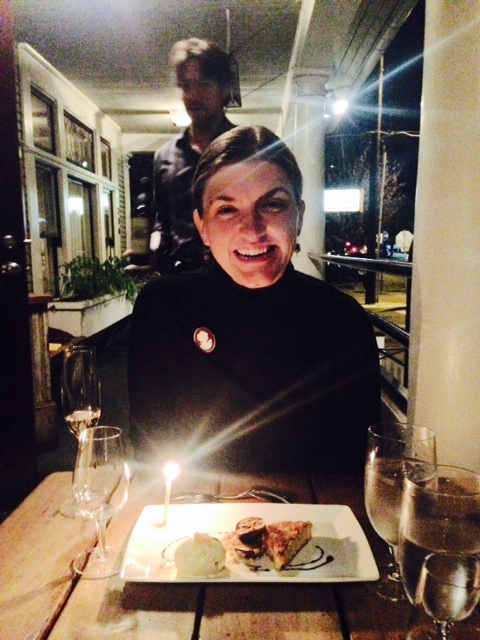
The sun sets and the late rush has hit Paley’s.  People order Chateauneuf du Pape with their appetizers and chat about how Robert Parker is a genius.  Meanwhile, we glow over LeMaire’s success.  And then dessert arrives. The ginger ice-cream is lovely, the almond tort crunchy, and figs earthy (if underripe):

DessertBut then Joshua emerges from the shadows with a bottle of Madeira. Nary twenty four hours had passed since I suggested Paley’s get Madeira. And The Rare Wine Co. provides (although it annihilates our desert…consider more balsamic glaze to counter).

Glowing from a three hour feast, we head home.

I walk to our mailbox, expecting nothing. But then, I pull out an odd, large envelope, with red stamps and blue pen. I nervously hand it to Tracy. She screams and tears it open:

Jancis Robinson Photo 2002a

Somehow, Jancis Robinson, the first non-trade MW, the Queen’s wine adviser, Tracy’s idol, writer of THE Encyclopedia of Wine, and my heroine, had found a photo of herself in Moscow, on the release of her World Atlas of Wine, from 2002, signed and sent it for Tracy, with no idea that her birthday was today.

Happy birthday.

Posted in Uncategorized | Tagged , , , , , , , , , , | 3 Comments