WORK.WINE.WORK.

Work. Wine. Work. Wine. Work. Wine.

The days blur my routine of tests and checks, morning and evening with my time at work. Selling and making the stuff eats my hours. But soon fermentation will stop. Soon all I will need is patience.

Don't sneeze. Don't sneeze.With each day I gain a percentage of alcohol. This is impressively fast compared to my last three wines, which brought in half that amount.

Still a way to go.

Three days pass. The tank still hovers around 70 degrees Fahrenheit: warmer than I’d like but fine. The yeasts have created nearly five percentages of alcohol. We’re half way home.

Curious, I sterilize a glass and taste my midway wine.

Tasty? Not really.

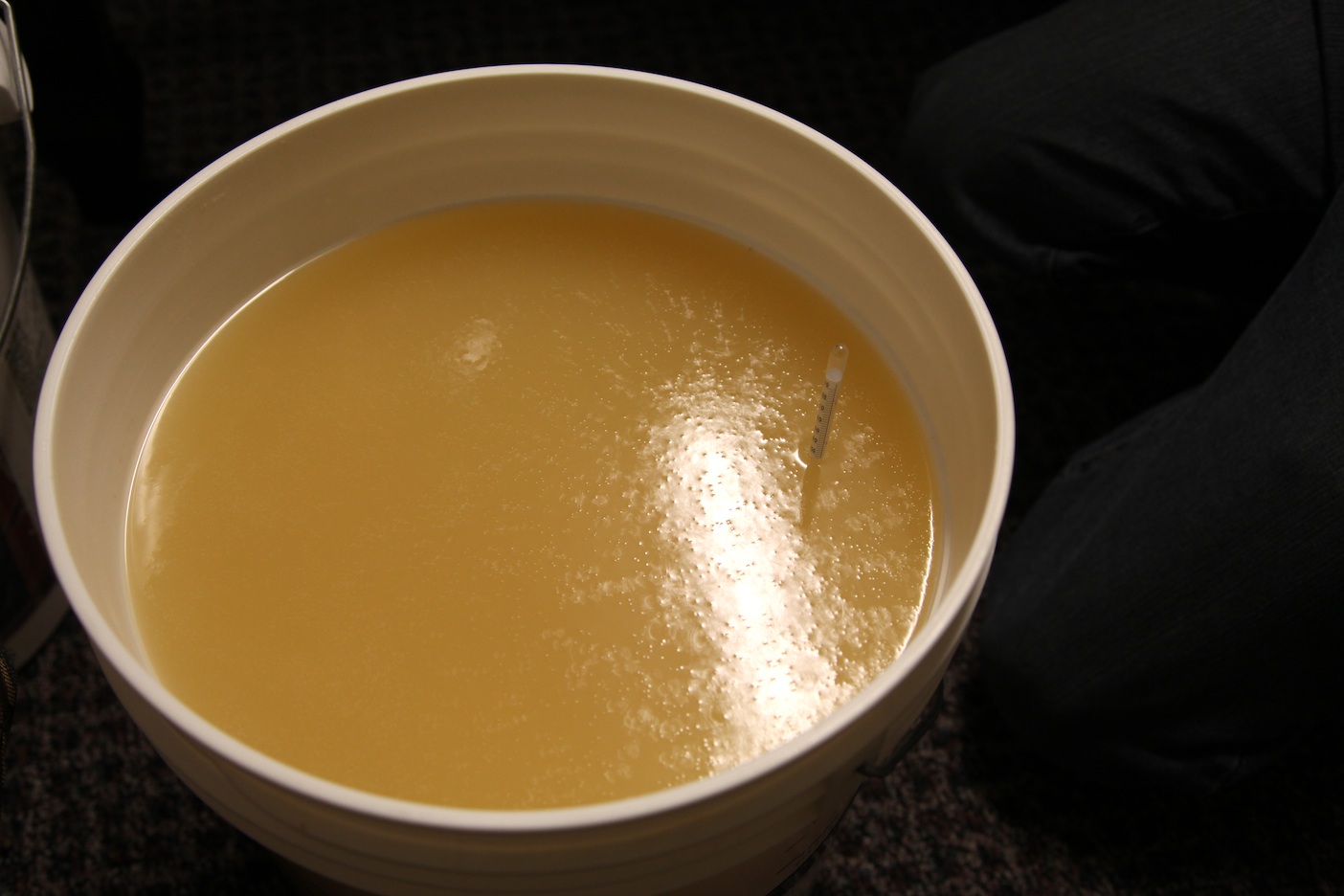
Although yeasts are microscopic, they’ve multiplied so massively that the wine is hazy, nearly opaque. The yellow green luster is now grey. The wine is fizzy and somewhat alcoholic like beer. As we near dryness, citrus notes and acidity are gaining on a wine that is now only moderately sweet. The flavors remain mild, pear-like.

Shrinking returns...

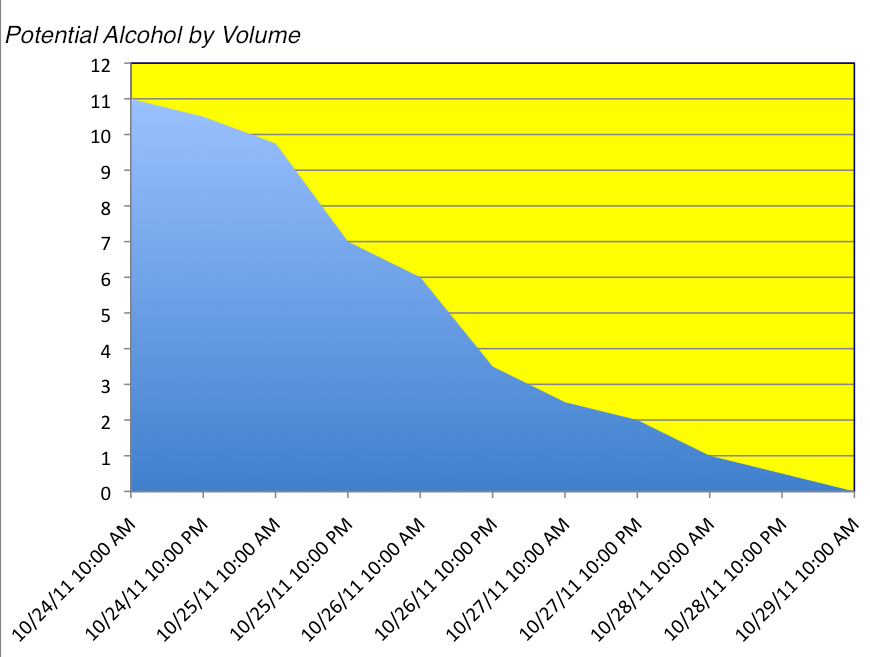
By day four, the alcohol jumps: only a quarter of the sugars remain. By day five, another jump leaves only 3 percentages to go.

Now that sugars are harder to find, the yeasts slow down.

The graph below shows this gradual, rapid, gradual arc:

Sugar density falling in terms of its potential alcohol.

The graph also shows that yeasts thrive in warmer temperatures. Their progress is slower at night than during the day. This matched changes in room temperature. If I had kept the wine fridged, where it’s constant and dark, the bell curve would have been smoother. Instead, yeasts woke up with the sun and slept with the night.

We’re nearly done.

I need to remember: this isn’t a race. Slower, cooler fermentations can lead to wines that better express their fruit flavors. Why? Because the yeasts have time to convert the grape’s chemical components into esters that you can smell and taste.

But I’m not going to risk chilling my yeasts into unconsciousness. For now, a stable wine is enough.

Come on!!!

The airlock keeps popping. Once it stops, so will the CO2. With that gaseous blanket gone, my wine will be exposed to oxygen. Then I must stabilize and rack it.

Posted in CABERNET CRISES: MY FOURTH WINE, OENOLOGICAL ODYSSEY | Tagged , , , , , , , , , , , , , | 4 Comments

BUBBLE.BUBBLE

I’m not worried.

Some yeasts take days to wake up. My blueberry wine, although crap, took days before fermentation started. So I don’t expect the vidal blanc that I bought 24 hours ago to have begun.

Still exhausted from my wine-tasting/juice-buying-marathon-birthday-weekend, I go to check my tank.

Heck yes.

That fizz means I win!

Good. But check your excitement. Yeasts make more than just alcohol and fizzy CO2. Their busy bodies also create heat. Too much heat kills fruit, drives rapid fermentation, and spawns volatile acidity. Worse, it could stop fermentation altogether by killing the yeast. Only in the age of AC and temperature controlled tanks can Texas (or for that matter California, Australia, Sicily etc.) make wine that isn’t already vinegar.

So I need to keep an eye on my tank’s temperature.

But the work day calls.

Once back home, I check our progress…

Not bad. Although it makes me wonder how Fallbright (my grapegrower) had a Brix of 17.8 (1.070 specific sugar gravity or 9.5% potential alcohol), while my reading was nearly 20 Brix this morning and is still around 18 or 19 now. Granted, my tank temperature has jumped to 70 degrees Fahrenheit. But that temperature means my Brix reading only needs minor adjustments (around the .01 territory). Who knows….

Either way, if things get too warm, I have a stolen…I mean borrowed mini-fridge from students to stick the tank in. But too much cold will put the yeasts to sleep. A happy balance is everything.

Tune in next week!

Posted in CABERNET CRISES: MY FOURTH WINE, OENOLOGICAL ODYSSEY | Tagged , , , , , , , , , , | Leave a comment

TIRED.TESTY.TROUBLE

I top off my fermentation tank to six gallons and save the extra gallon: with which to sweeten, make sparkling, or do whatever the heck else strikes my various fancies.

Last year’s vignoles wine was fine. I learned gobs of stuff while making a slightly sweet, accidentally bubbly wine. But you try drinking thirty bottles of sameness. This unfermented reserve gives me options.

I’m tired from driving. It’s late. But if I don’t put yeast in the juice tonight, either fermentation won’t  happen or wild yeasts and bacteria will ruin it for me.

I need to double check the potential alcohol…

ugh…I’m spent. Fine! I’ll have to trust the Brix of 17.8 that Fallbright grape growers gave me (although that puts the end alcohol under 10%…sad).

I taste the juice.

Viva la difference. Compared to 2010’s vignoles, this vidal is mild in many ways: just as its grapes tasted this morning. My chart breaks down its basics: Although a bit demure, this juice wafts up perfumed aromatics, fresh fruits, and dancing acidity (3.1 pH, .78 TA = zing!).

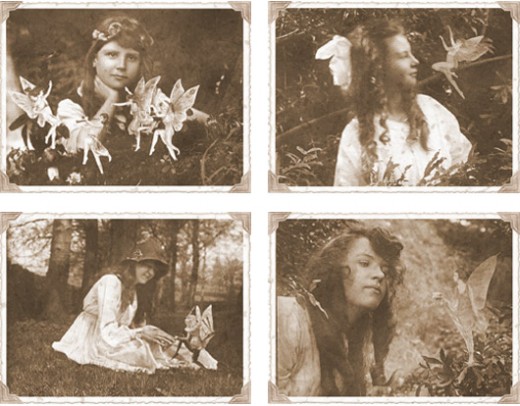
It reminds of fairies. No, not Disney’s pushy Tinkerbell, nor men scared of mice. You know, those silent, mysterious, perpetually childlike, airy yet mischievous fairies. The kinds that ruined Sir Arthur Conan Doyle, keeping him from continuing Sherlock Holmes. Damn fairies.

KILL THEM!!!

What? Oh right, wine.

I need a second opinion…

Hmmm…insightful. But how will it taste when dry? I need a yeast to keep the aromatics and flavors intact while not upping the acidity. The potential alcohol will be low: maybe 11% by volume, probably, so no problems there.

The "art" of winemaking...

Lalvin’s 71B-1122, (a.k.a. Narbonne) will have to do. It’s crazy popular for white wines. It’s from France (via Canada). I haven’t used it yet, but it handles aromatics and high acids.

Time to hydrate it (like watching water boil) and inoculate it into my waiting must:

Done. Sleep.

Posted in CABERNET CRISES: MY FOURTH WINE, OENOLOGICAL ODYSSEY | Tagged , , , , , , , , , , , , , , , | 3 Comments

VIDAL.VINEYARD.VISIT

Check your messages, your grapes might have evaporated.

The night before heading to New York State’s Fingerlakes, my cell phone informs me that Fallbright grape growers sent back my seven gallons of cabernet sauvignon. The fruit was junk.

Sure the past weeks of rain worried me. I just had no idea how much of a pain it is to grow cab. sauv. in New York. 2011’s season was too wet, cold, and short for a grape that needs to make it to the end of October.

Undeterred, wife, myself, and my step-dad hit the road. It’s my thirtieth birthday. I will make wine come hell or high tide.

Seneca Lake slides past us.

Like my vignoles last year, all that remains are unheard of, cold hardy, hybrid white grapes. That’s because you can store their juice. Whole grapes -the skins of which you need to make reds…red- break down and mold unless fermented soon after picking. So no red wine this year.

En route and on the phone, I ask Marcy what was harvested recently and still in supply. Fresh and available is always better than old and gone. Research (lots of drinking) makes me side with vidal blanc. Maybe this time I won’t blow up my wine.

But it’s my birthday in wine country. Drink now, work tomorrow.

The morning finds me waking rough in a Mad Men motel in Geneva on Seneca Lake. We breakfast, pack, and drive to Keuka Lake.

Retrotastic but cheap!

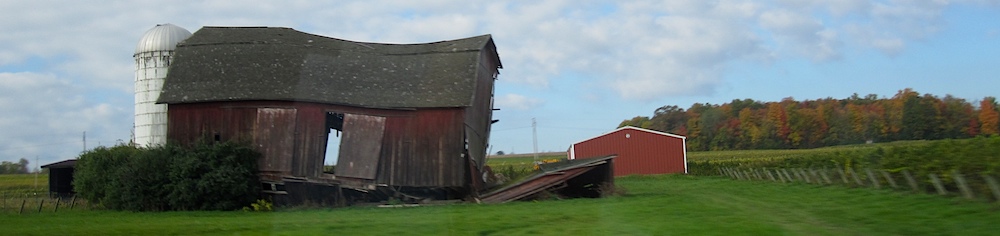
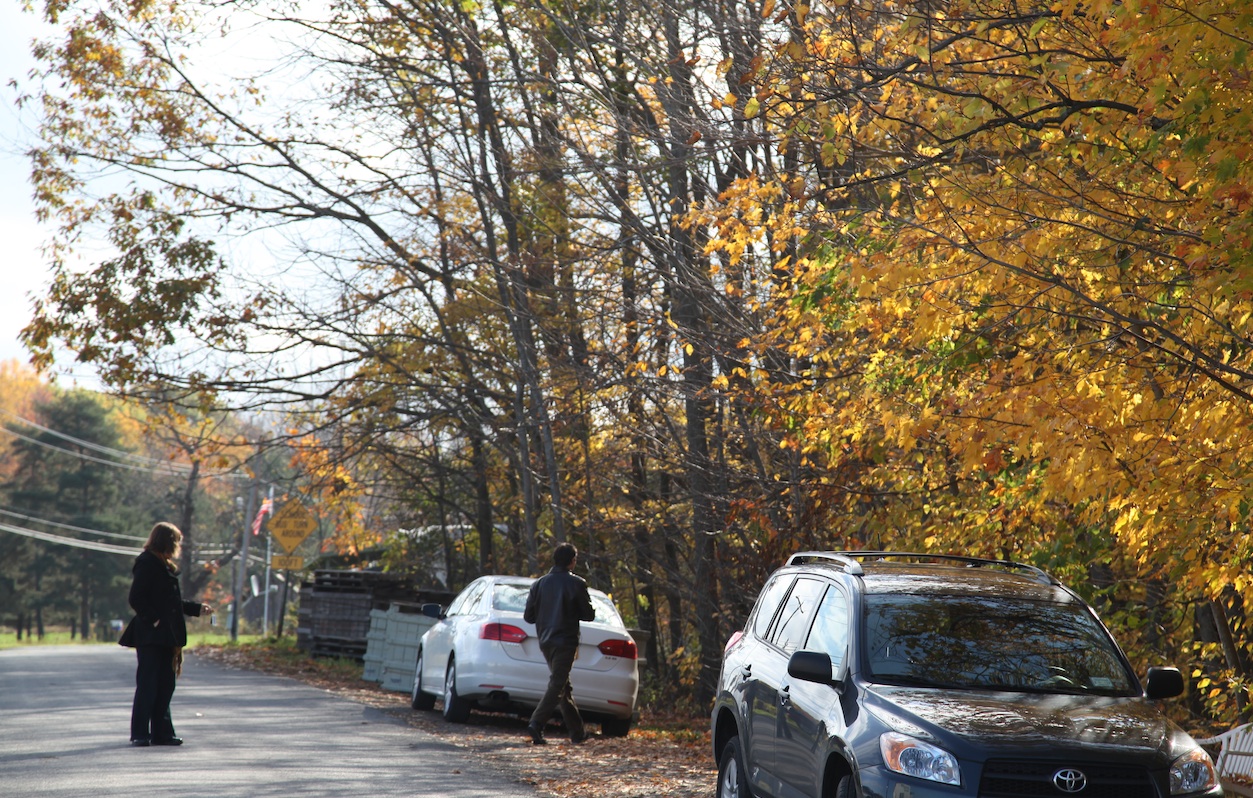
Vineyards and forested ravines roll past us, all fired in fall colors. Yet in between, the agricultural exodus has left its mark. Farms lie fallow. Some cow pastures still mill with moos. But our consumer cult has cut us from creating anything.

Another melted barn.

Winemaking remains a respectable, elite enough pursuit for mid life crises. Also, drinking it in wine country is a worthy excursion. But farming? Herding? Shoppers want convenience and cheapness in their milk and bread, not a local experience. We don’t care what country or cheap labor our eggs come from.

But enough soap box.

Keuka Lake hits us with its autumnal beauty. The crawl up to Fallbright is insanely pretty.

*blink**blink*

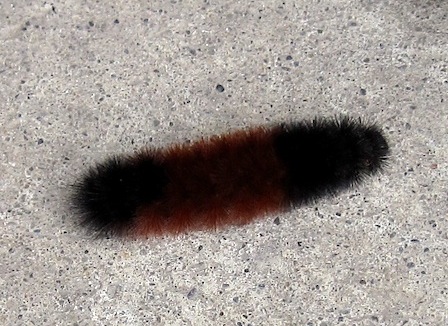
Once our jaws return to their closed and upright positions, I go to pick up my vidal blanc juice. Although a wet, not-great-ish year, frost has held off, so I know vidal wasn’t damaged this week. The fuzzy caterpillar of weather prognostication at Fallbright’s entrance tells me so.

HE KNOWS ALL!!!

So I lug my jugs back to the octopus-wall of juice tubes and wait.

Return to the octopus.

Seven gallons churn into two sterilized pales. Vidal was picked only five days ago. It looks and smell fresh. I trust Fallbright. They only grow grapes for home winemakers. This isn’t some winery’s leftovers.

Once full of must, I drop my tanks in the rental.

Wife and I load up the rental with juice.

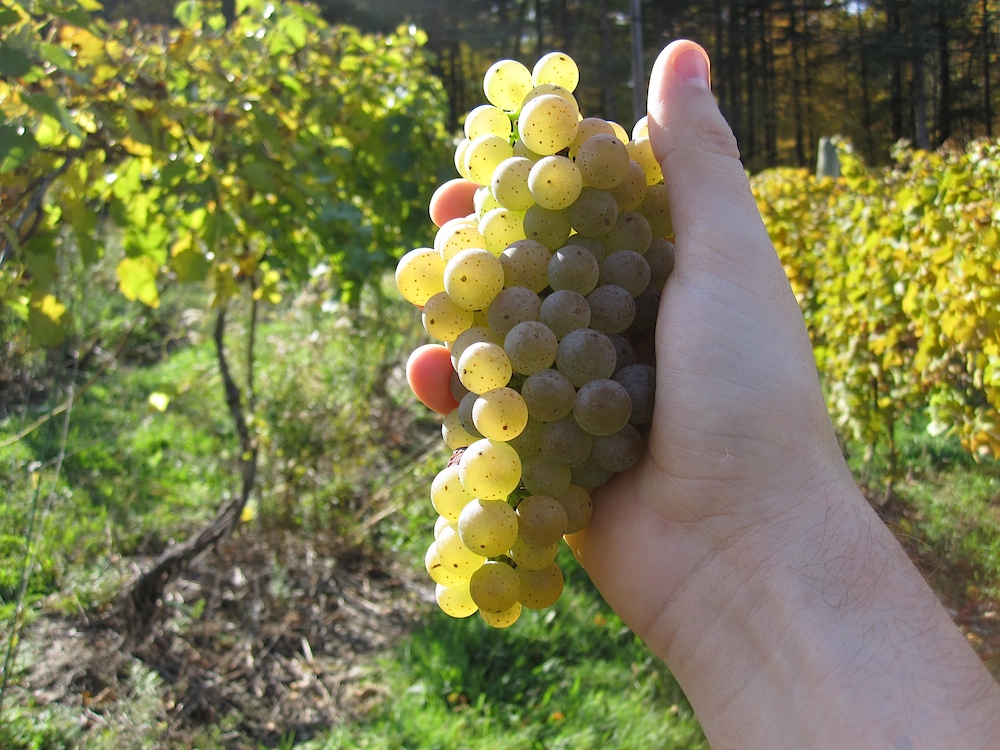
I go back to the shop, pay, and stumble, giddily down to the last strand of Vidal vines.

Still green.

I can’t help but video-document my new babies:

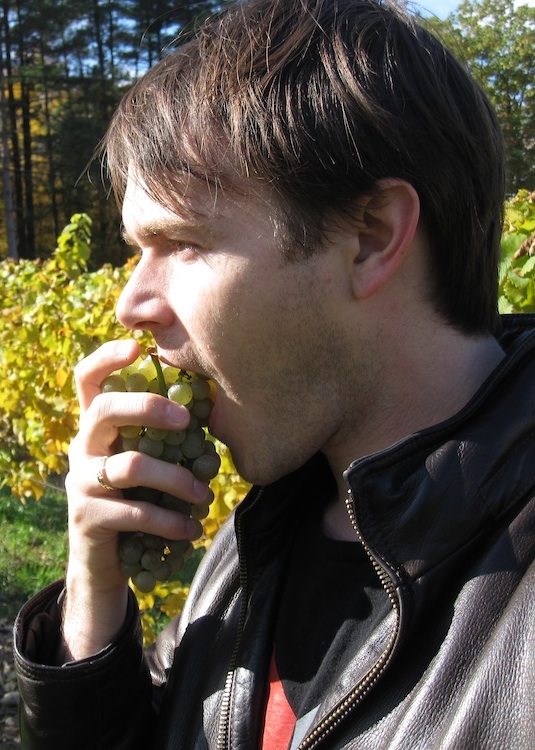
On that poorly edited note, I snapped a few more photos, ate more grapes and spent the rest of the day tasting wine.

Fermentation shouldn’t start on the way home. Fallbright sulphited the must enough, which will keep wild yeasts asleep. I also purged oxygen again from the tanks with a neutral gas spray.

I just need to figure out what style or styles I want from 2011’s vidal, given it’s mild, pleasant characteristics. That means picking the right yeast(s), corks, bottles, steps and not screwing up their timing…like last time.

The fuzzy caterpillar shall protect me.

Posted in CABERNET CRISES: MY FOURTH WINE, OENOLOGICAL ODYSSEY | Tagged , , , , , , , , , , , , , | 2 Comments

Midas Touch Ancient Ale, Dogfish Head Craft Brewery

Beer? I’m reviewing beer? Seriously? Well, it has been a few weeks.

But I thought this was a wine log: one of thousands, where another Caucasian, male, lump of righteousness rambles about stuff in a glass to justify his drinking habit.

Wait! Careful self, or I’ll write about tea. Heck, mineral water can be interesting.

In truth, wine and beer only recently signed their divorce papers. For millennia, grapes and barley were merely tools in a brewer’s box. If it had sugars, yeasts could make alcohol. Since the Mediterranean produced honey, grapes, and barley for food, making alcohol was easy. It was also more shelf-stable and sanitary than water and way more entertaining.

But alcohol was more than social lubricant; it was payment for soldiers and slaves, medicine for babies and elderly, offering to the dead and gods alike. Once alcoholic, drinks were blended and spiced with whatever was available and whatever would sell.

So how did we get to modernity’s single sourced monoliths of beer and wine?

The Greeks, Etruscans, Romans, and subsequent Catholic monks, solidified wine into a civilized alternative to beer. But blending beer with mead and wine continued on a smaller scale wherever possible and profitable.

So why does most beer taste, well, like beer?

You can blame the Reinheitsgebot: The German Beer Purity Law. In 1516, the Bavarian government shackled beer to three ingredients: water, hops, and barley. Rising nation-states and industrialization liked efficiency and regulation and thus carried this triumvirate into the modern age.

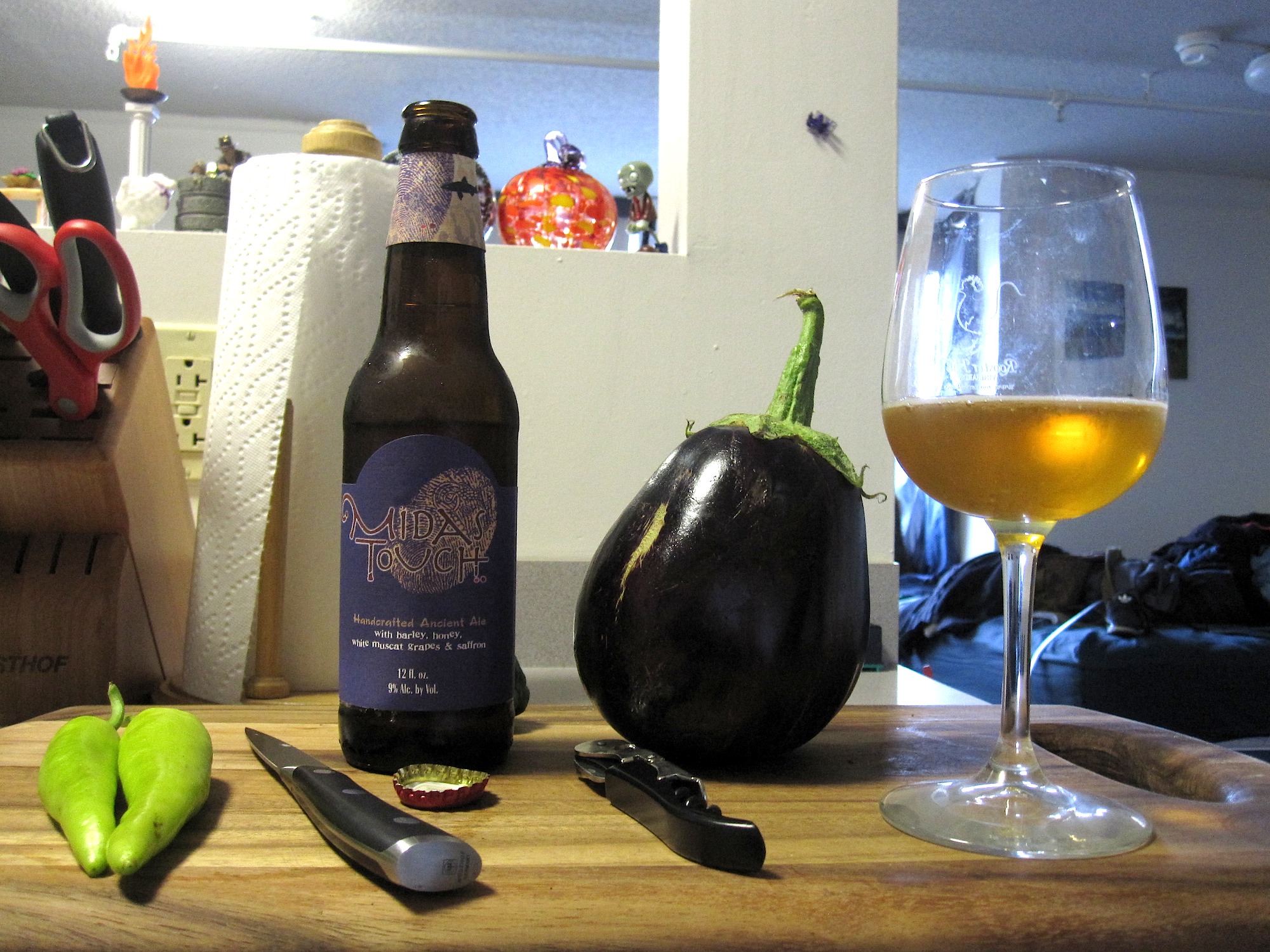
But then there’s tonight’s brew: Midas Touch Ancient Ale from Dogfish Head Brewery.

The eggplant is just there to show off.

This drink began its resurrection with paper bags. Inside each was some dirt. That dirt had sat in a basement at Penn U.’s museum since an excavation in 1957. Back then the university had unearthed a 700 BCE tomb in Gordion, Turkey. Within it they found the largest Iron Age drinking-set of 157 bronze vessels. Then someone deemed the dirt at the bottom of those vessels worthwhile packing back to Pennsylvania.
*Just add water.

Now set your TiVo to over a decade ago. Elizabeth Simpson was studying the tomb’s furniture and asked Patrick McGovern to analyze the bags. A tech. cocktail of infrared spectrometry, gas and liquid chromatography, and mass spectrometry allowed McGovern to isolate the dirt’s chemicals. They included tartaric acid from grape skins, beeswax from honey, and calcium oxalate or “beerstone” from barley. Wine, mead, and beer all in one drink. That fit into the ancient Near East’s proclivity for blending. Job done.

But McGovern didn’t stop there.

At a beer banquet within Penn Museum in 2000, he offered the ingredient list to the group of microbrewers in attendance. Like a true professor, he let them do the work and then judged their results, literally, as they came to his door (kinda like a wine blogger…Wait! No! Forget that!).

Yet it wasn’t involvement or accuracy he wanted, just “something drinkable”. He didn’t break out the mass spectrometer again to test each bottle. No, just a glass: “the assumption being that what tastes good to us probably tasted good to our ancestors, since they had a lot of the same sensory apparatus”.

Wait a sec.! That's just frickin' pasta!

Here’s my quibble. Our ancestors ate doormice. Lots and lots of doormice. Our ancestors shaved parmesian into wine. Jellyfish omelets were delicious. Did I mention wombs? Yes. Stuffed pork wombs. They ate countless herbs to extinction. Many foods were salted or honeyed beyond recognition to preserve them. Fish relish went on EVERYTHING. Heck, even my grandad liked blood pie. Our ancestors ate stuff that would make that Bizarre Foods guy faint.

To assume we’re like them -solely because of physiology- cherry picks the past and ignores its diversity.

But here’s the kicker. To our tastes, modern beer really isn’t beer without hops. It adds bitterness. But hops didn’t enter Europe until 700 C.E.

So Dogfish Head, overwhelmed by this sweet honey, grape, beer Frankenstein that they had created, added saffron. That spice cut through the muscat and mead wonderfully. It tastes beer-like and delicious (see my review chart below). And, lucky them, saffron is “the most expensive spice in the world”…well…it is today (it was readily available in antiquity). But McGovern admits, “we’ve never proven [that] the intense yellowish color of the ancient residues may be due to saffron”. So saffron is just marketing. Also, they injected CO2 for fizz and we have refrigerators to drink it chilled. No dice on those counts in antiquity. Beer was flat and only as cold as your best cellar.
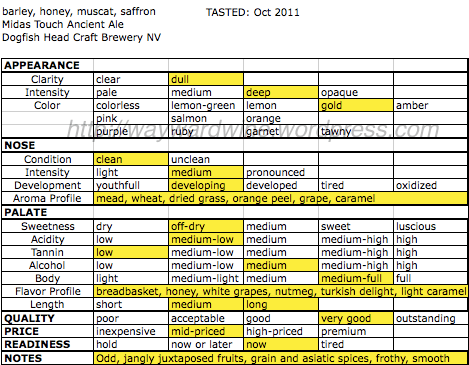
Yet tweaking an original recipe isn’t the worst problem. Just because the drink was in a tomb, doesn’t mean it was for consumption. Burial goods often reflect and decorate ideal afterlives. Tombs get filled with all kinds of impractical things: unusable armor, jars that don’t open, false doors, ceramic soldiers. We can’t know that any Midas -even if he existed- drank this just because it was in a tomb.

Granted, Midas Touch was merely a start. McGovern now works closely with Dogfish Head (recently chewing purple Peruvian corn to make chicha). It’s just that Midas Touch’s selling point is time-travel in a bottle. Yet that’s impossible, or at least imperfect. Experimental archaeology like this is full of pitfalls because the past will never meet the present.

Midas Touch only holds up a mirror. It turned out to be an accurate mirror, winning Dogfish Head more awards than any other beer. The drink is delicious. I love it. But it’s a shabby chic mirror at Pottery Barn: it looks old and French but was made last year in China, out of plastic.

SOURCES:

Dogfish Head Craft Brewery page on Midas Touch

McGovern’s University Website

McGovern’s Summary of Midas Touch

Article on McGovern and Dogfish Head that abuses the word grog.

Reviews of Various Ancient Cook Books

Reinheitsgebot Germany Purity Law, translated

Article on the ancient foods trend (wombs! but they wimped out on the doormice)

Posted in Beer | Tagged , , , , , , , , , , , , , | 2 Comments