Illahe Vineyards’ “1899” Pinot Noir: Making And Moving Wine Without Modernity

JancisRobinson.com recently finished their summer 2020 Wine Writing Competition (WWC20) and published 75 entries on Sustainability Heroes in the wine industry. I was honored to have all three of my submissions published. Although, I did not win the final, the below article on Illahe made it onto the shortlist of 18. For your re-reading pleasure, I will re-publish each over the following days.

Making And Moving Wine Without Modernity: Illahe Vineyards’ “1899” Pinot Noir
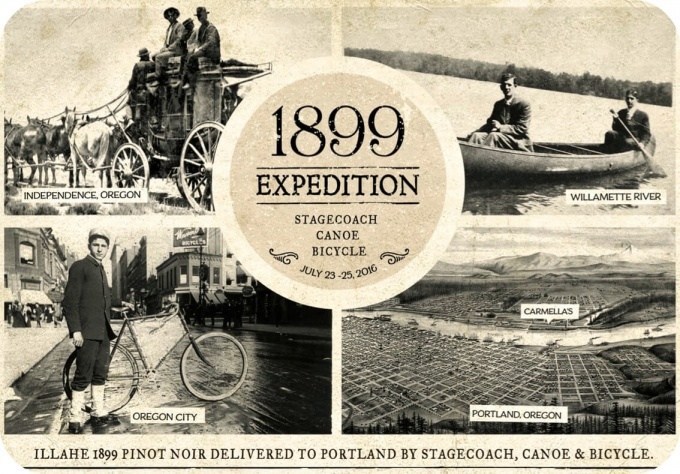
It begins with draft horses. Next come bicycle-powered pumps, then a stagecoach, then canoes. By the time bicycles deliver the wine, Illahe winery has not only created a sustainable wine but reinvented a complete cycle from production to distribution that predates electricity or mechanized shortcuts. Sustainable certifications may litter many a bottle’s back label. Illahe too flaunts their environmental accreditations as much as anyone. But beyond being earth-friendly, winemaker Brad Ford manages to keep one grape-stained foot in the scientific present and the other in a slower past. Illahe’s “1899” Pinot Noir recreates a time when winemaking was hard work that latched its maker not only to their land but to the challenging network that shipped and sold wine.

Even the name “Illahe” (pronounced Ill-Uh-Hee) means “earth”, “soil”, or “place” in native Chinook. That place sits smack dab in the middle of Oregon’s Willamette Valley: one hour’s drive south of Portland and a mere twenty minutes west of capital Salem.It runs up an eighty-acre, south-facing slope of clay, first planted in 2001 by Brad’s dad and now hosts sixty acres of seven varieties with Pinot Noir dominating fifty-nine of them. Their three-story gravity flow winery, and rain catch, allow no new-fangled electricity or gas for production (although the winery has solar panels). Brad even crafts his own clay fermenters from scratch.

Illahe’s hand-printed, hand-applied labels show off a quilt of sustainable plaudits. One, the LIVE (Low-Impact Viticulture and Enology) certification program demands a “whole-farm and whole-winery approach to sustainability. The entire property, including non-grape crops, landscaping, building operations, labor practices, even packaging must be managed to LIVE standards”.[1]Illahe also ties in LIVE’s Salmon-Safe certification, which protects water quality and restores watershed health and habitat.[2]They are also members of Oregon’s Deep Roots Coalition, (humbly referred to as “drc”), which argues that, “wine should reflect the place from which it emanates: its terroir. Irrigation prevents the true expression of terroir. In most cases, irrigation is not a sustainable method of farming”.[3]Thusly, Illahe proves their ongoing adherence to sustainability.

Illahe’s farming blends ancient methods, like selection massale, dry farming, hand pruning and green harvesting after veraison, with modern sustainable standards, such as cover crops, minimal sulfur sprays, and leaf pulling.  But more indicative of their sustainability is the lack of any machinery in the vineyard. Instead, two Percheron draft horses, Doc and Bea, pull an amish mower to cut the cover crops and, at harvest, transport grapes to the wineryin short totes or five-gallon buckets.

Once the horses bring in the grapes, the human appendages get to work: hands sort, destem or dump grapes into a feet-powered bicycle destemmer, which then pumps grapes into open wood fermenters, where foot stomping or manual punch downs begin. Native ferment carries through a ten-day soak. Instead, hands press must with a wooden basket press, then the bike pumps wine into barrel, where malolactic conversion carries on without inoculation. Later, horses Doc and Bea transport the wine to age in their 200 case cave. After two years, hands bottle the wine without gas, add cork, wax top and the letterpress label. Illahe’s “1899” Pinot Noir never touches dry ice, canned nitrogen, enzymes, stainless steel, forklifts, packaged yeast, electric pumps, or filters.

But many sustainable wineries attempt variations of the above. What makes Illahe’s “1899” the most sustainable wine is what comes next. They put the wine in a mule-drawn stagecoach, which carries it to the river. Then, finally, they float 96 miles in canoes up the majestic Willamette River. After four days they reach their distributor, Casa Bruno, in Portland, who carts the wine to warehouse with cargo bikes. Even the distributor’s sales representatives, I hear, are instructed to bicycle the wine to tastings with prospective buyers.

Illahe’s process may seem inefficient and impossible on a large scale. However, by keeping small, stripping away modernity and nullifying carbon concerns, as Brad sees it, “historical winemaking slows down the process, makes it more romantic, it also gets you involved with the materials you’re using”.[4]But beyond production, Illahe renders distribution, an oft forgotten but deep damage to the environment, sustainable as well. For $65 you and your wine glass can time travel over 150 years to when only human hands (and a few livestock hooves) helped make and deliver our wine.


BIBLIOGRAPHY


Image:

Illahe Website “Illahe 1899 Expedition”, Sunday, 12 August 2018https://www.illahevineyards.com/events/2018/8/12/illahe-1899-expedition


Deep Roots Coalition, “Main Page”, http://www.deeprootscoalition.org


Illahe, Website, https://www.illahevineyards.com/


Illahe, “Illahe 1899 Pinot Noir” video, https://youtu.be/sx5mGw6FzPw


Kovatch, Kristen, Horse Nation, Horsing Around The World, “Horses, Historical Winemaking & A Pinot Noir’s Epic Journey Illahe Vineyards”, 16 March 2017 https://www.horsenation.com/2017/03/16/horses-historical-winemaking-a-pinot-noirs-epic-journey-illahe-vineyards/


LIVE Wines Backgrounder, https://livecertified.org/sites/default/files/LIVE_Media_Primer_2018.pdf


Salmon Safe, “About”, https://salmonsafe.org/about/


[1]LIVE Wines Backgrounder, https://livecertified.org/sites/default/files/LIVE_Media_Primer_2018.pdf

[2]Salmon Safe, “About”, https://salmonsafe.org/about/

[3]Deep Roots Coalition, “Main Page”, http://www.deeprootscoalition.org

[4]Illahe, “Illahe 1899 Pinot Noir” video, https://youtu.be/sx5mGw6FzPw

Posted in Oregon, Uncategorized, WINERIES WANDERED | Tagged , , , , , , , , , , , , , , , , , , | 1 Comment

2020 Harvest Report: Tualatin Valley, Oregon

It’s time. My backyard row of vines survived a week of smoke from Oregon’s fires and now face a deluge of rain. Rains last year waterlogged vines, berries split, fruit flies moved in, leading me to triage the harvest. Luckily, through obsessive sorting, SO2, and a year of lees aging, my few bottles of 2019 turned out pretty crisp, clean, if a bit low in alcohol (10% abv).

This year, with iPhone forecast in hand, I pick for healthy fruit.

Watch the me and the Pinot Blanc in action:

Once in the carboy, another light dust of SO2 and Lavlin EC-1118 yeast drawn from Champagne for neutral, variety correct wines that clarify well (I don’t trust my native yeasts, which probably include toddler).

The next day, I picked and squeezed some vibrant Riesling and overripe Chardonnay into separate baby carboys (carbabies?) and inoculated them with the same EC-1118. Lastly, begrudgingly, came the reds. Birds had eaten most of my 777 and Dijon Pinot Noir (I netted the vines far too late), but my Meunier had dodged the winged ones.

Meunier clusters

I hand-crushed every decent looking cluster into open top fermentor, then pulled out th stems, peppered the few inches of skins and juice with Lalvin Bourgovin RC212 a Burgundy isolated strain used by everyone. Next year I will net all the vines before veraison starts to avoid the avian pests. Without expensive tests, fermentation will have to reveal the grapes suffered from smoke taint or not. Everyone is bubbling away now. Fingers crossed.

Posted in Uncategorized | Tagged , , , , , , , , , , , , , , , , | Leave a comment

Hiyu Wine Farm: Oregon’s Sustainable Utopia in the Columbia Gorge

JancisRobinson.com recently finished their summer 2020 Wine Writing Competition (WWC20) and published 75 entries on Sustainability Heroes in the wine industry. I was honored to have all three of my submissions published. Although, I did not win the final, one made it onto the shortlist. For your re-reading pleasure, I will re-publish each over the following days.

First:

Hiyu Wine Farm: Oregon’s Sustainable Utopia in the Columbia Gorge

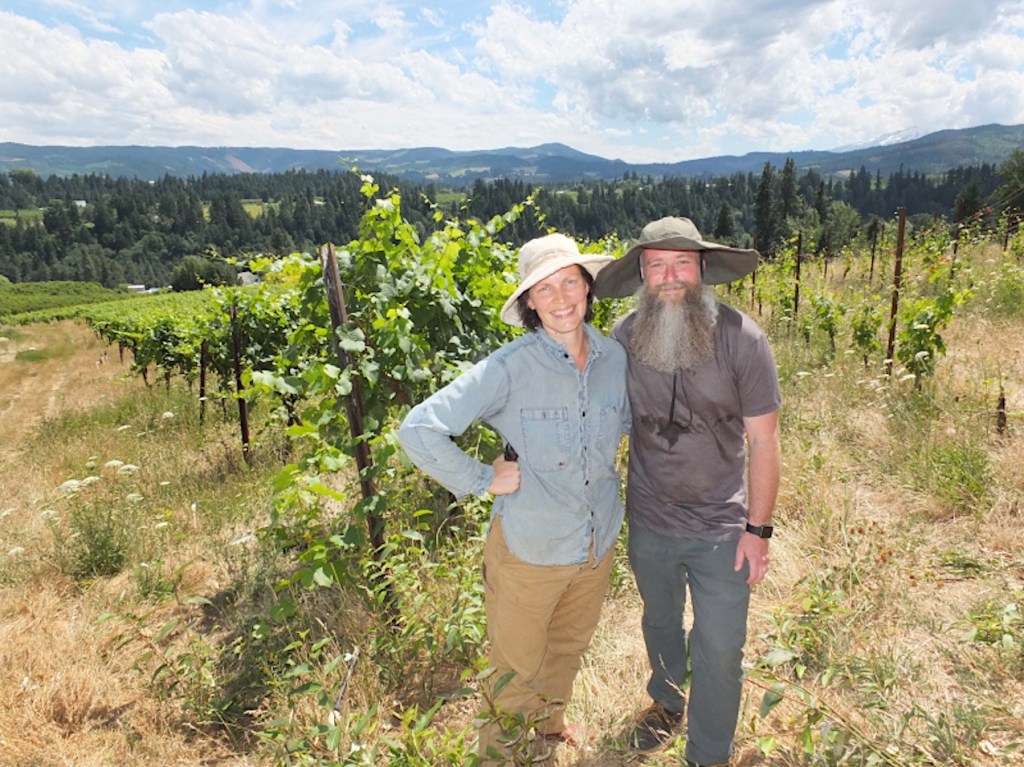
China Tresemer and Nate Ready of Hiyu Wine (Celce, Bertrand, “Hiyu Wine Farm (Oregon)”, Wine Terroirs, 19 August 2018 https://www.wineterroirs.com/2018/08/hiyu_wine_farm_oregon.html )

If sustainability needs mascots, Nate Ready and China Tresemer would fit perfectly. In floppy hats, with Nate’s druidical beard and China’s proud grin, they grow the most complete whole farm vineyard on Oregon’s northern fringe: the Columbia Gorge. Their minimal approach at Hiyu Wine Farm makes Biodynamics look conventional. Here, native plants grow higher than vines, animals seem to do more work than people, and you almost forget this is viticulture. Nate admits that they are “trying to nudge the system as close as possible to a wild system, and it isn’t a wild system, but we try to make agriculture look a little more like nature”.[1] Any visit confirms this.

            In 2010, China, a top Chef, and Nate, a Master Sommelier, left behind two decades in the pressure cooker of cuisine, including stints at The French Laundry and New York’s La Cuisine Sans Peur. They found The Columbia Valley Gorge: a freshly minted appellation that runs 40 narrow miles along the riverbank and holds nearly every microclimate imaginable. They bought a thirty acre, cool, alpine-like site riven with silt loam on basalt, twenty two miles below the shadow of Mt. Hood’s summit and just overlooking the town of Hood River. 

            Nate took the ten-year-old organic vineyard of standard Pinot Noir, Gris, and Syrah varieties[2]and started sourcing, grafting or own-rooting clones from UC Davis. Today, resisting any whiff of monoculture, Nate notes, “there are over 80 different varieties of grapes and many more clonal selections planted on the farm”.[3]In an effort of historical preservation, each half-acre block has plots planted to different moments in vinous history: “one plot is composed entirely of grapes planted in the 16th-century kingdom of Savoie. Another replicates a Southern Italian vineyard from 200 AD. There’s even a block devoted to the origins of cabernet franc at the Abbey of Roncesvalles in Basque country”.[4]However, to avoid imposing order on nature, Nate admits, “there’s no map” and the vines are “not even labeled”.[5]

            Hiyu’s viticulture is the least invasive imaginable. Instead of mowing or tilling, Nate only rarely clears weeds with a scythe, and allows the pigs, cows, chicken, ducks, and geese to do most of the work throughout the year. They never green harvest, irrigate, or leaf pull, and only make one vine cut at pruning in order to not interrupt the vine’s growth cycle.[6]They gently guide cover crop diversity by seeding directly into the dense growth or behind the pigs as they root around. Hiyu sprays eighty five percent less material than Biodynamic or Organic farms, uses no sulfur and instead controls mildew with cinnamon oil and mixed herbal teas. They use a light all-terrain vehicle (a mere 2,000 pounds instead of a 10,000 pound tractor) to avoid compacting the soil.

            In addition to Hiyu’s 14 acres of vines, four acres provide pasture, another four acres of forest are in transition to a food forest, with a pond. However, the heart of Hiyu beats in its half-acre market garden that China maintains. She applies what she learned from her parent’s biodynamic farm in Vermont. All the heritage vegetables, fruits, and herbs she grows get crafted by China and chef Jason Barwikowski into striking dishes paired to tasting flights, The Winefarmer’s Lunch, and weekly reserved dinners. This involves the livestock labor as well. Their five to ten Guinea Hogs not only maintain the cover crop but provide pork, their goats make milk, while their Jersey cows make 5 gallons of milk a day for cream, butter, a farmer’s cheese, and ice cream, and occasionally meat.[7]Hiyu takes farm to table seriously, by creating a self-sustaining farm and restaurant, where wine is but one small part. As Nate states, “The grand vision, it’s just biodiversity […] It’s meant to be this vibrant landscape with all these different life-forms. It’s more than the grapes. It’s about expanding palates and the ecological implications of that”.[8]

            At harvest, they hand-pick each historic block into small baskets with multiple passes. Nate avoids sorting them as to not damage the clusters. Eachblock with multiple varieties ends up together in the fermenter, free to become whatever they please. The native yeast biome ferments everything, so Nate only cleans with water, “to encourage a diverse microbial environment in the winery just like we’re encouraging it out in the field”.[9]The reds native ferment at ambient temperatures with minimal foot treads in open-top wooden vats, while the whites ferment in barrels of different sizes. If issues arise, Nate just moves the vat or barrel to a warmer or cooler part of the winery or varies his pigeageregimen. Once ferments finish, a small manual wooden ratchet press squeezes juice and gravity urges it to the lower, cooler cellar (Nate sold their hydraulic presses from Mondavi in California and Southern Oregon, because they were too extractive). They do not filter or fine any of the wines. The only additive, aside from Nate’s feet, is less than 10ppm SO2before the bottle.[10]There are no pumps, no bottling lines, no mobile bottling trucks. All bottles are hand-filled with gravity and a six-spout filler, then hand-labeled with China’s watercolor landscapes.[11]

            Hiyu crafts around 30 cuvées, with 12 complex field blends. The styles range from light whites, to skin-contact orange wines, light carbonic reds, to “May 1” a tannic 100-day macerated, four vintage solera red, and blends reaching beyond ten varieties like 2019’s “Avellana” of Blaufrankisch, Kadarka, Pignolo, Schiopettino, Corvina, Gamay, Vugava and many clones of heirloom Zinfandel. Vintage variation can even lead Nate to flip a wine’s style from white, to orange, and even red like 2018’s one-acre Aura Pinot Noir and Gris. Meanwhile, Hiyu’s second label, Smockshop Band, sources and supports other growers in the Gorge.[12]In all, the wines require nearly no resources but labor and serve mainly to enhance Hiyu’s expertly crafted dishes.

Hiyu means “big party” in native Chinook. Nate and China strive daily to create a dynamic, sustainable environment not only in the vineyard and farm but in the community with events and magnificent feasts. They say it best, “we live on a farm with plants, animals and all the beneficial creatures that inhabit the soil. From this culture, supported by a network of local growers, we cook food and make wine. We’ve built a place where you can gather at the table and experience life on our farm”.[13]That is something worth sustaining.

BIBLIOGRAPHY

Alberty, Michael “At Oregon’s Hiyu Wine Farm, A New Kind Of Tasting Room”, Sprudge,

11 October 2017 https://wine.sprudge.com/2017/10/11/hiyu-wine-farm/

Celce, Bertrand, “Hiyu Wine Farm (Oregon)”, Wine Terroirs, 19 August 2018 https://www.wineterroirs.com/2018/08/hiyu_wine_farm_oregon.html 

DeNies, Ramona, “One of the Northwest’s Most Talented Winemakers Is Hiding Near Hood River”, Portland Monthly, 10/17/2018 https://www.pdxmonthly.com/eat-and-drink/2018/10/one-of-the-northwest-s-most-talented-winemakers-is-hiding-near-hood-river

Hiyu Wine Farm, website https://www.hiyuwinefarm.com/

Tunmer, Sally, “A Look Inside Hiyu Wine Farm”, The Vintner Project, 18 MAY 2019

The Viticole Podcast, “TTGL #5 Brian Interviews Nate Ready of Hiyu Wine Farm” January 2020 https://soundcloud.com/viticolewine/ttgl-5-nate-ready-mixdown


[1]The Viticole Podcast, “TTGL #5 Brian Interviews Nate Ready of Hiyu Wine Farm” Jan 2020 https://soundcloud.com/viticolewine/ttgl-5-nate-ready-mixdown

[2]https://www.wineterroirs.com/2018/08/hiyu_wine_farm_oregon.html

[3]https://www.hiyuwinefarm.com/index.cfm?method=pages.showPage&pageID=0484290E-A9D7-321D-9C6A-C95A2AFF630F&sortBy=DisplayOrder&maxRows=10&&page=2

[4]Ramona DeNies, “One of the Northwest’s Most Talented Winemakers Is Hiding Near Hood River”, Portland Monthly, 10/17/2018

[5]https://www.pdxmonthly.com/eat-and-drink/2018/10/one-of-the-northwest-s-most-talented-winemakers-is-hiding-near-hood-river

[6]https://www.hiyuwinefarm.com/index.cfm?method=pages.showPage&pageID=0484290E-A9D7-321D-9C6A-C95A2AFF630F&sortBy=DisplayOrder&maxRows=10&&page=2

[7]https://www.wineterroirs.com/2018/08/hiyu_wine_farm_oregon.html

[8]https://www.pdxmonthly.com/eat-and-drink/2018/10/one-of-the-northwest-s-most-talented-winemakers-is-hiding-near-hood-river

[9]Sally Tunmer, “A Look Inside Hiyu Wine Farm”, The Vintner Project, 18 MAY 2019

[10]https://wine.sprudge.com/2017/10/11/hiyu-wine-farm/

[11]https://www.wineterroirs.com/2018/08/hiyu_wine_farm_oregon.html

[12]https://vintnerproject.com/discover/places/a-look-inside-hiyu-wine-farm/

[13]https://www.hiyuwinefarm.com/Eat-Drink-and-Gather

Posted in Oregon, Uncategorized, WINERIES WANDERED | Tagged , , , , , , , , , , , , | Leave a comment

Wine Review: Domaine Tollot-Beaut Chorey-Les-Beaune Rouge 2011

Now trapped at home, my cellar (aka crawl space) lights up the end of this dark tunnel. Each bottle holds a glimpse into the world before this plodding, boring present. I would rather open wines too early than too late for the sake of some palate time travel. So, yes, let us crack open another Burgundy.

Tollot-Beaut

Since the 1880s the Tollot family have made serious wine from their plantings in Burgundy in a 250 year old cellar. They jumped early to label when the Chorey-lès-Beaune appellation was created in 1921 and exported quickly to the states.

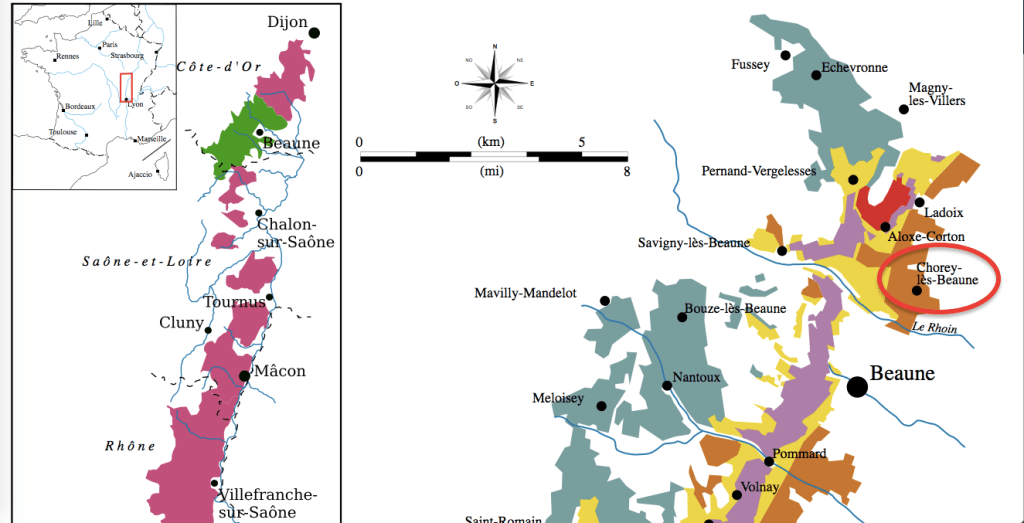
Chorey-lès-Beaune’s 336 acres are mostly Pinot Noir on plains beneath the shadow of the massive Grand Cru hill of Corton (red) and above the city of Beaune.

Chorey-les-Beaune: east-facing sunrise on the lower part of the slope

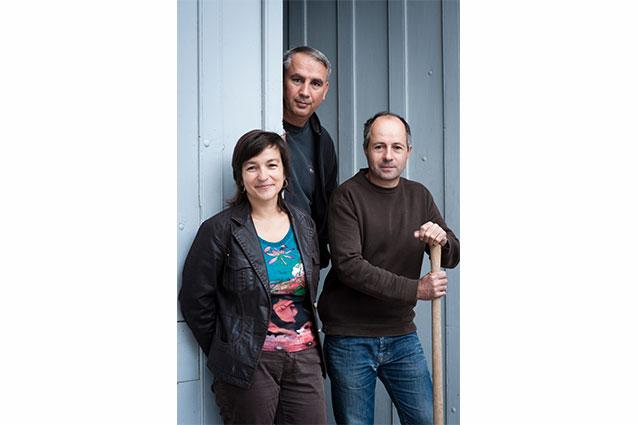
Almost half of Chorey’s producers are satisfied selling their Chorey off under the broader Côte de Beaune-Villages appellation. But not the Tollots. Generations of strategic small acquisitions in Savigny, Aloxe, and Beaune bumped their total to 60 acres, with two monopolies (vineyards they own outright), sustainably farmed (“lutte raisonée”) ofmostly old vines of the fancy Pinot Fin strain. Today, cousins Nathalie, Jean-Paul, and Olivier Tollot steer the ship.

The cousins Tollot that run Tollot-Beaut (I assume that’s a punch down paddle).

On trend, they de-stem most of the Pinot Noir and now limit new oak to 20% for village and 60% for Grand Crus.

I won a bottle of 2011 five years ago as an incentive when it was leaving Diageo. 2011 was stormy and tricky leaving aromatic and fresh reds that lack weight and power. Review agglomerators like CellarTracker.com say its window was 2014-2017, with 2020 reviews saying drink now. I am too bored to be patient.

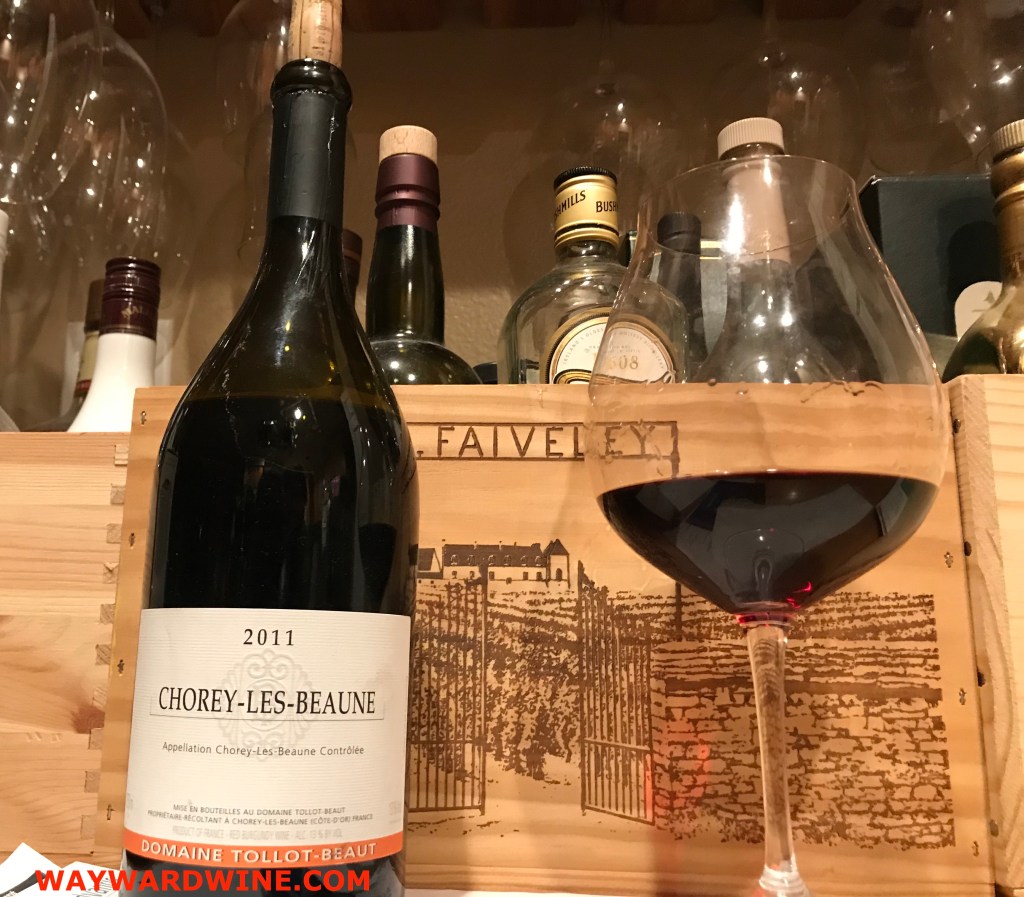
Domaine Tollot-Beaut Chorey-Les-Beaune Rouge 2011

The bottle feels substantial, like a show off Champagne bottle.

The appearance looks a clear, medium intense garnet-rimed, ruby-cored color.

Intense aromas jab and creak with cola nut, balsamic, licorice, kirsch and plum, vanilla powder, and orange marmalade.

The palate feels chalk dry, with wood-splitting high acidity, medium woody tannins, medium alcohol, a medium body.

Medium plus intense flavors start delicate then arch more toward wood, earth, and spice braced by high acidity, rather than the fruity, complex, brooding nose. On point with other 2011s, there just is not much core fruit here. Flavors carry a medium plus length.

Tollot-Beaut’s ’11 shows charm, drive, and complexity, but now, in 2020, is passing its peak. The core fruit is fading to its structures of acid and tannin, and fruit switching to earth and spice. It is very good but likely never outstanding. If you have one, drink it now, with a duck or mushroom pate or aged cheese.

Posted in Pinot Noir | Tagged , , , , , , , , , , , , | Leave a comment

Wine Review: Domaine Faiveley Mercurey 1er Cru Clos des Myglands Monopole France 2017

Trapped at home, with a tornado toddler, my office and garage bulges with nearly 180 bottles of samples that I can’t taste with my accounts. Some bottles may not make it to the other side. So, time to turn on a light in this viral tunnel.

If you are looking for something, well, at least interesting. When in doubt, go with the label with the most words:

Domaine Faiveley, Mercurey 1er Cru, Clos des Myglands, Monopole, France 2017

Is that the back label? What it all means:

This is an estate (Domaine) of the Faiveley family, in Mercurey (warm-ish southern Burgundy), from a 1er Cru (1st ranked and regarded) Clos (single vineyard) des Myglands (it’s name), Monopole (owned outright by the Faiveley family), from the 2017 vintage (generous and ripe, well, for Burgundy).

The appearance looks clear medium intense brilliant ruby core, with a wide clear wash rim.

Aromas smell clean, pronounced with oodles of baking spices and earth, balsamic, clove, blood orange, carob, tart red cherry, fennel.

The palate is dry, with high acidity, willowy medium intense tannins, medium alcohol, a medium body, and fine grained powdery earthen texture.

Lifted, complex, medium plus intensity flavors zing with blood orange, tart cherry, fine clove powder, granite powder, dried tobacco leaf, leather that carry a long length.

Faiveley’s Clos des Myglands 2017 is outstanding quality, bright but spiced, earthy and complex. I forget this is grapes. I did not even mention the grape is Pinot Noir until now.

It has personality, youth, and is all edge and energy with the world before it. This may be the blind hope of middle school. It may not age like its prestigious northern Burgundy neighbors. Give it a decade. But we could all use a bit of blind hope about now.

Posted in Uncategorized | Tagged , , , , , , , , , , , , , | Leave a comment